July 26, 2026 · The Key Bot
Automated Flagger Assistance Devices (AFADs), Explained
What AFADs are, the two types the MUTCD recognises, the two deployment methods and when one flagger can run both ends, where AFADs are and are not allowed, and how to think about the labor and equipment economics honestly.
In-depth guide · sources linked inline
Automated Flagger Assistance Devices are one of the few pieces of work zone equipment that change the shape of a crew rather than just the contents of a truck. They are also routinely misunderstood in both directions — sold internally as a way to cut a flagger, and dismissed as a gadget that does not survive real conditions.
The manual is fairly precise about what they are and are not. This walks through that, using the current 11th Edition of the MUTCD (effective January 18, 2024, Revision 1 effective March 5, 2026), which is worth flagging up front because the 11th Edition renumbered Part 6 and most published AFAD material still cites the 2009 Edition's chapter letters.
Standing caveat: requirements vary by state, county and city, and states adopt the national manual, adopt it with a supplement, or maintain their own. Several states have their own conditions on AFAD use. The approved plan and the authority having jurisdiction govern your job; this explains the national framework.
What an AFAD actually is
The MUTCD's own framing (Section 6L.02 in the 11th Edition of Part 6) is that AFADs "enable a flagger(s) to be positioned out of the lane of traffic and are used to control road users through TTC zones." They are designed to be remotely operated — either by a single flagger at one end of the zone or at a central location, or by separate flaggers near each device.
That first sentence contains the entire value proposition and the entire limit. The device relocates the human being. It does not remove them.
The manual recognises two types:
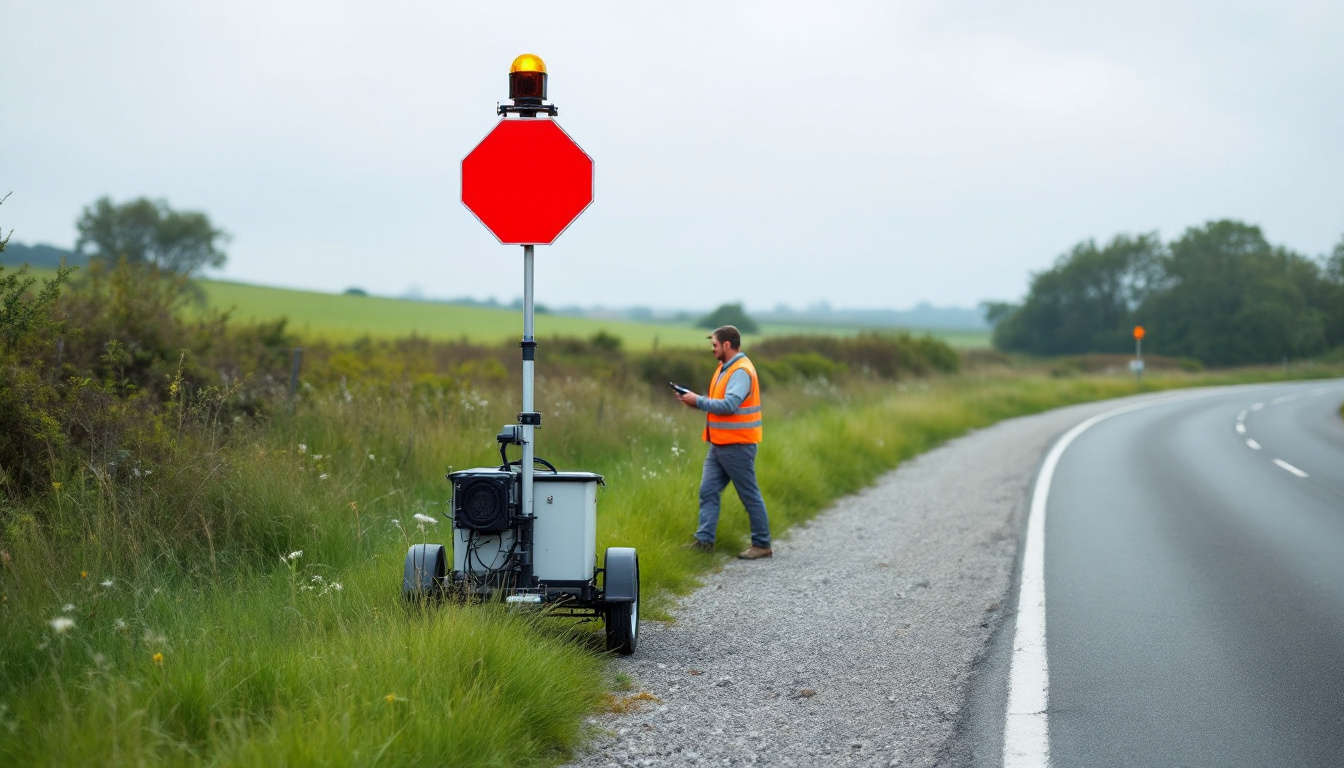
STOP/SLOW AFAD (Section 6L.03). A remotely controlled STOP/SLOW sign on a trailer or movable cart system, alternately displaying the STOP and SLOW faces of a paddle.
Red/Yellow Lens AFAD (Section 6L.04). Remotely controlled red and yellow lenses with a gate arm, alternately displaying a steadily illuminated circular red and a flashing circular yellow.
Both control right-of-way in a one-lane, two-way operation. They differ in how a driver reads them, and in how much of a signal-like impression they create — which is exactly why the manual draws a hard line between an AFAD and an actual temporary traffic control signal.
The hardware requirements, in brief
These are worth knowing because they are the things a device either meets or does not, and because a supplier's spec sheet should be checkable against them.
For a STOP/SLOW AFAD, the manual requires an octagonal STOP/SLOW sign of rigid material, mounted with the bottom of the sign a minimum of 6 feet above the pavement, at least 24 by 24 inches with letters at least 8 inches high, red-with-white on the STOP face and orange diamond-with-black on the SLOW face, both faces retroreflectorised. The sign must positively lock or otherwise stay stable in whichever position it is set to. It must be supplemented with active conspicuity devices — either flashing lights within the faces, or a Stop Beacon above the STOP face and a Warning Beacon near the SLOW face, with each prohibited from operating while the other face is displayed.
For a Red/Yellow Lens AFAD, at least one set of circular red and circular yellow lenses 12 inches in diameter, red on top and yellow below, complying with the applicable signal-indication provisions. Post-mounted, the bottom of the housing must be at least 7 feet above the pavement; located over any portion of the highway usable by motor vehicles, at least 15 feet.
And both are subject to crashworthiness. The manual requires AFADs to meet the crashworthy performance criteria in Section 6A.04, which states that MUTCD crashworthiness provisions "apply to all streets, highways, and site roadways open to public travel." The eligibility framework for roadside hardware — including how devices are assessed — is collected in FHWA's roadside hardware policy memoranda and guidance. When you buy, the crashworthiness documentation is part of what you are buying, and it belongs in the asset record, not in a drawer.
The rules that decide whether you can use one at all
Four constraints do most of the deciding.
One lane of approaching traffic. From Section 6L.02: "AFADs shall only be used in situations where there is only one lane of approaching traffic in the direction to be controlled." This is the constraint that rules out most multi-lane applications outright.
Not a substitute for a temporary traffic control signal. The manual states plainly that because AFADs are not traffic control signals, they shall not be used as a substitute or replacement for a continuously operating temporary traffic control signal. If the operation genuinely needs a signal — a long-running one-lane condition through a work zone — an AFAD is the wrong device, and a temporary traffic control signal under Section 6L.01 is the right one.
Duration. The manual says AFADs might be appropriate for short-term and intermediate-term activities, and advises they should not be used for long-term stationary work. Those categories are defined in Section 6N.01: short-term stationary is daytime work occupying a location for more than 1 hour within a single daylight period, intermediate-term is more than one daylight period up to 3 days or nighttime work over 1 hour, and long-term stationary is more than 3 days. If a job is going to sit for a week, an AFAD is not the answer.
Night illumination. When used at night, the AFAD location must be illuminated in accordance with the flagger station provisions. This is an operational cost people forget when they price night work — the device does not remove the lighting requirement. The wider set of things that change after dark is covered in night work traffic control.
Typical applications named in the manual are bridge maintenance, haul road crossings and pavement patching — short, repeating, one-lane operations. That is a fair description of the sweet spot.
The two methods, and the one-flagger exception
This is the part most often got wrong in the field, and it is the part with the clearest safety logic.
The manual permits two deployment methods:
Method 1 — an AFAD at each end of the TTC zone.
Method 2 — an AFAD at one end and a flagger at the opposite end.
And the default staffing for either: two flaggers.
There is a single exception. One flagger may simultaneously operate two AFADs under Method 1, or operate one AFAD while flagging the opposite end under Method 2, only if both of the following are true: the flagger has an unobstructed view of the AFAD or AFADs, and the flagger has an unobstructed view of approaching traffic in both directions.
Read those two conditions carefully, because they are what a crest, a curve, a parked truck, or a line of stopped vehicles quietly defeats. A site that satisfies both at 7 a.m. may not satisfy them at 11 a.m. once a queue forms or a delivery vehicle parks. The condition is on the view, continuously — not on the geometry as drawn.
There is also a standing requirement that sits above all of this: an AFAD may only be operated by a flagger who has been trained on the operation of that AFAD, and the flagger operating it shall not leave it unattended at any time while it is in use.
The advance signing the manual recommends when an AFAD is used includes a ROAD WORK AHEAD sign, a ONE LANE ROAD sign, and a BE PREPARED TO STOP sign. And placement guidance puts the AFAD in advance of the one-lane, two-way taper and downstream of the point where approaching traffic is to stop, with everything controlling movement readily visible to the driver of the initial approaching vehicle. The taper in question is the short one — 50 feet minimum, 100 feet maximum — described in taper length and buffer space explained.
The flagger is still a flagger
The most consequential misreading of AFADs is treating the operator as an equipment technician rather than a flagger. The manual's own cross-reference goes to Section 6D.01, Qualifications for Flaggers — a section that describes flaggers as responsible for public safety and making the greatest number of contacts with the public of all highway workers, and lists abilities they should be able to demonstrate: receiving and communicating instructions clearly, firmly and courteously; moving and manoeuvring quickly to avoid danger from errant vehicles; controlling signaling devices to give clear guidance in frequently changing situations; applying proper traffic control practice under stress; and recognising dangerous situations in time to warn workers.
Three of those five still apply directly to an AFAD operator, and the fourth and fifth arguably apply more — the operator now has less direct presence and more equipment mediating their judgment.
OSHA's construction standards reinforce this from the other side. 29 CFR 1926.201(a) requires that "Signaling by flaggers and the use of flaggers, including warning garments worn by flaggers, shall conform to Part 6 of the MUTCD," and OSHA's highway work zones page directs employers to the MUTCD for sign, barricade and flagging requirements. Buying hardware does not move you out of that. State flagger certification requirements are unchanged too — those vary considerably and are summarised in flagger certification requirements explained.
The economics, told straight
The pitch AFADs are usually sold on is labor reduction. The honest version is more nuanced.
Where the case is strong. Repeating short-duration one-lane operations, on sites with genuinely clear sightlines, where the same crew runs similar setups repeatedly — bridge maintenance cycles, utility patching programs, haul road crossings. Under the one-flagger exception with both view conditions genuinely met, the staffing change is real. The exposure reduction is real regardless of staffing, because the operator is out of the lane. Given that FHWA's data records 94 highway worker fatalities among 891 total work zone fatalities in 2022, and 108 among 963 in 2021, moving a person out of a live lane is not a marginal benefit.
Where the case is weaker than it looks. Sites that fail the sightline conditions — which is more sites than a spec sheet suggests — put you back to two flaggers plus the equipment cost, plus transport, plus setup time, plus maintenance, plus night lighting. That is not automatically a bad trade, but it is a different trade than the one in the sales deck. Long-duration work is out. Multi-lane approaches are out. And the device adds a failure mode a paddle does not have: batteries, radio link, and a mechanism that has to positively lock in position.
The cost you should model. Acquisition amortised over realistic service life, transport and setup time per deployment, maintenance and battery replacement, operator training on the specific device, and the night illumination requirement. Then compare against a fully loaded flagger rate — not a wage — because the comparison is only meaningful against the real cost of the labor you might not need. That build is covered in flagger labor cost per hour.
The wider context on why work zone exposure is worth spending money to reduce: the National Work Zone Safety Information Clearinghouse puts comprehensive societal crash costs in work zones at roughly $41 billion for 2024, alongside an estimated $8.6 billion in user delay costs and 470 million hours of vehicle delay. FHWA's work zone worker safety resources collect the protection and visibility material that sits alongside device selection.
What owning them changes operationally
Three things, all of which are administrative rather than dramatic.
They become tracked assets. An AFAD is a serialised item with a maintenance history, a crashworthiness documentation trail, and a location. It belongs in the asset register alongside arrow boards and portable signals, not in a bin count with cones. If your yard tracking is quantity-based, this is the category that forces the change — see tracking devices by job site.
Operator training becomes a qualification you have to track per person per device. "Trained on the operation of the AFAD" is device-specific. If you run two models, that is two records per operator, and the record needs to be producible when someone asks.
Deployment eligibility becomes a dispatch decision. Whether an AFAD can be used on a given job depends on the approach lanes, the duration category, the sightlines, and what the approved plan says. That is a set of conditions a dispatcher has to check before assigning the equipment, which means the conditions need to be recorded somewhere other than in a supervisor's head.
Questions worth asking before you buy
Supplier conversations about AFADs tend to be about features. These are the questions that decide whether the device fits how you actually work.
"Show me the crashworthiness documentation." Not a claim in the brochure — the actual assessment paperwork. It belongs in your asset file from day one, because the question will be asked by an agency or an insurer, not by you.
"How does it fail, and what happens when it does?" Battery exhaustion, lost radio link, a mechanism that jams between faces. The manual requires the STOP/SLOW sign to positively lock or otherwise maintain a stable condition when set — ask specifically what happens if it cannot. The answer determines your fallback procedure, which your flaggers need to have rehearsed rather than improvised.
"What is the realistic runtime, at night, in cold, with the beacons running?" Conspicuity devices and illumination are not optional extras on the power budget.
"What does setup and teardown actually take, with two people?" Compare it honestly against deploying a paddle. On a short-duration job the difference can consume the labor saving entirely.
"What training do you provide, and does it produce a record?" The manual requires the operator to be trained on the operation of that AFAD. You need a per-person, per-device record you can produce, which means the training needs to generate one.
"What do the states we work in require?" Several impose their own conditions on AFAD use beyond the national manual. That is a question for each authority having jurisdiction, and it is worth resolving before capital is committed rather than after.
The short version
An AFAD moves a flagger out of the travel lane in a one-lane, two-way operation. It does not eliminate the flagger, it does not work on multi-lane approaches, it is not for long-term stationary work, and it is not a temporary traffic control signal. Two flaggers is the default; one is permitted only when both unobstructed-view conditions hold, continuously, in the real conditions of the site rather than the drawn ones.
Used inside those limits on the right kind of repeating work, it is a genuine reduction in worker exposure and sometimes a genuine labor saving. Used outside them, it is expensive equipment creating a compliance question.
If the equipment, qualification and deployment-condition records described above currently live across a spreadsheet and several people's memories, that is the gap worth closing first — Traffic OS keeps serialised assets, operator qualifications and job assignments on the same records, priced in flat monthly tiers rather than per user. Bring a real one-lane job to a walkthrough if you want to see how the eligibility checks land in dispatch. For the wider structure of Part 6 and what moved in the 11th Edition, start with MUTCD Part 6 explained.
Frequently asked questions
What is an AFAD?+
An Automated Flagger Assistance Device is a remotely operated device that lets a flagger control one-lane, two-way traffic from a position out of the travel lane. The MUTCD recognises two types: one using a remotely controlled STOP/SLOW sign on a trailer or movable cart, and one using remotely controlled red and yellow lenses with a gate arm.
Does an AFAD replace the flagger?+
No. The MUTCD is explicit that an AFAD may only be operated by a trained flagger, and that the flagger operating it must not leave it unattended at any time while it is in use. The device moves the flagger out of the lane; it does not remove the flagger from the job.
Can one flagger run AFADs at both ends?+
Only under specific conditions. The default is two flaggers for either deployment method. A single flagger may operate two AFADs, or one AFAD plus flag the opposite end, if that flagger has an unobstructed view of the device or devices and an unobstructed view of approaching traffic in both directions.
Where are AFADs not appropriate?+
They may only be used where there is a single lane of approaching traffic in the direction being controlled, and the manual advises against using them for long-term stationary work. They are also not a substitute for a continuously operating temporary traffic control signal, because they are not traffic control signals.
Do AFADs have to be crashworthy?+
Yes. The MUTCD requires AFADs to meet the crashworthiness performance criteria in its general TTC device provisions, which apply to streets, highways and site roadways open to public travel.
Do we still need a certified flagger if we buy AFADs?+
Yes, and arguably a better one. The operator is a flagger under the manual's own definition, must be trained on the specific device, and is now managing an alternating-traffic operation through equipment rather than directly. Flagger qualification and state training requirements are unchanged by owning the hardware.