August 19, 2026 · The Key Bot
Bicycle Accommodation in Work Zones: What the MUTCD Actually Requires
Bike lanes get closed with cones and no plan more often than any other facility in a work zone. Here is what the 11th Edition says, where the thresholds sit, and why routing cyclists onto the pedestrian path is the one thing you cannot do.
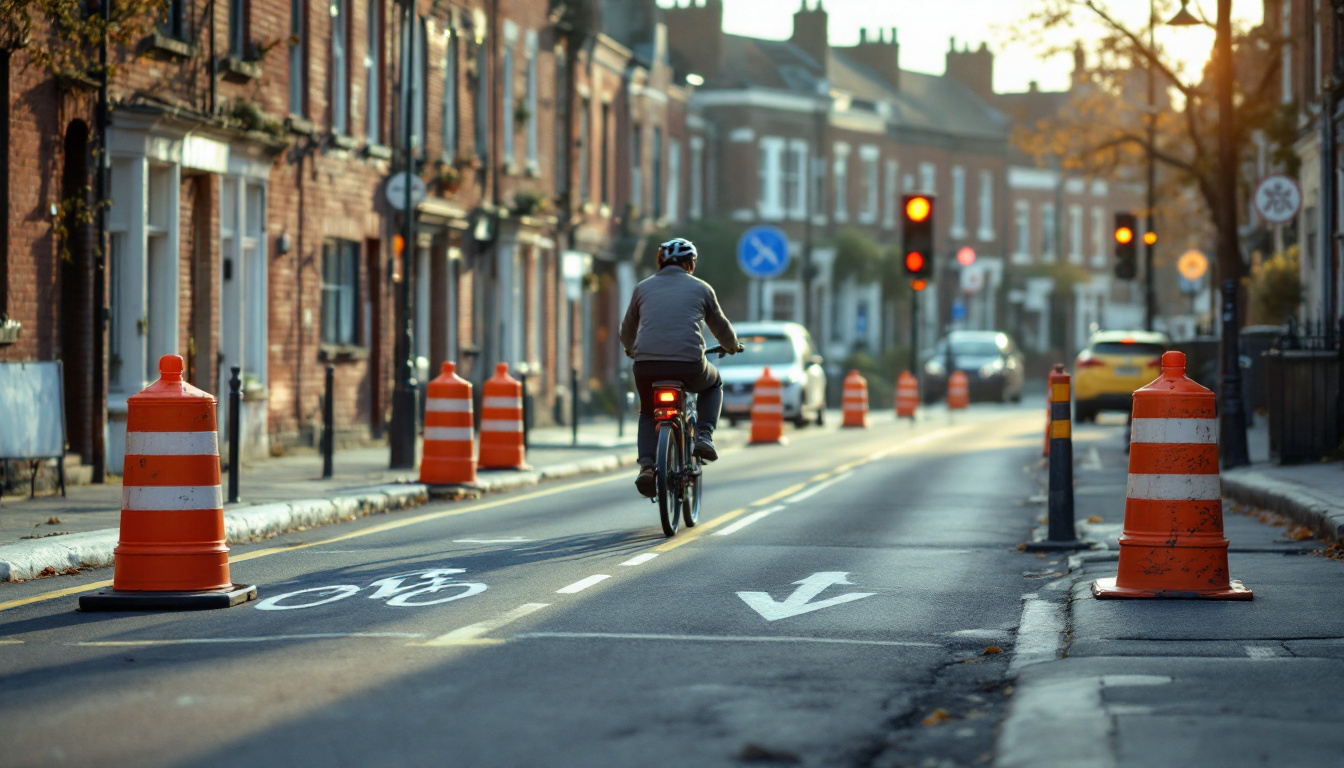
Of all the facilities a work zone can disrupt, the bike lane is the one most likely to be handled by putting cones in it and moving on. Part of that is habit. Part of it is that bicycle provisions are scattered across several chapters of the manual rather than collected in one place, so a foreman who knows Part 6 well can still not know where the bicycle rules live.
This is a short orientation to what the MUTCD 11th Edition actually says, where the numeric thresholds sit, and which decisions are the ones agencies push back on.
Requirements vary by state, county and city. States adopt their own manual versions and agencies layer permit conditions on top. Nothing here substitutes for the requirements of the authority having jurisdiction over your specific work. Verify with them, every time.
Where the requirements actually live
FHWA published the MUTCD 11th Edition in December 2023 and makes Part 6 available in full at no cost. If you are still working from 2009-edition section numbers, note that Part 6 was substantially renumbered — pedestrian and worker safety moved to Chapter 6C, flaggers to Chapter 6D, and the typical applications to Chapter 6P. Our note on what changed in the 11th Edition covers the renumbering more broadly.
For bicycles specifically, four places matter.
The fundamental principles in Chapter 6A. Among the principles for temporary traffic control, the manual states that bicyclists and pedestrians, including those with disabilities, should be provided with access and passage through the TTC zone. This is the general obligation everything else elaborates.
Section 6N.04, Work Affecting Pedestrian and Bicycle Facilities. The 11th Edition gives this its own section. Its guidance includes that where pedestrian or bicyclist usage is high, the typical applications should be modified with particular attention to the accessibility and detectability provisions elsewhere in Part 6 — and, plainly, that bicyclists and pedestrians should not be exposed to unprotected excavations, open utility access, overhanging equipment, or similar conditions.
Section 6N.10, work within the traveled way of an urban street. This is where the strongest language sits. The manual carries a Standard that if the TTC zone affects the movement of bicyclists, adequate access to the roadway or shared-use paths shall be provided. In MUTCD terms a Standard is a requirement, not advice.
The typical applications in Chapter 6P, specifically the ones covering a bicycle lane closure without a detour, a bicycle lane closure with an on-road detour, and a paved shoulder closure with a bicycle diversion onto a temporary path. Those carry the numeric guidance below. Do not reproduce the figures — reference them, and work to the version your agency has adopted.
The one rule people break
Section 6N.10's guidance states that if a designated bicycle route is closed because of the work being done, a signed alternate route should be provided — and then, directly: bicyclists should not be directed onto the path used by pedestrians.
That is the shortcut nearly everyone takes. The bike lane closes, there is a sidewalk right there, and a SHARE THE PATH improvisation appears. It is understandable and the manual addresses it specifically, because a cyclist at fifteen miles an hour on a temporary pedestrian route — often already narrowed to the minimum width, often carrying people with disabilities using detectable edging — is a conflict the accommodation was supposed to prevent, not create.
If pedestrians and cyclists must be routed differently, the sign set supports it. The 11th Edition includes a combined Pedestrian/Bicyclist Detour sign for a shared route, and separate Pedestrian Detour and Bicyclist Detour signs where the routes diverge. Where the combined sign is used, it is required to carry an arrow pointing in the appropriate direction.
The thresholds worth memorising
The typical-application notes give two speed-keyed decision points, and they are the numbers that come up in plan review.
At 30 mph or less, where a bike lane is closed, the manual offers two options depending on the adjacent lane width. If the travel lane is at least 14 feet wide throughout the zone, Bicycle Warning signs in association with IN STREET or IN ROADWAY plaques may be used. If it is less than 14 feet, BICYCLES ALLOWED USE OF FULL LANE signs are the option offered. The logic is straightforward: 14 feet is roughly the width at which a car can pass a cyclist within the lane, and below it the honest instruction is that the cyclist takes the lane.
At 35 mph or higher, the guidance changes materially. Where a bike lane is closed and conditions are not appropriate to direct bicyclists into a shared lane, the manual directs that a separate bicycle facility or a detour route should be considered. Merging cyclists into faster traffic is not treated as the default.
For a plan reviewer, those two thresholds are the first thing checked on any urban closure that touches a bike facility. Getting them wrong is a predictable rejection — see traffic control plan rejections for the wider pattern.
Agencies frequently go further
State and local requirements commonly exceed the manual, and bicycle accommodation is one of the areas where they most often do.
MDOT SHA's utility permit general provisions require a permittee to provide for safe bicycle and pedestrian access through work zones where applicable and to the maximum extent feasible, to show those provisions clearly on the work zone traffic control plan, to submit plans for all proposed road closings or detours to the agency's Bicycle and Pedestrian Coordinator for review and comment, and to make the accommodation ADA compliant.
Note the second reviewer. A submittal timeline built around a single reviewer will slip on any job with a detour. That is a scheduling fact, not a compliance detail — and it is one of the more common reasons a start date moves. Our post on Maryland work zone requirements covers that state's set in full, and submitting a traffic control plan for approval covers the process generally.
Why this is not just paperwork
Vulnerable road users are a meaningful share of work zone deaths, and the number is not small.
FHWA's compilation reports 145 pedestrians and bicyclists killed in work zones in 2022, and 174 in 2021, out of totals of 891 work zone fatalities in 2022 and 963 in 2021. That is roughly one in six. The Work Zone Safety Information Clearinghouse records 850 work zone fatalities in 763 fatal crashes in 2024.
The federal data does not break out how many of those involved an inadequate accommodation, and it would be dishonest to imply it does. What the data does establish is that the population the accommodation exists to protect is not a rounding error in this hazard.
A short field checklist
- Identify bicycle facilities during planning, not on setup day. A bike lane discovered by the crew at 6 a.m. gets coned.
- Decide the treatment from the speed and the lane width, using the thresholds above and your agency's adopted version of them.
- Do not route cyclists onto the pedestrian path. If routes must diverge, sign them separately.
- Sign the alternate route over its whole length. A detour signed only at its start leaves people stranded at the first junction — the same principle the manual applies to vehicular detours.
- Show the accommodation on the plan, because agencies increasingly require it explicitly and some route the plan to a separate reviewer.
- Photograph what you built, from the cyclist's approach as well as the driver's. If the accommodation is later questioned, that is the evidence.
The last one is the operational habit that makes the rest defensible. A record captured at the time, on every job, is worth more than a thorough one captured on the jobs somebody thought were risky — those are rarely the jobs that get asked about. If you want to see how that capture works in the field, our features page covers the ticket and photo side.
Frequently asked questions
Does the MUTCD require bicycle accommodation in a work zone?+
Yes, at more than one level. The fundamental principles in Part 6 state that bicyclists and pedestrians, including those with disabilities, should be provided with access and passage through the TTC zone. And for work within the traveled way of an urban street, the 11th Edition carries a Standard that if the zone affects the movement of bicyclists, adequate access to the roadway or shared-use paths shall be provided.
Can we just send cyclists onto the sidewalk?+
The manual's guidance is explicit that bicyclists should not be directed onto the path used by pedestrians. It is the single most common shortcut and the one the manual addresses most directly. If a designated bicycle route is closed because of the work, the guidance is that a signed alternate route should be provided.
Where does the 14-foot figure come from?+
It appears in the notes to the typical application for a bicycle lane closure without a detour. Where a bike lane on a roadway posted at 30 mph or less is closed and the adjacent travel lane is at least 14 feet wide throughout the zone, Bicycle Warning signs with IN STREET or IN ROADWAY plaques may be used. Below 14 feet, BICYCLES ALLOWED USE OF FULL LANE signs are the option offered.
What about a bike lane on a faster road?+
The guidance changes. Where a bike lane on a roadway posted at 35 mph or higher is closed and conditions are not appropriate to direct bicyclists into a shared lane, the manual directs that a separate bicycle facility or a detour route should be considered. Merging cyclists into fast traffic is not the default the manual reaches for.
Are there specific signs for a bicycle detour?+
Yes. The 11th Edition includes a Pedestrian/Bicyclist Detour sign for a shared route, and separate Pedestrian Detour and Bicyclist Detour signs where the two are routed differently. Where used, the combined sign is required to carry an arrow pointing in the appropriate direction.