Running the business · November 3, 2026 · 9 min read
General Contractor Wants to Supply Their Own Flaggers With Your Equipment
Traffic control companies face liability risks when general contractors supply their own flaggers to use your equipment in mixed-crew arrangements.
By The Key Bot
In this article+
- What the Arrangement Actually Looks Like
- Where Liability Sits When Someone Else Supplies the Operator
- Documentation Requirements That Protect Both Parties
- Common Failures in Mixed-Crew Arrangements
- How Traffic Control Software Handles Equipment Dispatch to Non-Employee Flaggers
- Photo Documentation of Work Zone Setups
- Next Steps: Document the Arrangement Before the First Job
- Related reading
A general contractor who wants to supply their own flaggers with your equipment creates a mixed-crew arrangement where one party owns the assets, another provides the labor, and liability sits uncomfortably between them. The request is common on fixed-price projects where the GC controls labor costs and you control specialized traffic control assets. The operational question is not whether to say yes, but how to document who is responsible for what when something goes wrong.
Traffic Os handles jobs and dispatch for traffic control operations where equipment moves to sites staffed by your own crews or by workers you do not employ. Get started with a platform built ground-up for traffic control, barricade rental, and lane-closure operations.
What the Arrangement Actually Looks Like
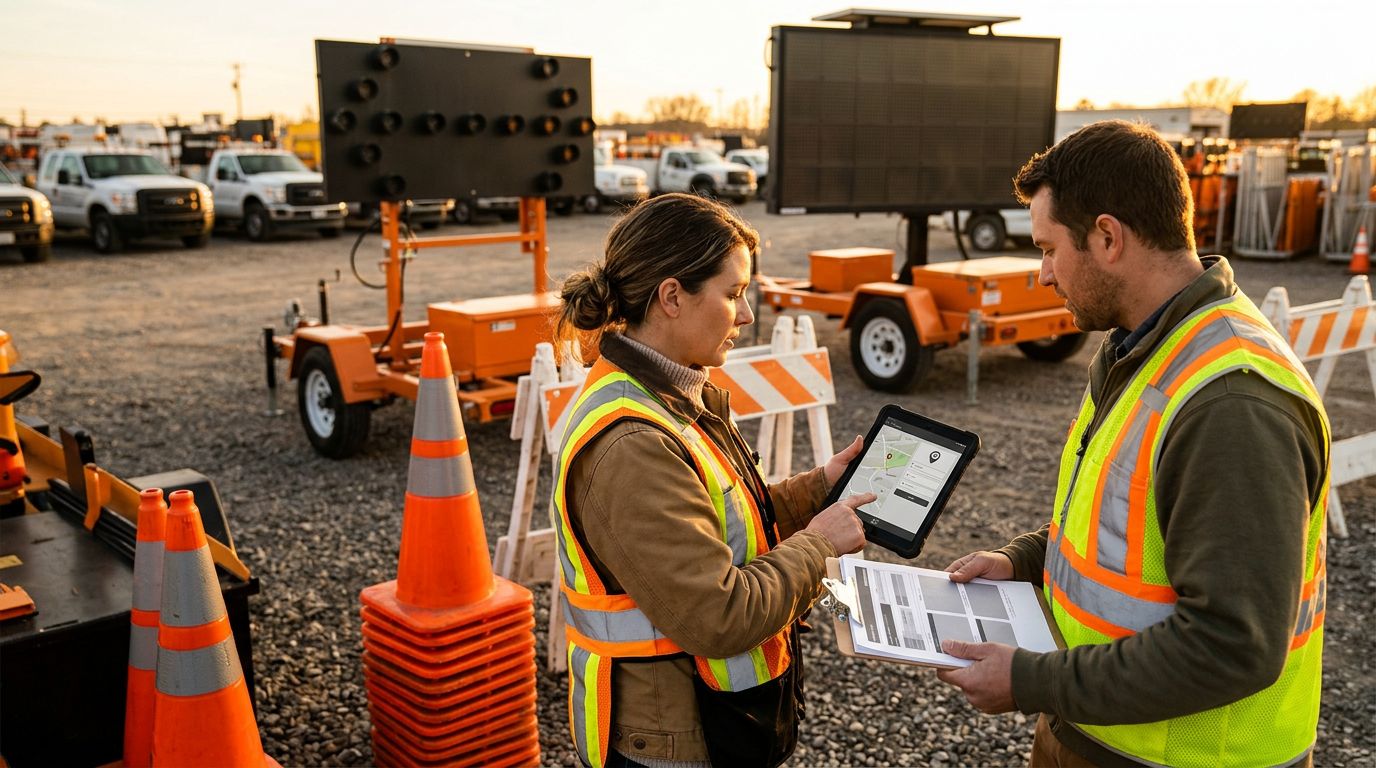
The general contractor hires flaggers directly—often through their own payroll or a staffing agency—and asks your company to deliver arrow boards, message boards, cones, barrels, and sometimes vehicles to the site. The GC's flaggers set up the work zone using your equipment under a traffic control plan that may have been prepared by you, the GC's engineer, or a third-party consultant. Your equipment leaves your yard on your trailer, arrives at a site you may never visit, and is operated by workers whose training and qualifications you did not verify.
From a dispatch perspective, the job looks like a delivery: equipment out, equipment back, with no crew labor billed. From a liability perspective, the arrangement creates ambiguity about who controlled the work zone setup and who is responsible if the configuration does not match the approved plan or if a flagger is injured while moving your barricades.
The GC benefits by paying lower labor rates or using workers already on site for other tasks. You benefit by moving equipment that would otherwise sit idle and by preserving a relationship with a customer who may not need your flagging services but does need your assets.
Where Liability Sits When Someone Else Supplies the Operator
Liability follows control. When your employee sets up a work zone with your equipment, you control the setup and you own the outcome. When a GC's employee sets up a work zone with your equipment, control is divided. You provided the assets and may have provided the traffic control plan. The GC provided the labor and supervised the setup. If the work zone fails and someone is hurt, both parties will be named, and the question becomes who made the decision that caused the injury.
Equipment failure points to the owner. A defective arrow board that does not display properly, a barricade with a cracked leg that collapses, or a trailer with failed lights creates exposure for the party responsible for inspection and maintenance. That is you.
Operational failure points to the operator. A flagger who stands in the wrong position, a taper that is too short, or advance warning signs placed at the wrong intervals create exposure for the party that deployed and supervised the worker. That is the GC.
The problem is that equipment and operational failures intertwine. A work zone with adequate advance warning but a non-functioning arrow board may be an equipment failure or an operational failure depending on whether the flagger noticed the malfunction and failed to report it or whether the board left your shop already broken.
Insurance responds based on the claim. Your general liability and inland marine policies cover your equipment and your operations. The GC's general liability covers their employees and their operations. But when the same incident touches both policies, carriers argue about who pays first, and both parties spend money on defense even if one eventually prevails.
Documentation Requirements That Protect Both Parties
A written agreement defines who does what. The document does not need to be long, but it must answer four questions: who inspects the equipment before use, who supervises the setup, who is responsible for maintenance and repair, and who carries what insurance.
Inspection obligations should be explicit. If your company delivers equipment and the GC's flagger is expected to inspect it before deployment, state that. If your driver inspects and certifies the equipment at delivery, document that. The inspection record becomes evidence of the equipment's condition at the time control transferred from your company to the GC. Traffic Os supports daily tickets signed with GPS that can capture delivery time, location, and the name of the person who accepted the equipment, which creates a timestamp for when responsibility shifted.
Supervision responsibilities must be clear. The agreement should state that the GC directs and supervises the setup, that the GC's employees operate under the GC's safety program, and that your company has no authority to instruct or correct the GC's workers. That separation matters when an injury claim argues that you exercised control over the work zone by virtue of owning the equipment.
Maintenance and repair terms define who fixes what. Routine wear and normal operation are the owner's problem. Damage caused by misuse or negligence is the operator's problem. The line between the two is arguable, so the agreement should state how damage is assessed, who makes the determination, and whether the GC is billed for repairs beyond normal wear.
Insurance requirements protect both parties. The GC should be required to carry general liability with limits appropriate to the project and to name your company as an additional insured. You should be required to maintain inland marine or commercial auto coverage for the equipment and to provide proof of that coverage to the GC. Each party should agree to notify the other immediately if a claim or incident occurs.
Common Failures in Mixed-Crew Arrangements
The most frequent failure is no written agreement at all. The GC calls, asks if they can rent equipment and use their own people, and you say yes because the equipment is available and the revenue is easy. The job runs without incident until it does not, and then both parties discover that nothing was documented about who agreed to what.
The second failure is vague language in the agreement. Terms like "the GC is responsible for proper use" or "the owner will maintain equipment in good condition" do not answer the questions that arise after an incident. What is proper use? What is good condition? Who inspects, when, and what happens if an inspection reveals a defect after the equipment is already on site?
The third failure is failing to verify insurance. You require the GC to carry liability coverage, but you never ask for a certificate of insurance. The job runs, an incident occurs, and you learn that the GC's coverage lapsed or that the limits are insufficient to cover the claim. Your own carrier may still defend you, but the absence of coverage from the GC means your policy responds first.
The fourth failure is informal changes to the scope. The GC originally asked for cones and barrels, but the project expands and now they want an arrow board and a truck-mounted attenuator. You agree over the phone, but you do not update the written agreement or verify that the GC's workers are trained to operate a TMA. The equipment leaves your yard, the GC's employee operates it incorrectly, and an incident occurs involving equipment that was never covered by the original agreement.
The fifth failure is poor record-keeping. The equipment goes out, comes back, and no one documents its condition at delivery or return. Weeks later, you discover damage and bill the GC, who denies responsibility and claims the damage existed before their job. With no inspection record at the time of transfer, the argument devolves into memory and assumption.
How Traffic Control Software Handles Equipment Dispatch to Non-Employee Flaggers
Dispatch software built for traffic control operations tracks equipment separately from labor. Traffic Os allows operators to quote, dispatch, sign daily tickets, and sync invoices to QuickBooks for jobs that involve only equipment, only labor, or both. When a GC supplies their own flaggers, the job is dispatched with equipment items and no crew assignment.
The daily ticket workflow becomes an equipment transfer record. The driver who delivers the equipment signs the ticket, and the GC's representative on site can sign to acknowledge receipt. The ticket captures GPS location and timestamp, which establishes when and where the equipment was handed off. That record sits in the system as evidence of the equipment's condition at delivery and the identity of the person who accepted it.
The same workflow applies at pickup. When the equipment returns, the driver inspects it and documents any damage on the return ticket. If damage is present that was not noted at delivery, the record shows that the damage occurred while the equipment was in the GC's custody. That documentation supports a billing dispute or an insurance claim without relying on memory or reconstructed timelines.
Inventory tracking applies regardless of who operates the equipment. Traffic Os tracks multi-outlet inventory so operators know where each asset is, whether it is assigned to one of their own crews or delivered to a GC's site. Equipment does not disappear into an untracked job just because a non-employee is using it.
The platform does not manage the GC's crew qualifications or training records. If you need to verify that the GC's flaggers hold valid certifications before you release equipment, that verification happens outside the software and is recorded in your own files. Traffic Os handles your dispatch and your equipment; it does not audit another company's labor practices.
For shops evaluating software options, understanding how dispatch and ticketing workflows handle mixed-crew arrangements is part of the Traffic Control Dispatch Software: A Buyer's Guide.
Photo Documentation of Work Zone Setups
When you deploy equipment to a site staffed by a GC's flaggers, you lose visibility into how the work zone is configured. You do not see the taper length, the spacing of advance warning signs, or the position of the arrow board. If an incident occurs and the work zone configuration is challenged, you have no firsthand knowledge of what the setup looked like.
Photo documentation shifts that risk back to the GC. The written agreement should require the GC to photograph the completed setup and provide those images to you within a specified timeframe. The photos should show the full work zone from approach to downstream taper, including all devices and their spacing. The images become evidence that the setup matched—or did not match—the approved traffic control plan.
You can require the photos as a condition of future rentals. If the GC does not provide documentation, you decline the next request. That policy creates accountability and ensures that both parties have a record of what the work zone looked like when your equipment was deployed.
For detailed guidance on what to photograph and when, see Photo Documentation of Work Zone Setups: What to Shoot, When, and Where to Keep It.
Next Steps: Document the Arrangement Before the First Job
The decision to supply equipment to a GC's flaggers is a business decision, not a technical one. The revenue is straightforward, the operational complexity is low, and the risk is manageable if you document the arrangement before the equipment leaves your yard. Without documentation, the risk is unquantifiable and the exposure is open-ended.
Start with a written agreement that assigns inspection, supervision, maintenance, and insurance responsibilities. Require proof of the GC's insurance before the first delivery. Use daily tickets to capture equipment condition at transfer and return. Require photo documentation of the completed work zone setup. Treat each job as a standalone event with its own paper trail, and do not rely on an informal relationship or past performance to protect you if something goes wrong.
Traffic Os provides the dispatch and ticketing infrastructure that traffic control operators use to track equipment, sign daily records, and document custody transfers without adding administrative overhead. Get started with a platform designed for operators who cannot afford to take crews off the road for training and who need documentation that holds up when a claim is filed.
Related reading
- Tracking Crew Qualifications Before Dispatch: Flagger Cards, Supervisor Certs and Crew Composition
- Photo Documentation of Work Zone Setups: What to Shoot, When, and Where to Keep It
- Traffic Control Dispatch Software: A Buyer's Guide
- Hiring a Traffic Control Company: 12 Questions to Ask Before the First Shift
- Rental Software vs Field-Service Software for Traffic Control
Frequently asked questions
Can I refuse to supply equipment if I do not trust the GC's flaggers?+
Yes. You own the equipment, and you decide the terms under which it leaves your yard. If the GC cannot provide proof of training, insurance, or a safety program, you decline the request.
Does the GC need to name me as an additional insured on their policy?+
That is negotiable, but it is standard practice in mixed-crew arrangements. Being named as an additional insured on the GC's liability policy means their carrier defends you if a claim arises from their employee's actions.
What happens if the GC's flagger damages my equipment?+
The written agreement should specify that the GC is responsible for damage beyond normal wear. You bill the GC for repairs, and if they dispute the charge, the daily ticket and inspection records provide evidence of the equipment's condition at delivery and return.
Should I inspect the work zone after the GC's crew sets it up?+
You are not required to inspect unless the written agreement says you will. If you do inspect and find deficiencies, you create a duty to correct them or to notify the authority having jurisdiction. If you do not inspect, you do not assume that duty.
How do I document the equipment transfer without creating liability for the setup?+
Use a delivery ticket that identifies the equipment, the delivery location, the recipient's name, and the time and date. The ticket should state that the recipient accepts the equipment in inspected condition and assumes responsibility for its deployment and operation. Traffic Os captures that information on daily tickets signed with GPS.