September 17, 2026 · The Key Bot
Maintaining Driveway and Business Access in Work Zones
The complaints that reach an agency fastest are from the business whose customers cannot turn in and the resident who cannot get out. What the manual expects, what permits usually require, and how to plan access so it does not become a change order or a shutdown.
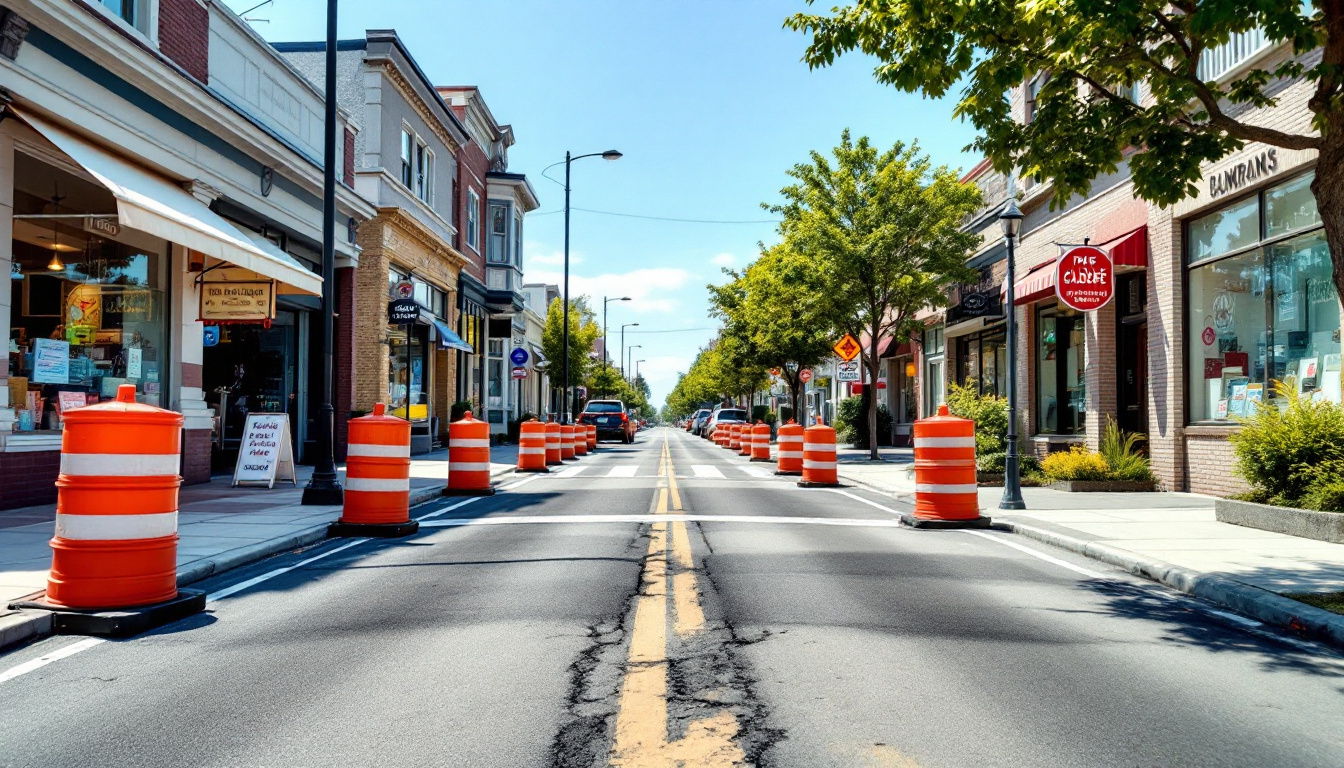
Every experienced traffic control crew has had the conversation. The setup is correct, the plan is followed, and a man is standing in the taper explaining that this is his hardware store and those are his customers driving past.
Access is the part of urban and suburban work that plans under-describe and permits quietly require. It is also the fastest route to an agency complaint, because unlike a driver stuck in a queue, a business owner knows exactly who to call.
What the manual actually says
The MUTCD does not have a single "driveways" section, but driveways and side streets appear through Part 6 of the 11th Edition, currently carrying Revision 1 effective March 5, 2026, in three useful places.
Warning traffic that enters from a driveway. The guidance for the ROAD (STREET) WORK sign is that where traffic can enter a temporary traffic control zone from a crossroad or a major, high-volume driveway, an advance warning sign should be used on that crossroad or driveway. A driver pulling out of a shopping centre into your closure has seen none of the warning on the main approach.
Sign placement around access points. The manual's support text on advance warning distances notes that decreasing sign spacing might be justified in order to place a sign immediately downstream of an intersection or major driveway, so traffic turning onto the road in the direction of the zone is warned of what is ahead. That is the fix for the sign sequence a turning driver never sees.
Access as a design factor. When the manual lists what to consider in evaluating temporary traffic control signals, "affected side streets and driveways" appears alongside volumes, speeds, sight distance, parking, turning restrictions, pedestrians and the nature of adjacent land uses. Access is a design input, not an afterthought.
The fundamental principles in Section 6A.02 sit behind all of it: road user movement should be inhibited as little as practical, and early coordination with officials having jurisdiction over affected cross streets should occur where significant impacts are anticipated.
The permit is usually more specific
The binding requirement is normally in the permit or contract, not the manual. Municipal street-opening permits, utility permits and DOT land-use permits commonly include conditions about maintaining reasonable access to abutting property, notifying affected owners in advance, keeping at least one access open where a property has two, or restoring access outside working hours.
Agencies receiving federal-aid funds also work within the Work Zone Safety and Mobility rule at 23 CFR 630 Subpart J, which pushes them to consider work zone impacts on significant projects — and access to adjacent land uses is one of the impacts that generates public complaints fastest.
Read the conditions before you price the job. "Maintain access to all businesses during business hours" can change the staging, the number of devices, the shift timing and the crew size. Right-of-way permits for traffic control work and multi-jurisdiction permit tracking cover the permit layer.
Plan it before you are standing in it
A workable routine, and most of it happens before mobilisation:
1. Inventory the access points. Walk or drive the limits and count driveways, side streets, alleys, fire lanes, loading docks and building entrances. Note which are two-way, which are the only access a property has, and which carry trucks. The count is usually higher than the plan implies.
2. Classify them. Which must stay open at all times, which can be closed briefly with notice, which can be closed for a day. A fire station, a hospital entrance, a pharmacy drive-through and an unused rear gate are not the same problem.
3. Decide the treatment for each. Keep open with a device gap and guidance; close and detour to another entrance on the property; close with advance notice for a stated window; provide temporary access across the work.
4. Sign it. Advance warning on every approach a turning driver uses, guidance at the access point, and — where the manual's guidance applies — a warning sign on the major driveway or side street itself for drivers entering the zone.
5. Notify. Door-knock the affected properties before the work, with dates, hours, what changes, and a phone number. Doing this badly is the single largest cause of access complaints; doing it well converts most complainants into people who already knew.
6. Assign it. Name the person responsible for access on the job, so that when the situation changes on day three there is someone whose job it is to re-solve it.
What goes wrong on site
The device line crosses the driveway. Cones or drums placed at uniform spacing straight across an access point. Physically obvious, easily fixed, and the most common complaint trigger.
The gap is unsigned. A gap left in the devices with no guidance is an invitation for a driver to turn into the work space or to stop in a live lane while deciding.
Access moves and nobody tells the customer. A staging change relocates the temporary entrance overnight. The notice you gave on Monday is now wrong.
Trucks cannot make the turn. A delivery vehicle that could use the driveway normally cannot with devices narrowing it. Check the turning path, not just the width.
Pedestrians are forgotten. Vehicle access is maintained and the sidewalk route to the same business is blocked or made inaccessible. Accessible routes are a requirement, not a courtesy — ADA and temporary pedestrian access routes in work zones covers the standards, and pedestrian accommodation in work zones covers the practice.
Nobody recorded the request. A business asks for a change, a crew lead agrees, nothing is written down, and the extra work never reaches an invoice. Change orders on traffic control jobs covers capturing it.
Access costs money — price it
Maintaining access is not free, and it is frequently mispriced because it looks like a detail.
Devices get moved several times a day. Crews spend time directing turning traffic. A flagger may be needed at a busy entrance. Extra advance warning appears on side streets and driveways. Work may have to be staged in shorter segments so each property regains access sooner.
If the permit requires access to be maintained, that requirement belongs in the estimate as labour and devices, not absorbed. Bidding traffic control jobs: estimating basics covers building it in. If access requirements appear after award — a business objects, the agency imposes a condition — that is a scope change, and it should be documented on the ticket the day it happens.
Keep the record
Access disputes are recollection contests months later: was the driveway blocked, for how long, was notice given, did the agency agree to the closure.
What settles them: the access plan showing each point and its treatment, dated notices with photos of them posted or a list of who was spoken to, daily tickets recording access work and any closures with times, and photos of the setup at the access points. Preventing daily ticket disputes covers the ticket side.
Traffic OS keeps that evidence attached to the job — signed, GPS-stamped daily tickets with photos, plus the permit and plan on the same record, so the access commitments and what actually happened live together. Flat monthly tiers of $499, $949 and $1,499 as of September 2026, no per-user charge; see the pricing page and features page, or take a walkthrough.
Access requirements vary by state, county, city and permit, and property access rights are a legal matter beyond the traffic control manual. Nothing here is legal advice — confirm your obligations with the authority having jurisdiction and, where property rights are in question, with counsel.
Frequently asked questions
Does the MUTCD say anything about driveways in work zones?+
Yes, in several places. Affected side streets and driveways are among the factors listed for consideration when temporary traffic control signals are being evaluated; guidance calls for an advance warning sign on a crossroad or major, high-volume driveway where traffic can enter the zone from it; and the manual notes that sign spacing may be reduced to place a sign just downstream of an intersection or major driveway so turning traffic is warned.
Who decides whether access has to be maintained?+
The agency, through the permit or contract, and in some cases property rights independent of either. Many municipal and utility permits require that reasonable access to abutting properties be maintained or that affected owners be notified in advance. Read the permit conditions; they are usually more specific than the manual.
What is the usual failure?+
Nobody assigned it. The plan shows the closure, the crew sets it correctly, and no one identified that three businesses and eleven driveways fall inside the work space — so access gets improvised, badly, by whoever is nearest when someone complains.
How should temporary access be signed?+
With advance warning on every approach a turning driver uses, clear guidance at the access point, and devices that do not obscure it. Where traffic enters the zone from a major driveway or side street, the manual's guidance is to warn on that approach too.
What about pedestrian access to businesses?+
It has to be maintained as an accessible route, not left to improvisation. That means a detectable, unobstructed path, and an accessible alternative if the normal route closes — including access to building entrances along the work.
Can access be closed at all?+
Sometimes, for defined periods, with notice and the agency's agreement — for example during a paving pass or a concrete pour. The difference between an acceptable closure and a complaint is almost always advance notice and a stated reopening time that turns out to be true.