August 2, 2026 · The Key Bot
Pedestrian Accommodation in Work Zones
Closing a sidewalk is not the same as closing a lane. What the traffic control manual and federal accessibility guidelines expect when your work zone crosses a pedestrian route, and why 'Sidewalk Closed, Cross Here' is often not an acceptable answer.
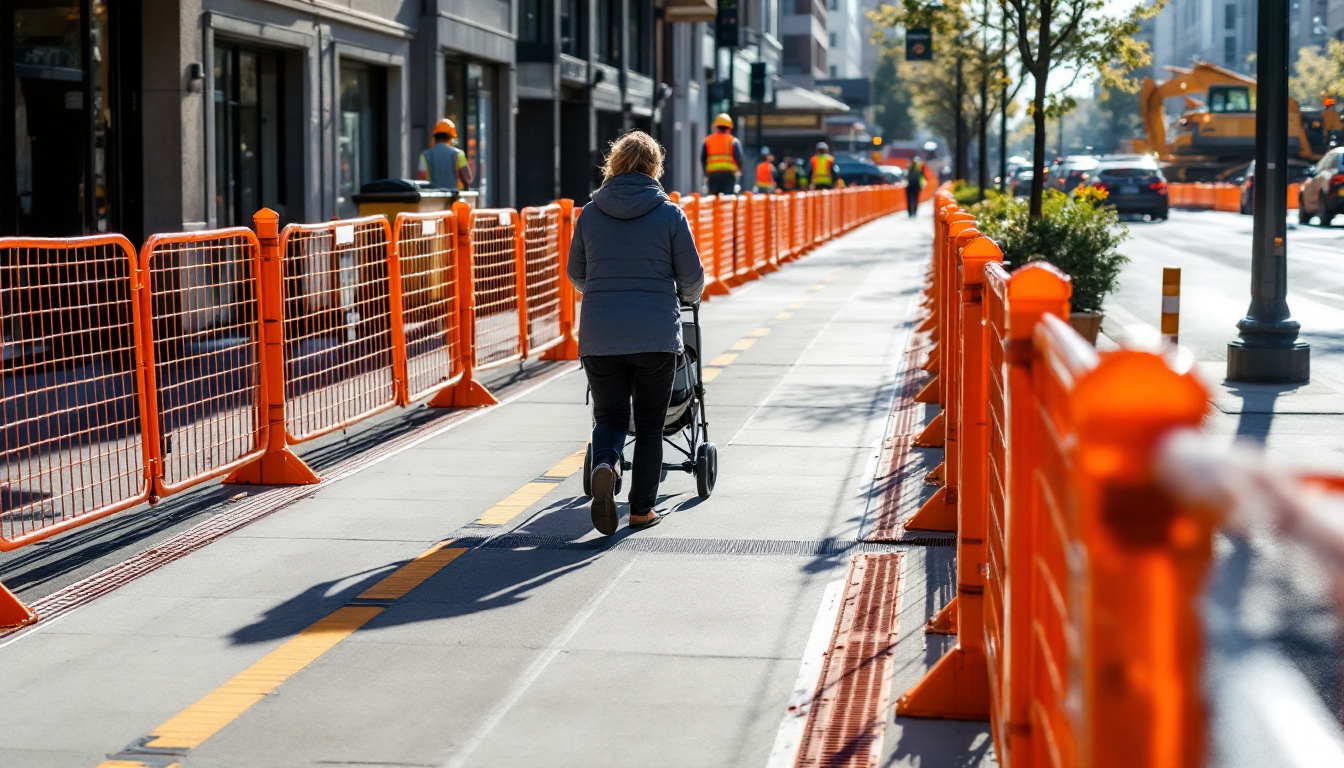
Most traffic control planning is about vehicles. The plan shows lanes, tapers, and devices; the quantities are counted in drums and flagger hours; and the review comments come back about advance warning distance.
Then the setup goes in and somebody in a wheelchair arrives at a closed sidewalk with a sign that says the sidewalk is closed and nothing else.
Pedestrian accommodation is the scope most consistently under-planned in this trade, and it is worth understanding why before understanding what to do about it.
Pedestrians are road users
The organizing idea in the traffic control manual is that a temporary traffic control zone has to accommodate road users through or around the work — and pedestrians are road users. They are not an exception to the plan; they are a category the plan is supposed to address.
The federal manual devotes explicit attention to pedestrian and worker considerations within Part 6. The current national text is Part 6 of the MUTCD 11th Edition, published free by FHWA. Two cautions about citing it. First, Part 6 was restructured in the 11th Edition, so section numbers from the 2009 edition may no longer resolve — we cover that in the 11th Edition post. Second, and more importantly, the document your work is judged against is the manual your state has adopted, not necessarily the national one. Per 23 CFR 655.603, states adopt within two years of a federal rule's effective date, and a state manual may be more prescriptive than the national one.
The practical version of the manual's expectation, stated without reference to any particular section number: where a pedestrian route is affected by work, the plan should address where pedestrians go, that route should be reasonably direct and continuous, it should be separated from both the work space and vehicular traffic, and it should be usable by pedestrians with disabilities.
That last clause is the one that changes what "accommodation" means in practice.
The accessibility layer
Accessibility obligations do not pause for construction.
The Access Board published the Public Right-of-Way Accessibility Guidelines as a final rule on August 8, 2023, covering sidewalks, streets, crosswalks, curb ramps, pedestrian signals, on-street parking, and shared use paths under the ADA and the Architectural Barriers Act. The Department of Transportation subsequently adopted PROWAG on December 18, 2024 as part of its ADA standards for transit stops in the public right-of-way.
What that means for your temporary condition on a specific project is genuinely a question for the agency having jurisdiction, and this is not a dodge — the interaction between accessibility guidelines, state adoption, and a particular municipality's permit conditions is exactly the kind of thing that differs meaningfully between jurisdictions.
What does not differ is the underlying design question, which you can reason about without any citation: does the alternate route actually work for someone who cannot see it, or cannot step over things, or cannot navigate a surface change?
That question has concrete implications:
Continuity. A route that requires stepping off a curb, crossing gravel, or squeezing past a device is not a route for a substantial share of pedestrians.
Detectability. Someone using a white cane navigates by detecting edges. A route bounded by cones or tape provides no detectable edge at cane height. This is the single most common accessibility failure in temporary pedestrian routes and it is invisible to anyone who does not use a cane.
Surface. Temporary surfaces need to be firm, stable, and slip resistant, and transitions need to be manageable rather than abrupt.
Advance information. A closure that is only discoverable at the closure point forces a wheelchair user to backtrack an entire block. Information belongs at the last point where an alternate decision could reasonably be made.
The "cross here" trap
The most common accommodation is also the most commonly mishandled: closing one side of the street and directing pedestrians to the other.
That can be entirely appropriate. It becomes a hazard when the crossing being directed to is not itself adequate. Directing pedestrians to a mid-block crossing with no signal, no marked crosswalk, and no advance warning to drivers converts a sidewalk obstruction into a roadway exposure — which is a materially worse trade.
The relevant data point is that pedestrians are a substantial and distinct share of work zone deaths. The Work Zone Safety Information Clearinghouse records, for 2024, 37 "at work" pedestrian fatalities and 119 other pedestrian-involved fatalities in work zones, against 33 and 145 respectively in 2023. The second number in each pair is largely people on foot in or around a work zone that did not adequately accommodate them.
That is not a rounding error against national totals of 850 work zone fatalities in 763 fatal crashes in 2024. It is roughly one in seven.
If you are going to route pedestrians across a roadway, the crossing has to be part of the plan — marked, signed to drivers, and located where a driver can see someone using it.
Why this gets plans rejected
Pedestrian accommodation is a recurring reviewer comment, and it shows up in a predictable way: the vehicular side of the plan is complete and competent, and the pedestrian route is either absent or drawn as an arrow with no supporting detail.
Reviewers ask for the same things repeatedly. Where does the route go, exactly. What bounds it. How does someone with a visual impairment detect it. What happens at each end. Is there an accessible crossing. Is the route maintained when the work moves.
Our post on common reasons traffic control plans get rejected covers the broader pattern; pedestrian detail is consistently in the top tier of comments. Getting it right the first time is faster than a revision cycle, which on a permitted job is measured in weeks.
Maintenance, which is where it actually fails
A pedestrian accommodation that was correct at setup and degraded by week two is the normal outcome, not the exception.
Temporary fencing gets pushed aside. Detectable edging gets moved by a crew that needed the space. Signs get turned. A stockpile appears in the route. None of that is malice; all of it is the predictable result of a route that exists in the plan but has no owner in the field.
Two habits help.
Include the pedestrian route in the daily walk. If the setup check covers cones and signs but not the pedestrian path, the path will drift.
Photograph it at setup and periodically after. Same discipline as the vehicular setup — timestamped, located, attached to the job. This is the only record that will exist if someone is injured and the question becomes what the route looked like on a particular Tuesday.
That documentation habit is not specific to pedestrians, but pedestrian complaints and claims arrive later than vehicular ones and rely more heavily on reconstruction, which makes contemporaneous evidence disproportionately valuable. It is one of the reasons Traffic OS attaches setup photos and daily tickets to the job with location and time captured automatically — the record that answers a complaint is the same one that lets a supervisor notice the route has drifted before anyone complains.
Standing caveat, and it is not boilerplate: requirements vary by state, county, and city. Accessibility obligations, adopted manual editions, and permit conditions are set by the agency having jurisdiction and by applicable law. Nothing here is legal advice or an interpretation of whether a specific requirement applies to a specific project. Verify with the authority having jurisdiction, every time.
The short version
Plan the pedestrian route with the same seriousness as the vehicular one. Make it continuous, detectable, and connected to a crossing that actually works. Put advance information where a decision can still be made. Maintain it as deliberately as you maintain the taper. Document it.
If you want the field documentation side, the features overview walks the workflow and you can book a walkthrough to see it on real screens; the pricing page covers what is at each tier.
The person your accommodation fails is usually not the person who signs your ticket. That is precisely why it needs to be in the plan rather than left to whoever is standing there at 7 a.m.
Frequently asked questions
Can you just close a sidewalk during construction?+
Generally not without providing for the pedestrians who were using it. The traffic control manual treats pedestrians as road users requiring accommodation through a temporary traffic control zone, and accessibility obligations apply to the temporary condition as well as the permanent one. What specifically is required is set by the agency having jurisdiction — verify before you plan a closure.
What is PROWAG and does it apply to work zones?+
The Public Right-of-Way Accessibility Guidelines are accessibility guidelines for sidewalks, crosswalks, curb ramps, pedestrian signals, and related facilities in the public right-of-way. The Access Board published them as a final rule on August 8, 2023, and the U.S. Department of Transportation adopted them on December 18, 2024 as part of its ADA standards for transit stops in the public right-of-way. How they interact with a temporary condition on a specific project is a question for the agency having jurisdiction.
Is a detour across the street an acceptable pedestrian accommodation?+
Sometimes, and only when the crossing itself is safe and accessible. Directing pedestrians to cross mid-block, or to a crossing that is itself obstructed, converts a sidewalk problem into a roadway problem. The test is whether the alternate route actually works for someone using a wheelchair, a white cane, or a stroller.
Why do pedestrian accommodations get skipped so often?+
Because the pedestrian is not the customer, is not in the plan quantity, and does not call to complain until after the fact. It is a scope that is easy to under-plan and expensive to get wrong, and it is one of the more common reasons a traffic control plan gets rejected on review.