July 26, 2026 · The Key Bot
Utility Work Traffic Control: What Changes
Why utility jobs behave differently from road construction for a traffic control contractor — duration categories that shift mid-job, open excavations, moving work spaces, the coordination layer, and how to price work whose schedule you do not control.
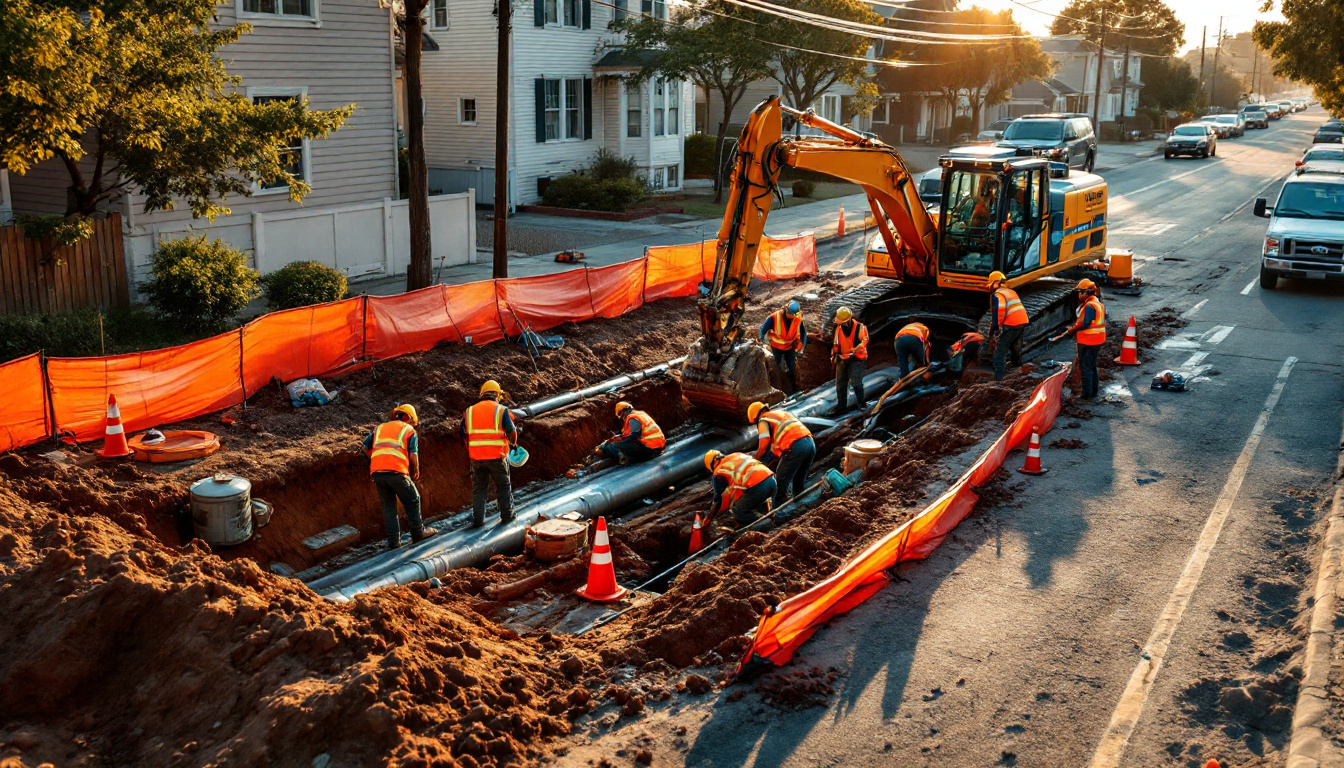
Utility work is where a lot of traffic control companies make their steady money, and it is also where a setup that would be textbook on a road construction job quietly stops fitting.
The differences are not primarily about the devices. They are about time, control and coordination.
The duration category moves under you
The MUTCD's five work-duration categories drive device requirements, and utility work sits right on a boundary.
The manual observes directly that most maintenance and utility operations are short-term stationary work — daytime work that occupies a location for more than 1 hour within a single daylight period (Section 6N.01, 11th Edition). The category above it, intermediate-term stationary, covers work occupying a location more than one daylight period up to 3 days, or nighttime work lasting more than 1 hour. Above that, long-term stationary is more than 3 days.
Why this matters on a utility job specifically: the crossing happens by accident. A service tap that was going to take four hours hits unmarked conduit, or the wrong fitting, or groundwater. Now it is a two-day job. The manual's requirement follows automatically — since intermediate-term operations extend into nighttime, retroreflective and/or illuminated devices are required for those zones.
The traffic control setup that was correct at 9 a.m. is not necessarily correct at 6 p.m. on the same hole. That transition has to be someone's explicit responsibility, and on most utility jobs nobody has been assigned it.
Practical response: treat the duration assumption as a decision point in the job record, not a note on the quote. When a job crosses a daylight boundary or a day boundary, that is a trigger for a setup review, and it should generate a real action rather than a silent continuation.
The work space moves
Road construction generally has a work space that stays put for a while. Utility work frequently does not — a crew progresses along a run, potholes at intervals, or works a series of service connections down a street.
The MUTCD's own framing allows for this: the work space may be stationary or may move as work progresses, and where there might be several work spaces within the project limits, each should be adequately signed to inform road users and reduce confusion (Section 6B.06).
That last clause is the operational trap. A progressing utility crew tends to move the immediate protection with them and leave the advance warning where it was first placed. After a few hours the signs are describing a condition that is now two hundred feet down the road, which is worse than no signs — it trains the driver to disregard them.
Two habits address most of it: advance warning moves when the work space moves, and somebody walks the zone from the driver's approach at least once per shift, not from the work outward.
Open excavations and the lateral buffer
Utility work introduces a hazard road construction often does not have in the same form: an open hole, next to a live lane, sometimes for hours.
The MUTCD's provision for lateral buffer space specifically contemplates this — a lateral buffer may be used between the traffic space and the work space, or such areas as excavations or pavement-edge drop-offs (Section 6B.06). And the standing rule about buffers applies: neither work activity nor storage of equipment, vehicles or material belongs in a buffer space.
On a utility job that rule collides with reality daily, because spoil piles, pipe, plates and the vacuum truck all need somewhere to go, and the buffer is the most conveniently empty place available. It is empty on purpose. Where genuinely there is not room, that is a plan question for the jurisdiction, not a field decision. The buffer's function and how a shadow vehicle changes its boundary are covered in taper length and buffer space explained.
The coordination layer nobody prices
On a road construction job the traffic control contractor typically works under one prime with one schedule. Utility work often involves more parties: the utility owner, their contractor, the road-owning agency, sometimes a locate service, sometimes a second utility whose facilities are in the same corridor.
The MUTCD flags the general point — coordination should be made between adjacent or overlapping projects to check that duplicate signing is not used and that traffic control treatments are compatible (Section 6B.01). In utility corridors, overlapping work is normal rather than exceptional.
Three things worth establishing in writing before the first setup:
Who holds the permit, and therefore whose conditions govern. The permit side is covered in right-of-way permits for traffic control work.
Who can authorise a change to the traffic control setup. On multi-party jobs this is frequently ambiguous, and ambiguity resolves in favour of whoever is standing there wanting the cones moved.
Who calls the stop. If conditions change — weather, an incident, a discovery in the hole — somebody has authority to suspend and someone has authority to resume.
There is also a signing detail worth knowing: the manual provides a specific UTILITY WORK sign (W21-7) among its warning signs (Section 6H.24). Using the sign that describes the actual activity is a small thing that improves how a zone reads.
Pricing work whose schedule you do not control
This is the commercial core of the difference, and it is where traffic control companies most often lose money on utility work while staying busy.
You are typically providing protection for someone else's operation, at a pace you do not set. The consequences:
Standby is structural, not exceptional. Waiting for a locate, waiting for a part, waiting for an inspector. Cost it, track it separately from productive hours, and know per customer how much of it their jobs generate. A day rate that quietly absorbs it is a day rate that is profitable on the good jobs and loss-making on the common ones. The mechanics are in job costing for traffic control companies.
Duration assumptions belong in the terms. If the quote assumes a single daylight period and the job runs into a second, the additional devices required by the duration category are a real cost. Whether that is billable is a contract question — but it can only be billable if the assumption was stated in the first place. This is one of the more common sources of change orders.
Devices sit longer than planned. On rental-based arrangements that is revenue; on job-price arrangements it is cost, and it is equipment unavailable for other work. Either way it needs recording as it happens rather than reconstructing later — see tracking devices by job site.
Mobilization dominates short jobs. The manual notes that during short-duration work it often takes longer to set up and remove the zone than to do the work, and that workers face hazards during both. A utility program of many small jobs is mostly mobilization, and pricing it on time-on-site systematically under-recovers.
What a good utility traffic control operation does differently
Little of this is about equipment.
It documents the setup at each move, not just at the start. On a progressing job the setup at 2 p.m. is not the one photographed at 7 a.m., and the photograph that matters later is the one covering the moment in question.
It has a duration-crossing trigger. Crossing into a new day or into darkness generates a review, and the review is recorded.
It prices standby explicitly and knows which customers generate it.
It keeps permit conditions with the job, because utility work concentrates in jurisdictions with active permit regimes and notification obligations.
It treats the daily ticket as the record of what actually happened — hours, devices, moves, standby, signatures — because on multi-party jobs the ticket is frequently the only contemporaneous account any party has. That is the same argument as in preventing daily ticket disputes, with more parties available to disagree.
Requirements vary by state, county and city, and the authority having jurisdiction governs the specific job. If your utility work is currently tracked as a series of day rates with the interesting details in people's heads, bring a recent messy one to a walkthrough — Traffic OS keeps setups, moves, standby time and devices on one job record, priced in flat monthly tiers rather than per user.
Frequently asked questions
How is utility traffic control different from road construction?+
Three ways that matter operationally: the work space moves frequently and unpredictably, the duration category often changes mid-job when a dig takes longer than planned, and the traffic control contractor usually does not control the schedule — the utility crew does.
What duration category does utility work fall into?+
Most maintenance and utility operations are short-term stationary, which the MUTCD defines as daytime work occupying a location for more than 1 hour within a single daylight period. The risk is drifting past that into intermediate-term, at which point retroreflective and/or illuminated devices are required because the operation extends into nighttime.
Who is responsible for the traffic control on a utility job?+
That is a contractual question, and it varies. What matters practically is that responsibility, the permit holder, and the party who can authorise a change to the setup are all identified in writing before work starts — because on utility jobs they are frequently three different organisations.
How do you price a job whose schedule you do not control?+
By pricing standby explicitly and separately from productive time, and by making the duration assumption a stated term rather than an implicit one. A day rate that silently absorbs four hours of waiting is a day rate that loses money on the jobs that wait.
Do open excavations change the traffic control requirement?+
They introduce a hazard adjacent to the travel way that lateral buffer space and channelization are meant to address. The specifics belong to the approved plan and the authority having jurisdiction, but a drop-off next to a live lane is not a detail a generic setup handles by default.