August 8, 2026 · The Key Bot
Adverse Weather Traffic Control Operations: Rain, Wind, Heat, and Ice
Weather changes device behavior, marking performance, driver capability, and crew endurance all at once. Here is how to plan setups, staffing, and stand-down decisions around it.
Weather is treated as an interruption to traffic control work. It is more accurately a change in the operating conditions of every component at once: devices behave differently, markings perform differently, drivers see less and stop worse, and crews degrade faster than they notice.
Companies that handle weather well do not have better forecasts. They have decided in advance what changes at each threshold, and who has the authority to make the call.
What each condition actually changes
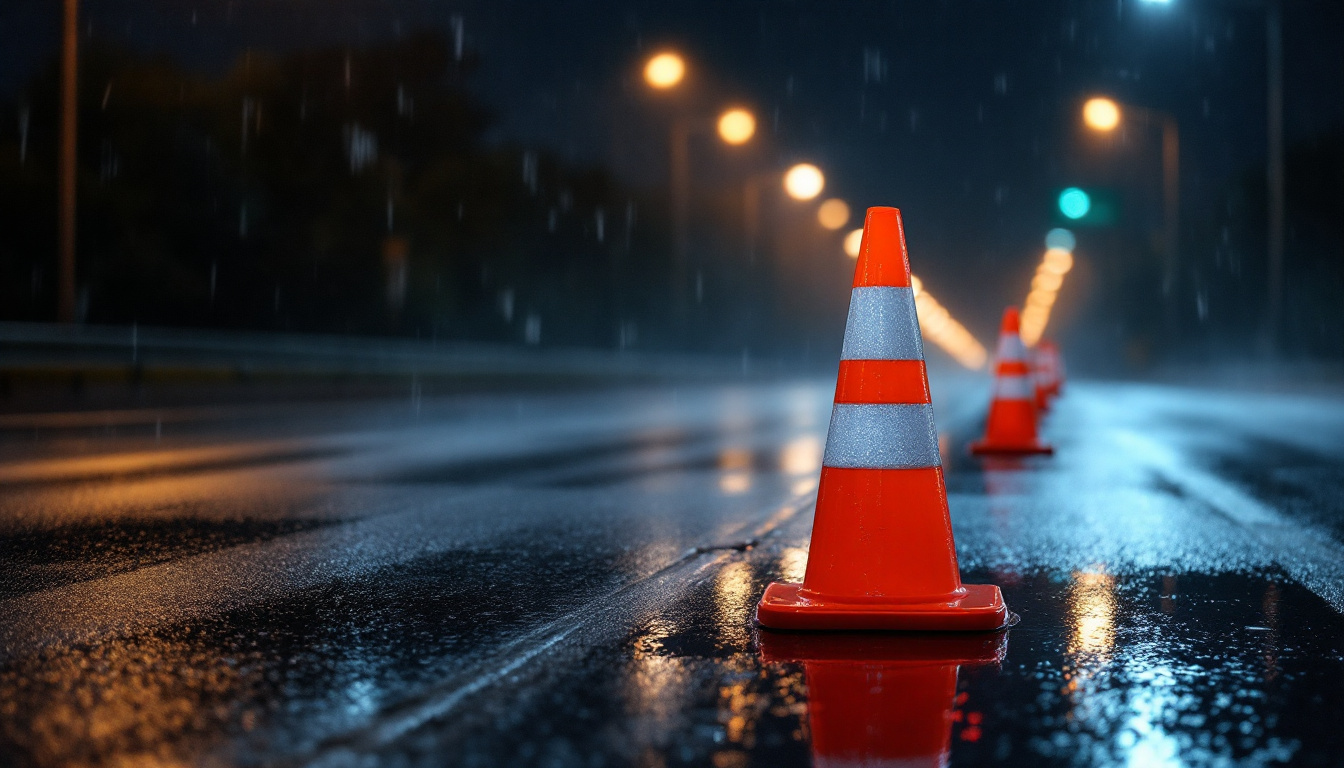
Rain. Three effects, in ascending order of importance. Visibility drops for everyone. Stopping distances lengthen. And retroreflective performance degrades — a water film on a marking or a sign scatters the return, so devices that read clearly in dry conditions read poorly in wet ones. That last effect is why wet-night conditions are the worst case for a work zone and why they deserve their own review rather than an assumption that daytime adequacy transfers. The marking side is covered in temporary pavement markings in work zones.
Wind. The most consistently underestimated condition. Cones migrate, Type III barricades act as sails, sign panels load their supports well beyond ordinary conditions, and raising a light tower mast becomes hazardous. Wind also does its damage without the theatrical warning that rain and snow provide, so crews plan around a storm and get caught by a clear windy afternoon.
Heat. Degrades the crew, primarily, and does it invisibly. A flagger three hours into a hot afternoon has diminished attention, and attention is the entire job. Heat also softens adhesives and affects pavement-applied materials.
Cold and ice. Adhesive-backed materials frequently will not bond below manufacturer-specified temperatures, which makes marking installation a scheduling constraint rather than an option. Ice adds a hazard that a work zone cannot mitigate: a driver who loses control on ice will not be recovered by a taper.
Fog. Compresses the effective advance-warning distance to whatever the visibility is, which can be far less than the sign spacing your plan assumes.
The threshold decisions worth making in advance
The value of a weather policy is not that it is scientific. It is that it exists before the moment of pressure, so the decision is not made by the person most invested in finishing.
Name the stand-down authority. The on-site supervisor stops work and explains afterwards. Any policy requiring a call to someone off-site will fail at 3 a.m., which is when it is most needed.
Set wind thresholds for specific tasks. Mast raising, sign installation, and high-panel device deployment should each have a wind speed above which the task waits. Crews are good at respecting a number and poor at judging "too windy."
Set heat and cold rotation rules. Shorter flagger rotations and mandatory relief above and below defined temperatures, with the relief actually staffed. A rule that assumes a spare person who does not exist is not a rule.
Decide what happens to an existing setup. Standing down is not the same as removing a setup. A closure already in place may be safer left, or may need devices recovered before wind scatters them into the traveled way. Decide which per setup type in advance.
Define the ice trigger. Ice is the condition where continuing is hardest to justify and where schedule pressure is often greatest. Having decided in advance removes the argument.
Weather and the crew
The under-discussed effect of weather is what it does to people. Sustained rain, heat, and cold all shorten the interval over which a person maintains reliable attention, and the person most affected is usually the flagger — who has the least physically demanding job and the most attentionally demanding one.
That matters because the internal hazard does not pause for weather either. NIOSH investigations found that 41 of 78 roadway work zone fatalities examined, 55 percent, involved construction vehicles and equipment operating inside the work zone. Degraded visibility inside the work space, a hood up over a worker's ears, and equipment operators with wet windows is a combination that makes the internal circulation discipline in internal traffic control plans more important in bad weather, not less.
Practical adjustments: shorten rotations before anyone asks; make relief and warm or shaded space genuinely available rather than nominally available; brief the specific weather hazard at the tailgate rather than generically, per tailgate safety meetings; and be alert to the fact that crews under-report their own degradation, which means supervisors have to watch for it rather than wait to be told.
Devices in weather
Ballast and anchoring should be specified for expected conditions rather than for calm ones. Devices that migrate create a setup that no longer matches the approved plan, which is both a safety issue and a compliance one.
Inspection frequency rises. A setup that holds for a week in calm conditions may need checking twice a shift in wind. Someone has to be assigned; a general expectation that "the crew will check" is not an assignment.
Recovery of scattered devices is a real task. Budget the time. A device in the traveled way is a hazard you created.
Condition degrades faster. Weather-exposed devices lose retroreflective performance more quickly, which feeds back into the standards discussed in sign retroreflectivity and device condition standards and into replacement planning.
Throughout all of it, the underlying obligation does not flex: MUTCD Part 6 governs how a temporary traffic control zone must be built, and OSHA's construction standard requires at 29 CFR 1926.200(g)(1) that "At points of hazard, construction areas shall be posted with legible traffic control signs and protected by traffic control devices". A setup degraded by weather is a setup that no longer meets that standard, whatever the reason.
Document the decision, contemporaneously
Weather generates commercial consequences — delays, standby time, remobilization, sometimes claims — and those are settled on the strength of records made at the time.
The minimum useful record for a weather event: the condition observed, with a time; the decision made and by whom; photos of the site condition; what happened to the existing setup; and the crew time affected. Five fields, captured on a phone, on the spot.
Reconstructing that a month later from memory and a weather service archive is a much weaker position, and it is the position most companies find themselves in — because at the moment of the decision, everyone was busy managing the weather. That is precisely the case for field capture that takes seconds rather than a form that takes a meeting, which is how Traffic OS treats it: timestamped, GPS-stamped, attached to the job, capturable offline. A demo can be run against one of your own jobs, weather included.
Frequently asked questions
Who decides to stand down for weather?+
Someone should be named in advance, with authority that does not require a phone call. The failure mode is a crew waiting for permission from a person who is asleep, so the standing rule should be that the on-site supervisor can stop work and explain afterwards.
What weather condition is most underestimated?+
Wind. It moves devices, turns signs into sails, and makes mast-raising on light towers hazardous, and it does all of that without the visual drama of rain or ice. Crews plan for rain and get surprised by wind.
Do temporary markings behave differently in the wet?+
Yes, substantially. A film of water scatters the retroreflective return, so markings that perform adequately dry can be much harder to see wet at night. This is a physics limitation rather than a compliance failure, and it argues for supplementing markings and reducing reliance on them in wet-night conditions.
How should weather affect staffing?+
Shorter rotations and more relief. Heat, cold, and sustained rain all degrade attention faster than crews recognize in themselves, and a flagger whose attention has degraded is standing in traffic.
Should weather delays be a change order?+
That depends on the contract, but the operational point is to document the condition, the decision, the time, and who made it — contemporaneously. A weather claim reconstructed weeks later from memory rarely survives review.