August 8, 2026 · The Key Bot
Moving Operations and Rolling Lane Closures: How They Work
Rolling roadblocks and continuously moving work zones are among the highest-skill operations a traffic control company performs. What makes them different, where the risk concentrates, and what has to be agreed before the crew rolls.
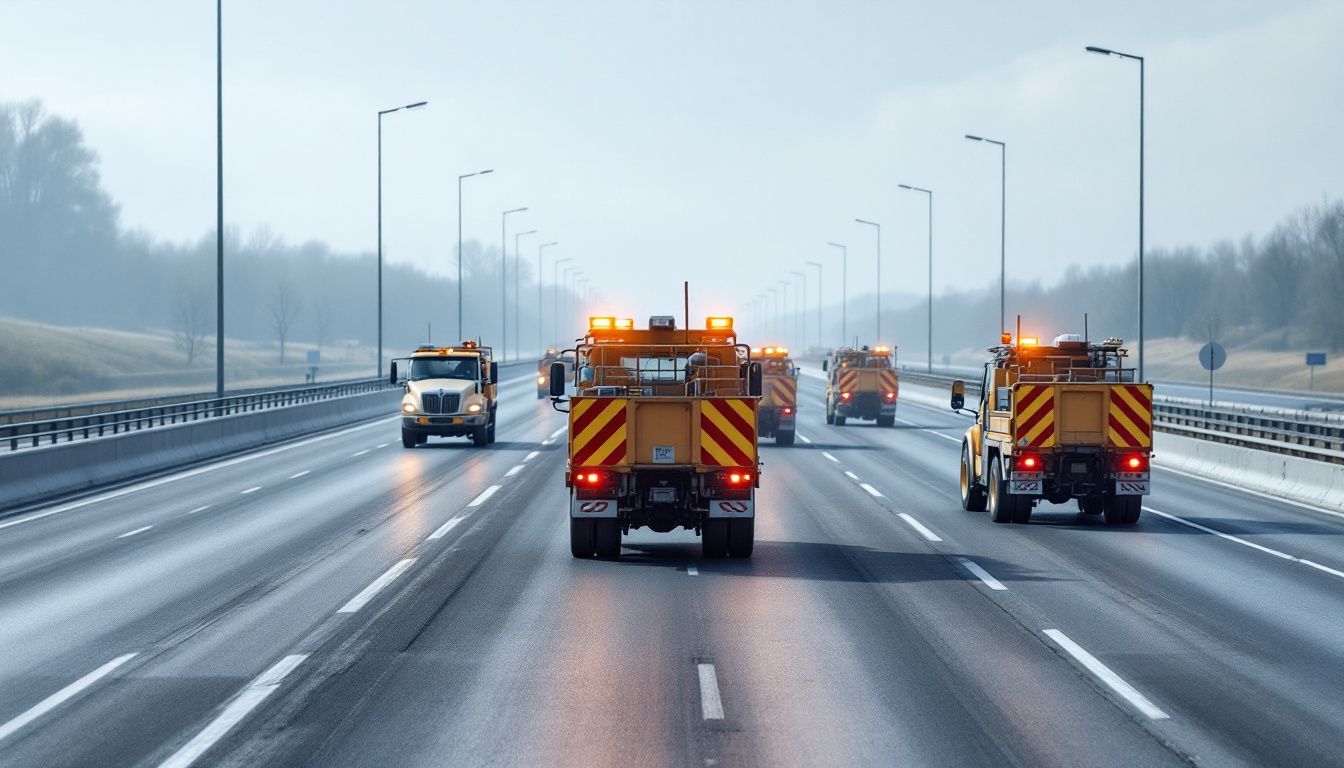
Rolling closures are the operation that separates experienced traffic control crews from competent ones. Everything happens in motion, the margin for error is measured in seconds, and there is no arrangement standing on the road to protect anyone if the coordination fails.
They are also increasingly requested, because agencies are under pressure to minimize delay and a rolling operation can complete work across miles of road with a fraction of the disruption a stationary closure would cause.
What is actually happening
The core idea is simple. One or more vehicles travel at a reduced speed across the lanes being controlled. Traffic behind them slows and bunches; the road ahead of them empties. Work happens in that clear space. When the operation finishes or the gap closes, the pace vehicles release and traffic resumes.
What makes it demanding is that every element is moving and interdependent. The gap ahead is created and consumed continuously. The work has to keep pace or the operation has to be repeated. The queue behind grows for as long as the pace continues. And the whole thing depends on drivers behaving predictably in a situation most of them have never encountered.
A typical operation involves several roles: pace vehicles establishing and holding the reduced speed across the controlled lanes; a work vehicle or crew performing the actual task in the clear space; and often a trailing or shadow vehicle providing protection at the rear of the work, frequently equipped with an attenuator — see truck-mounted attenuators explained. Advance warning, whether fixed signs, portable changeable message signs, or both, prepares drivers before they arrive.
Configuration is jurisdiction-specific and operation-specific. The national baseline is the Manual on Uniform Traffic Control Devices, currently the 11th Edition issued in December 2023, but the operative requirements come from the agency's own standards and from the specific approval. Requirements vary by state, county, and city, and this is not an operation to improvise from general principles.
Where the risk actually sits
The instinct is to worry about the work. The data and the practice both point elsewhere: the risk is at the back.
Traffic approaching a slowed or stopped queue at full speed is the dominant hazard in a rolling operation, and it is the same mechanism that makes queue-related rear-end collisions such a prominent pattern in work zone crash data generally. The National Work Zone Safety Information Clearinghouse has recorded annual U.S. work zone fatalities in the range of roughly 800 to 1,000 across recent reporting years, and the majority of those killed in work zones are road users rather than workers — a fact that matters here specifically, because the population most at risk in a rolling closure is the traffic behind it.
Three consequences follow for how these are run:
Advance warning is not optional decoration. Drivers need to know a slow-moving operation is ahead before they see brake lights. On high-speed facilities this is where portable changeable message signs earn their cost.
Queue length has to be watched by someone. The person at the back of the operation is doing a safety job, not a traffic job. If the queue is growing beyond what the approach can absorb, the operation needs to release.
Speed differential is the variable to manage. The bigger the gap between traffic speed and pace speed, the harder the closing problem. This is why work zone speed management matters more here than in most setups, and why law enforcement participation is commonly required.
What has to be agreed before the crew rolls
Rolling operations fail on coordination far more often than on technique. The pre-operation agreement should be explicit about:
The authorized hold time. How long traffic may be paced or held, set by the agency. Design the operation to finish inside it.
The release trigger. What conditions end the operation early — queue length, a vehicle in distress, an emergency vehicle, weather, communication loss. Everyone should know the trigger before it happens, because deciding in the moment is how a crew ends up debating on the radio.
Communication method and backup. Radio channel, who calls what, and what happens on loss of communication. The default on communication loss should be release, not continue.
Emergency vehicle protocol. Emergency vehicles will arrive. How they are passed through has to be settled in advance, not negotiated at speed.
Roles and vehicle order. Who is in which position, who leads, who calls the release. Ambiguity here is the operation's single biggest failure mode.
Repeat cycle. If the work needs several passes, how the operation resets and how long between cycles.
This is also a briefing that has to actually happen properly — a rolling operation is the wrong place for a perfunctory tailgate meeting.
Crew selection is a real constraint
Not every crew should run these. Rolling operations require judgment under time pressure, radio discipline, and vehicle handling in traffic — and the cost of a mistake is high.
Practically, this means rolling capability is a capacity constraint distinct from headcount. A company with fifteen crews may have four who should run rolling operations, and pretending otherwise on a busy week is a decision with consequences. It is worth tracking that capability explicitly on the dispatch side rather than discovering it at 5 a.m. — see the daily dispatch routine.
The corollary is that these operations should be priced to reflect the skill and the risk. A rolling closure is not a lane closure with fewer cones; it is a different service with a different cost structure, and companies that price it off device count are underpricing their most demanding work. See bidding traffic control jobs.
Documentation, which is unusually important here
Rolling operations leave almost no physical trace. When they are over, the road looks exactly as it did before, which creates a specific problem: there is nothing to photograph afterward that demonstrates what was done.
That makes contemporaneous records disproportionately valuable. Worth capturing on every rolling operation: start and end times, vehicles and personnel by role, the approved parameters, the actual pace speed and hold durations, any early releases and why, any intrusions or near-misses, and the agency or law enforcement personnel present.
If a question arises later — about whether the operation ran as approved, about a crash on the approach, about billing for a night that produced no visible work — that record is the entire answer. And because it has to be captured by a crew in vehicles, in motion, at odd hours, it only exists if capture is fast: a field entry on a phone with the job and time already populated, not a form waiting at the office.
That is the shape Traffic OS is built around — GPS-stamped signed tickets and job records completed from the field, on flat-tier pricing by company size. If rolling and mobile work is a growing share of what you do and the paperwork has not kept up, book a walkthrough.
Frequently asked questions
What is a rolling lane closure?+
A rolling closure — sometimes called a rolling roadblock or a traffic pace — uses vehicles moving at reduced speed to create a gap in traffic behind them, so that work can be performed in the clear space ahead. Rather than closing a lane in place, it moves the closure along the road with the work. It is used for short operations over a length of road where a stationary closure would be impractical or would cause disproportionate delay.
How is that different from a mobile operation?+
A mobile operation is work that moves along the road with vehicle-based protection travelling with it — sweeping, striping, patching, locating. A rolling closure is a technique for creating a traffic gap, which may be used to enable a mobile operation or a brief stationary one. In practice the terms get used loosely, so agree definitions with the agency rather than assuming shared vocabulary.
Do rolling closures need agency approval?+
Almost always, and frequently law enforcement participation as well. Requirements vary by jurisdiction and by road, and the approval process is generally more involved than for a stationary closure because the operation affects a length of road and depends on precise coordination. Establish what is required with the authority having jurisdiction well before bidding.
What is the main hazard?+
Closing speed. Traffic approaching a slow-moving or stopped queue from behind at full speed is the dominant risk, which is why advance warning, the pace vehicle configuration, and communication discipline receive so much attention. The hazard is at the back of the operation, not at the work.
How long can traffic be held?+
That is an agency decision, set by the approval, and it is usually short. Holding traffic longer than authorized is both a compliance failure and a genuine safety problem, because queue length and driver frustration both grow non-linearly. Build the operation around the authorized hold time rather than hoping for tolerance.