September 23, 2026 · The Key Bot
Portable Changeable Message Signs: What to Display, and What Not To
A portable message sign is the one device in the zone whose wording your crew writes. Here is what the MUTCD 11th Edition asks of PCMS messages, placement and maintenance, why most bad messages fail the same three ways, and how to run a message board fleet without losing track of it.
In-depth guide · sources linked inline
A portable changeable message sign is the only device in a work zone whose wording your own crew writes.
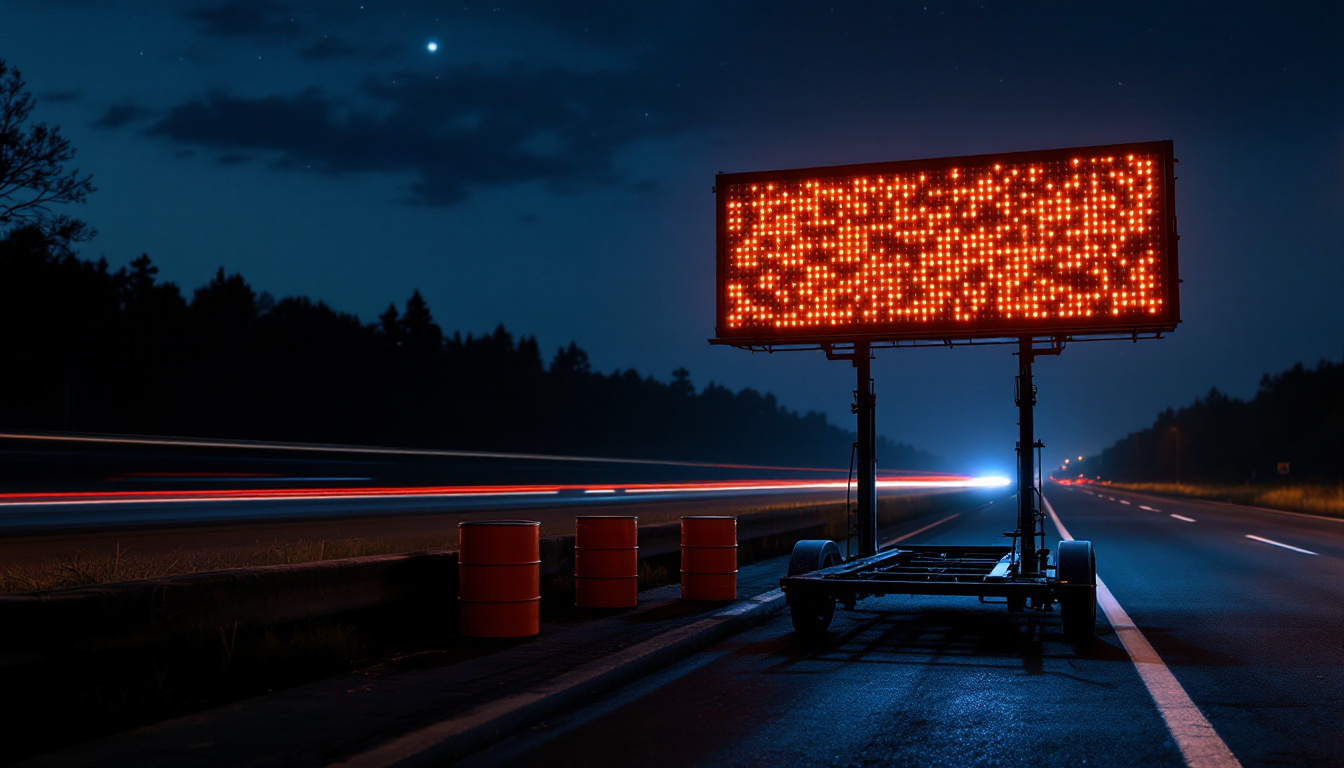
Every other device arrives with its message baked in. A Lane Ends sign says what it says. A drum is a drum. An arrow board has a small set of modes. But a message board is a blank matrix that says whatever somebody typed into the controller at 5:40 in the morning, and that makes it the device most likely to be technically present and practically useless.
This post is about the message: what the national manual asks for, why most bad messages fail in the same three ways, where the sign should sit, and what running a fleet of these trailers actually demands from the office. For the basics of the device class and how it relates to arrow boards, start with our arrow boards and message signs explainer.
As with everything on this site, the national manual is the floor. Your state's manual, its standard sheets and your approved plan sit on top of it, and the inspector enforces those. Verify message requirements with the agency that has jurisdiction over the road.
Why the message is a safety device
It is tempting to treat a message board as a courtesy — nice to have, useful for telling commuters about delays. The crash data says the job it does is more serious than that.
FHWA's work zone facts and statistics record 891 work zone fatalities in 2022 across 821 fatal crashes. The same page reports that rear-end collisions accounted for 174 of those fatal crashes, or 21 percent, and that 281 were speeding-related, or 34 percent. Those are the two crash patterns a well-placed message board most directly addresses: drivers arriving at a slowdown faster than they expected, and drivers arriving at a queue they did not know was there.
The people standing inside the zone carry the other half of that risk. The National Work Zone Safety Information Clearinghouse reports that workers on foot struck by motor vehicles accounted for 52.7 percent of road construction worker deaths on average across 2022 to 2024, based on the Bureau of Labor Statistics fatality census. NIOSH has separately reported that 1,462 fatal occupational injuries occurred at road construction sites from 2011 to 2022, with a worker struck by a vehicle involved in 44 percent of them.
A message board does not prevent any of that on its own. What it does is give a driver a reason to slow down and change lanes earlier than the static signs alone would have produced — which is only true if the driver can read the message, understand it, and believe it.
What the MUTCD 11th Edition actually asks for
The governing national text is Section 6L.05 of the MUTCD 11th Edition, Part 6. The 11th Edition was published in December 2023; FHWA's 11th Edition page tracks revisions. Older crews will remember this material under Section 6F.60 of the 2009 edition — the section numbering moved, and a few details moved with it, so an old laminated card in the truck is worth replacing.
What follows is a paraphrase organized by what a crew does, not a reproduction of the manual. Read the section itself before you rely on any of it.
The manual states the purpose plainly. In its words, "The primary purpose of portable changeable message signs in TTC zones is to advise the road user of unexpected situations." That one sentence is the best filter for any message you are considering. If the situation is not unexpected — the driver can already see it, or the static signs already say it — the message board is probably the wrong tool, or the wrong message.
Character budget. The guidance is three lines of eight characters per line, or a full-matrix display. Eight characters is shorter than most people assume. RIGHT LANE does not fit on one line. CLOSED does. Every message decision starts from that constraint.
Phases. No more than two phases, no more than three lines per phase, and each phase understandable by itself regardless of which one the driver catches first. The manual notes that road users have difficulty reading more than two phases on a typical three-line sign. If a message genuinely needs more, the guidance is to add a second sign — spaced at least 1,000 feet apart on freeways and expressways and at least 500 feet on other highways, on the same side of the road — rather than add a third phase.
Timing. When a message is split into two phases, each phase should display for at least 2 seconds, and the two together should total no more than 8 seconds.
Content. The guidance is that a message be as brief as possible and carry three thoughts, ideally one per line: the problem or situation ahead, where it is or how far, and what the driver should do. Abbreviations have to follow the manual's rules in Section 1D.08; an improvised abbreviation that makes sense to the crew can be unreadable to a driver.
Prohibited display techniques. Animation, rapid flashing, dissolving, exploding, scrolling, and text traveling across the face are not allowed — except when the sign is simulating an arrow board display. That rule is a Standard, not a suggestion.
Advertising and non-traffic messages. The sign may display only traffic operational, regulatory, warning and guidance information. While in a temporary traffic control zone it should display only temporary traffic control messages.
Legibility. The guidance is that the sign be visible from half a mile, day and night, and that letters be at least 18 inches tall. Shorter letters are permitted on service patrol and incident response trucks, where the manual allows letters as short as 10 inches, and on low-speed facilities if the message is legible from at least 650 feet.
Equipment requirements. The manual requires the sign to adjust its brightness automatically, requires a control-system screen where the message can be reviewed before it is displayed, requires the controller to retain its memory when power is lost, and requires a primary power source plus battery backup. When operating on a trailer or truck, the bottom of the sign has to sit at least 7 feet above the roadway in urban areas and 5 feet in rural areas.
Role in the zone. A PCMS should supplement, not substitute for, conventional signs and pavement markings. The static sign package has to stand on its own.
The three ways messages fail
Almost every bad message board message fails for one of three reasons, and all three are fixable in the office before the trailer ever leaves the yard.
Failure one: the message is generic
WORK ZONE AHEAD / DRIVE SAFELY tells a driver nothing the orange signs have not already told them. The 2013 guidance document produced by the American Traffic Safety Services Association under an FHWA grant — Guidance for the Use of Portable Changeable Message Signs in Work Zones — puts the problem directly. Citing Ullman, Dudek and Ullman, the guide notes that "generic messages can cause PCMS to lose effectiveness with the motorists" because they lack the specificity a driver needs to make a decision.
The cost is not just the one wasted message. Drivers learn from exposure. A commuter who drives past a board that says BE ALERT every morning for six weeks learns that the board says nothing, and stops reading it — including on the morning it says something that matters.
The fix is the manual's three-thought structure. Problem, location, action. If you cannot fill in all three with something specific, you may not need a message at all.
Failure two: the message is too long
A driver at highway speed has a few seconds with the sign. The same guide quotes the underlying research: "To be effective, a PCMS must communicate a meaningful message that motorists can read and comprehend within a very short time period."
The guide reproduces an FHWA table relating character height to legibility distance: 18-inch characters to about 720 feet, associated with 40 mph, and 24-inch characters to about 960 feet, associated with 50 mph. The assumption behind the table is that the driver reads the whole message twice. The faster the road, the less text survives that test — which is exactly why the national guidance caps phases and lines rather than leaving length to judgment.
Practical rule: write the message, then delete a word. Then ask whether the remaining message still carries problem, location and action. If it does, keep deleting.
Failure three: the message is wrong
A message that describes a condition that no longer exists teaches drivers to ignore the board faster than a generic one does. RIGHT LANE CLOSED displayed at 2 p.m. after the lane reopened at 11 a.m. is not a neutral error. Drivers who merge early for a closure that is not there, and then see an open lane, learn that the message is decoration.
This is the failure that is hardest to fix from the office, because it is an operations problem, not a writing problem. Someone has to own the message change when the zone changes, and someone has to check that it happened. More on that below.
Placement: where the sign sits matters as much as what it says
The national guidance on placement is short and specific, and it is mostly about keeping the sign readable without turning it into a hazard.
Off the shoulder, behind barrier if practicable. Where there is no barrier, the guidance is off the shoulder and outside the clear zone. If the sign has to sit on the shoulder or inside the clear zone, it should be delineated with retroreflective devices — see our channelizing devices guide for what those devices are and how they are spaced.
Far enough ahead to act on. For route diversion in particular, the guidance is to place the sign far enough ahead of the diversion that drivers can change lanes, adjust speed or exit. A detour message placed after the last exit that avoids the closure is worse than no message.
Aimed for legibility. The ATSSA guide's placement advice adds practical detail: keep the sign close to the lane it applies to, keep it out of the buffer space, do not let it block other warning signs, and angle it slightly toward the roadway to reduce glare. It cites a driver's comfortable "cone of vision" of about 10 degrees either side of the line of travel.
Dark signs go away. When the sign is not displaying a traffic control message, the guidance is to move it outside the clear zone or behind barrier and turn it away from traffic, or delineate it if that is impracticable. The manual also calls for conspicuity material — retroreflective tape in a continuous line — on the trailer face as seen by approaching drivers.
If the job involves an interchange, placement gets harder, because a message intended for mainline traffic can be misread by ramp traffic and vice versa. We cover that geometry in traffic control for freeway ramp closures.
Writing messages that work: a short method
This is not a message library. Your state likely publishes one, and where it does, use it. This is a method for checking any message before it goes live.
1. State the unexpected thing. What will a driver encounter that they would not otherwise predict? A lane closure beyond a curve. A queue. A ramp closed. A detour. If you cannot name something unexpected, question whether the board belongs at this location today.
2. Put the problem on line one. The manual's structure puts the situation first. A driver who reads only one line should get the most important one.
3. Put the location or distance on line two. A distance a driver can use (1 MILE, NEXT EXIT, the exit number) beats a vague one (AHEAD) when you have room.
4. Put the action on line three. MERGE LEFT. USE EXIT 42. EXPECT DELAYS is weaker than an action because it asks nothing of the driver, but on a queue warning it may be the honest message.
5. Check the character count. Eight per line on a character-matrix sign. Use only abbreviations the manual allows.
6. Split across phases only if you must. And if you split, make each phase stand alone. A driver who catches phase two first must still understand it.
7. Read it aloud at speed. Literally. Have someone who did not write it read both phases while you count seconds.
8. Decide when it changes. Every message should have a condition that ends it — the lane reopens, the queue clears, the shift ends. Write that condition down next to the message.
Speed messages and radar-equipped boards
Many boards now carry radar and can display a passing vehicle's speed or a speed-triggered message. The manual addresses speed display design in Section 2B.21, which Section 6L.05 points to.
The ATSSA guide summarizes a body of studies reporting that speed-feedback PCMS reduced average speeds by roughly 4 to 9 mph, while also noting the limits: the effect can fade over time, is not always maintained through the whole zone, and adds cost. It also relays a Maryland caution that on high-speed roads, drivers may test the device, and that where passing vehicles run more than 25 mph over the limit, the agency recommended not displaying the speed.
The operational lesson is simple. If you deploy a radar board, check the radar at deployment — the guide calls for that on every deployment — and have a policy for what the board shows at the extremes.
Running a message board fleet from the office
The device rules above are the easy part. The part most traffic control companies struggle with is operational: knowing where every board is, what it is saying, whether it is working, and who changed it last.
Condition is not optional
The ATSSA guide sets a maintenance bar for deployed boards drawn from the association's quality guidelines: at least 90 percent of the pixels per character operating properly and dimming appropriately. A board with dead LEDs does not display a weaker version of the message; it displays a different message, or a puzzle. The guide shows exactly that example — a board meant to read LANE CHANGES AHEAD made hard to read by failed pixels — and concludes that a board not meeting the quality guidelines should not be used.
That means pixel checks belong in your pre-deployment inspection and your periodic zone inspections, alongside battery and solar charging checks. Our post on equipment maintenance programs for traffic control fleets covers how to structure those inspections so they actually happen.
Know what the asset is worth
The same 2013 guide reported that a PCMS generally cost between $12,000 and $20,000 at the time, and that a carefully handled unit typically lasted about 10 years before parts and cost-effective repairs became difficult. Prices have moved since 2013, so treat those as historical figures, not current quotes — but the order of magnitude explains why message boards deserve their own line in your equipment register and their own rental rate. A board that sits on a job for three weeks past its need, unbilled, is a meaningful leak.
Know what each board is saying, and who said it
This is the gap that turns into disputes. When a crash happens near your zone, one of the first questions will be what the message board displayed and when. When a customer disputes a day on the ticket, one of the questions will be whether the board was deployed and working.
Answering those questions after the fact requires a record made at the time: the board's unit number, the job it was on, the message displayed, when it changed, and who changed it. Many boards log messages internally, and remote-managed boards may keep a history. But the controller log is not your business record, and it does not tie the board to a job, a customer and a ticket.
The minimum workable practice:
- Every board is a numbered asset assigned to a specific job, not a generic "message board" line.
- The approved message is written on the job, alongside the condition that ends it.
- Every change is recorded with time, message and initials — on the daily ticket or in the job record.
- The daily ticket notes the board was deployed, displaying, and inspected.
In Traffic OS, message boards are tracked as individual units assigned to jobs and rentals, with assignment history, maintenance records and a photo per unit, and the crew's signed daily ticket carries the job notes. The features page lists what is included, and pricing is flat per tier rather than per user. If you want to see how equipment assignment and daily tickets connect, book a demo.
A pre-deployment checklist for every board
- Plan check. Is this board shown on the approved plan or directed by the agency? Is the message specified?
- Message check. Problem, location, action. Eight characters per line, no more than two phases, each phase standalone. Only manual-approved abbreviations.
- Timing check. At least 2 seconds per phase, no more than 8 seconds total.
- Display check. No scrolling, flashing or animation unless simulating an arrow board display.
- Condition check. Pixels, brightness auto-dimming, battery and backup power, controller memory.
- Mounting check. Operating height at least 7 feet urban, 5 feet rural, measured to the bottom of the sign.
- Placement check. Off the shoulder, behind barrier or outside the clear zone where practicable; delineated otherwise; far enough ahead to act on; not in the buffer; not blocking other signs.
- Spacing check. Multiple boards on the same side, at least 1,000 feet apart on freeways and 500 feet on other roads; only one showing a sequential message where two are simultaneously legible.
- End condition. Written down, with a named person responsible for changing or blanking the message.
- Record. Unit number, job, message and time captured before the crew leaves.
The bottom line
The message board is the one device where the quality of your work zone depends on a sentence. Keep it specific, short and current. Put it where it can be read and where it will not become the hazard. Keep it maintained to the point that every character is readable. And keep a record good enough to answer, months later, exactly what it said and when.
Where the national guidance and your agency's standards differ, your agency wins. The approved plan and the inspector define what compliant looks like on your job.
Frequently asked questions
How many characters can a portable changeable message sign show?+
The MUTCD 11th Edition's guidance is that a portable changeable message sign should be limited to three lines of eight characters per line, or should be a full-matrix display. That character budget is the single biggest constraint on message design, and it is why abbreviations and word choice matter so much. Check the agency's own standards, which can be stricter.
How many phases can a PCMS message have?+
The national guidance is no more than two phases, with each phase no more than three lines, and each phase understandable on its own regardless of which one a driver sees first. If a message needs more than two phases, the guidance is to add another sign rather than add a third phase.
Can a message board scroll, flash or animate?+
No. The 11th Edition prohibits animation, rapid flashing, dissolving, exploding, scrolling and other dynamic display techniques on a portable changeable message sign, with one exception: when the sign is being used to simulate an arrow board display.
Can a PCMS replace the required static work zone signs?+
No. The guidance is that a portable changeable message sign should supplement conventional signs and pavement markings, not substitute for them. Treat the message board as an extra layer of information on top of a sign package that would be compliant without it.
Where should a message board be parked when it is not displaying anything?+
The guidance is to move it outside the clear zone or shield it behind barrier and turn it away from traffic, and if that is impracticable, to delineate it with retroreflective devices. A dark trailer sitting on the shoulder is a fixed object, not a sign.
Who is allowed to change the message on a job?+
That is a contract and plan question, not a device question. On many projects the message is specified in the traffic control plan or directed by the agency, and changing it is not a crew decision. Find out who has authority on your job before the first shift, and record every message change with a time and a name.