Blog / topic
Equipment and yards
Barricades, signs, arrow boards and attenuators: what to stock, rent and track. 20 articles.
Equipment and yards
Portable Message Board Rental: What to Track Between Jobs
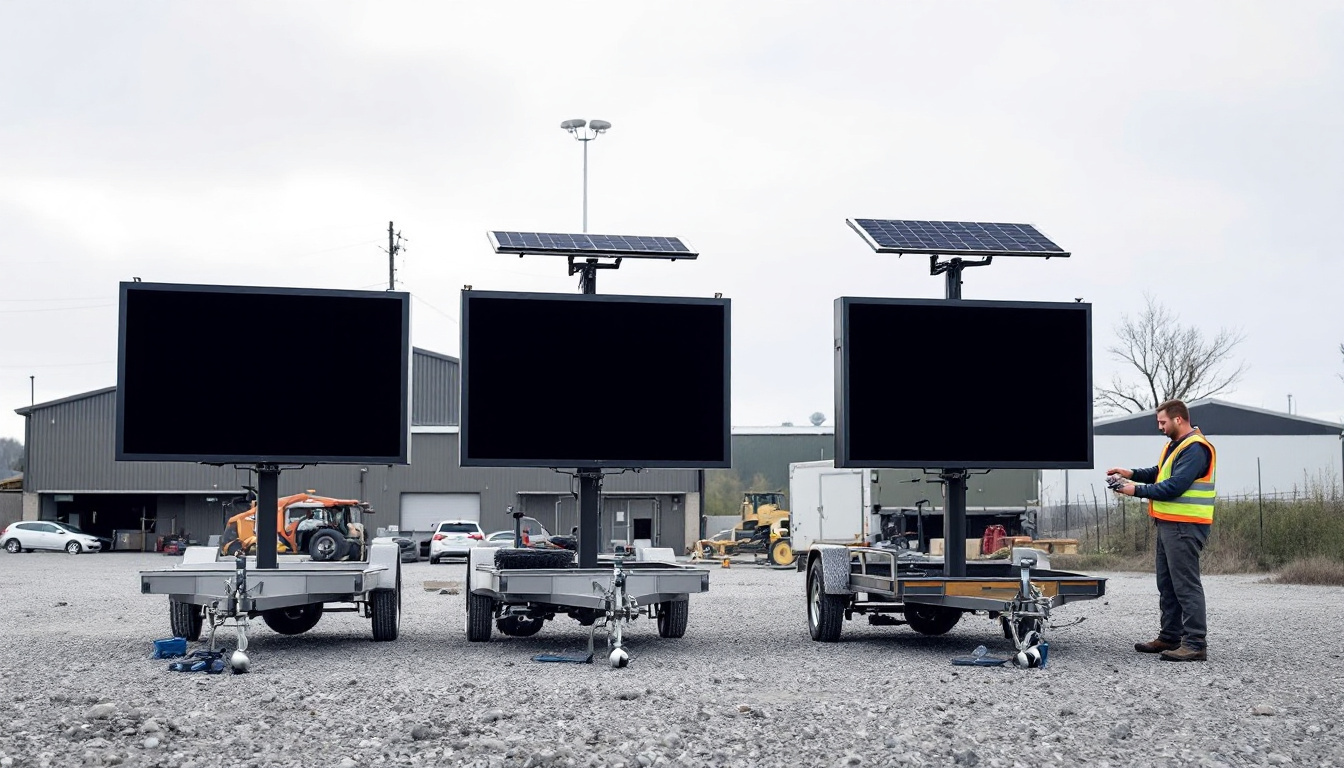
What to record on a portable changeable message sign when it comes back from one rental and before it goes out on the next: location, power, display and controller, the message left on it, the trailer, damage and maintenance, plus how weekly and monthly rental billing fits.
Nov 10, 2026 · 6 min read

Equipment and yards
Stationary Crash Cushions in Work Zones, Explained
What a stationary crash cushion does at the end of a temporary barrier, how the MUTCD frames inspection and repair, and how to keep these units visible in your equipment and job records.
Nov 8, 2026 · 5 min read

Equipment and yards
Portable Message Board Pre-Trip Inspection Checklist for Traffic Control Crews
A message board that fails on the shoulder is a fixed object with a dead screen. This checklist walks through what to check in the yard before a portable changeable message sign goes out, organized around what the MUTCD 11th Edition requires of the equipment.
Oct 30, 2026 · 5 min read

Equipment and yards
Portable Variable Message Sign, Changeable Message Sign, Message Board: Which Name Is Right?
Crews say message board, buyers search portable variable message sign, and the MUTCD says portable changeable message sign. Here is how the names line up, why it matters on a rental order or a plan note, and what the national manual says the device must do.
Oct 30, 2026 · 5 min read

Equipment and yards
Temporary Concrete Barrier in Work Zones: What the MUTCD Says and What Crews Should Know
Temporary traffic barrier is the main form of positive protection in a work zone, and the MUTCD 11th Edition attaches specific conditions to it: crashworthiness, connected segments, delineation and limits on use in tapers. Here is a plain-language guide for traffic control companies.
Oct 30, 2026 · 4 min read

Equipment and yards
Portable Changeable Message Sign Placement and Visibility: Where the Trailer Goes and Why
A portable changeable message sign only works if drivers can read it in time and the trailer itself is not a hazard. Here is what the MUTCD says about visibility distance, letter height, mounting height, lateral placement and spacing between signs, and what a traffic control company should check on delivery.
Oct 10, 2026 · 7 min read

Equipment and yards
Channelizing Device Spacing Explained: How Far Apart Cones, Drums and Barricades Go
The MUTCD's guidance on channelizing device spacing is one sentence long and widely misapplied. How taper and tangent spacing work, where the manual calls for closer spacing, how to count devices for a setup, and what crews get wrong in the field.
Oct 2, 2026 · 8 min read

Equipment and yards
Portable Changeable Message Signs: What to Display, and What Not To
A portable message sign is the one device in the zone whose wording your crew writes. Here is what the MUTCD 11th Edition asks of PCMS messages, placement and maintenance, why most bad messages fail the same three ways, and how to run a message board fleet without losing track of it.
Sep 23, 2026 · 14 min read

Equipment and yards
Sign Stands, Sandbags and Ballast in Work Zones
Ballast is the most improvised item in a traffic control yard and one of the few that can turn a device into a projectile. What the MUTCD says about ballasting cones, drums and barricades, why more is not better, and what a yard should standardise.
Sep 17, 2026 · 6 min read

Equipment and yards
Work Zone Sign Types and Sizes Explained
Why work zone signs are orange, what the shape and series tell you, why the same sign comes in several sizes, and what a yard needs to stock to cover the roads it actually works on.
Sep 11, 2026 · 6 min read

Equipment and yards
Barricade Lights Explained: Type A, B, C, and D, and Which One Goes Where
Warning lights are cheap, small, and misused constantly. What each type is for, why flashing and steady-burn are not interchangeable, and the rules crews break most often.
Aug 29, 2026 · 5 min read

Equipment and yards
Temporary Rumble Strips in Work Zones: What They Do and When They Help
What temporary rumble strips are for, where they go in the advance warning area, how removable and milled versions differ, the maintenance and noise problems nobody mentions, and an honest read on the evidence.
Aug 23, 2026 · 6 min read

Equipment and yards
Smart Work Zones and Queue Warning Systems: What They Do and When They Pay
Rear-end crashes at the back of a queue are one of the most common fatal work zone crash types. Queue warning systems exist to address exactly that — here is how they work, what the evaluation data actually shows, and when they belong in a bid.
Aug 19, 2026 · 5 min read

Equipment and yards
Portable Traffic Signals in Work Zones: When They Beat Flaggers
Temporary portable signals can control one-lane two-way operations without putting a person in the road. Where they fit, what they cost to run properly, and the failure modes that catch companies deploying them for the first time.
Aug 8, 2026 · 5 min read

Equipment and yards
Sign Retroreflectivity and Device Condition: When a Device Stops Counting
A faded sign and a scuffed drum are not cosmetic problems — a device that no longer performs is functionally not there. How condition standards work, how to run an inspection that catches decline, and how to make retirement a budget line rather than a surprise.
Aug 8, 2026 · 5 min read

Equipment and yards
Work Zone Lighting and Light Towers: Getting Night Illumination Right
Night work needs light, and badly aimed light creates glare that makes the work zone more dangerous than darkness. Here is how illumination requirements, tower placement, and glare control actually work.
Aug 8, 2026 · 5 min read

Equipment and yards
Channelizing Devices: Cones, Drums, Tubular Markers, and Vertical Panels
The devices that make up most of a traffic control inventory, what each one is actually for, why they are designed to be knocked over, and how retroreflectivity quietly decides whether any of them work at night.
Aug 2, 2026 · 6 min read

Equipment and yards
Truck-Mounted Attenuators, Explained
What a TMA is, why a shadow vehicle without one is itself a hazard, how the MUTCD frames positive protection and shadow vehicle positioning, the inspection obligation after any hit, and how to think about owning versus subbing them.
Jul 26, 2026 · 6 min read

Equipment and yards
Arrow Boards and Portable Message Signs, Explained
What each device is for, where they belong in the zone, how they differ, and why the ones you own are usually the hardest assets in your fleet to keep track of.
Jul 25, 2026 · 5 min read

Equipment and yards
Type I, II, and III Barricades: What the Types Actually Mean
How barricade types differ, where each is generally used, why substituting a lighter device is a false economy, and what tracking barricade inventory across yards actually requires.
Jul 21, 2026 · 5 min read