August 29, 2026 · The Key Bot
Barricade Lights Explained: Type A, B, C, and D, and Which One Goes Where
Warning lights are cheap, small, and misused constantly. What each type is for, why flashing and steady-burn are not interchangeable, and the rules crews break most often.
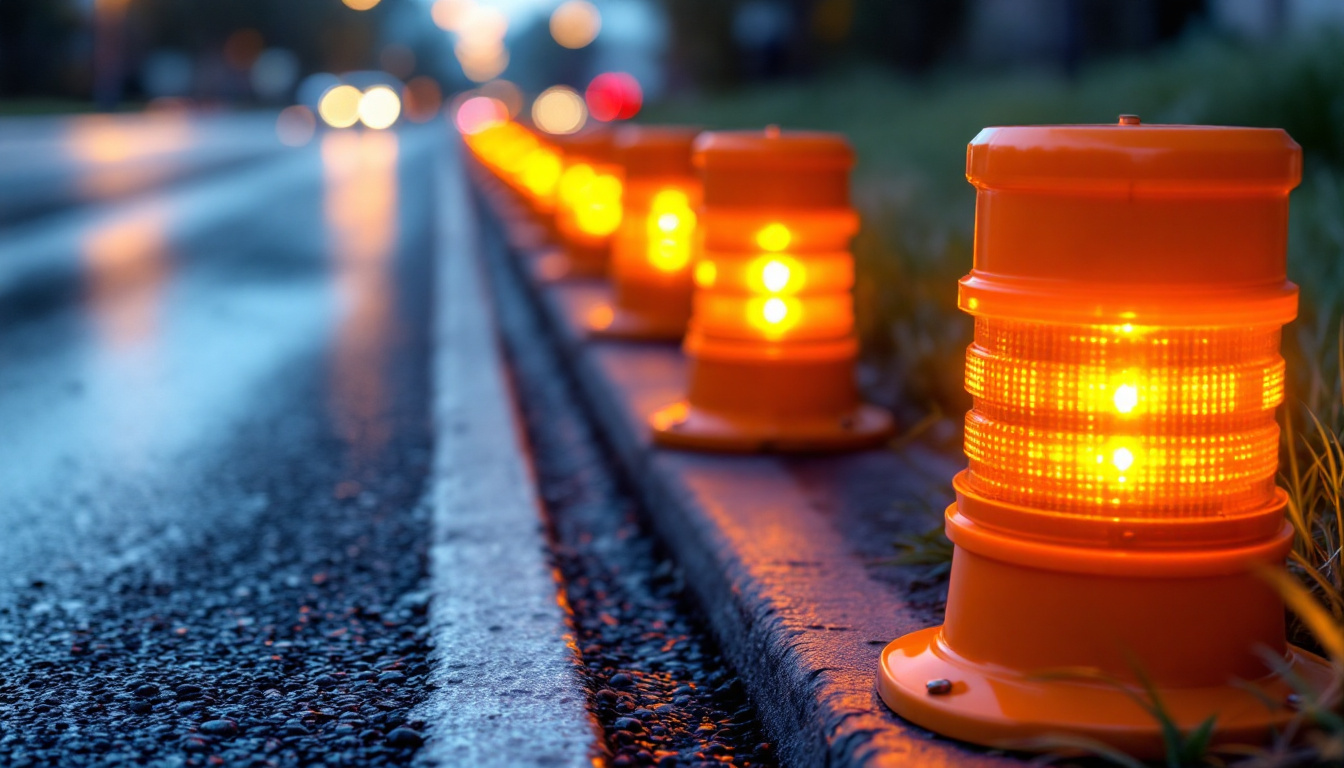
Warning lights are the cheapest item on the truck and among the most consistently misused. They get clipped onto whatever is nearest, in whatever type the yard happened to hand out, and because nothing visibly fails, the mistake persists for years.
The rules are short and worth knowing properly, because the distinction between the types is functional rather than cosmetic.
As always: the national MUTCD is a floor and your state manual and permit conditions may be more restrictive. Verify with the agency having jurisdiction.
The four types
All four are described in the same way at the top of MUTCD Section 6L.07: portable, powered, yellow, lens-directed, enclosed lights. What separates them is intensity, whether they flash, and what job they are doing.
Type A — low-intensity flashing. Used to warn road users during night-time hours that they are approaching or proceeding in a potentially hazardous area. May be mounted on channelizing devices.
Type B — high-intensity flashing. Used to warn during both daylight and night-time hours. Designed to operate 24 hours a day, and mounted on advance warning signs or on independent supports.
Type C — steady-burn. Used during night-time hours to delineate the edge of the traveled way.
Type D — 360-degree steady-burn. Same delineation role as Type C, visible from all directions.
Read that list again with the verbs in mind. Two of them warn. Two of them delineate. That is the whole distinction, and everything else follows from it.
The rule people break: flashing does not delineate
This is the misuse worth eliminating first.
The MUTCD requires that warning lights flash when placed on channelizing devices used alone or in a cluster to warn of a condition. It requires that lights placed on devices used in a series to channelize road users be steady-burn. And it states plainly that flashing warning lights are not to be used for delineation, because a series of flashers fails to identify the desired vehicle path.
The reasoning is worth internalising rather than memorising. A row of independently flashing amber lights at night does not read as a line. It reads as scattered points appearing and disappearing, and the driver's eye cannot assemble them into a path. A row of steady-burn lights reads as a line, which is exactly what a taper needs to communicate.
So: one drum sitting alone in front of a hazard gets a flasher. Twenty devices forming a taper get steady-burn. Crews that grab whichever type is in the bin get this backwards regularly, and the failure is silent — nothing malfunctions, the setup simply communicates the wrong thing at the moment it matters most.
There is one deliberate exception. A sequential flashing system on a merging taper is permitted, and it works precisely because it is not a set of independent flashers: the lights flash in order from the upstream end of the taper to the downstream end, which draws the path rather than scattering it. The MUTCD specifies that each light in the sequence flash at a rate of not less than 55 or more than 75 times per minute.
Visibility, height, and mounting
Three requirements that turn up in inspections.
Note the word maintained. This is not a purchasing specification you satisfy once. A light with a fogged lens, a dying battery, or a season of road film on it can fail the standard while still switching on, and "it lights up" is the test most yards actually apply. It is the same maintenance logic that governs sign retroreflectivity and device condition.
Mounting height. A minimum of 30 inches to the bottom of the lens.
Windshield penetration. Lights must be mounted on signs or channelizing devices in a manner that, if hit by an errant vehicle, they are not likely to penetrate the windshield. This is a real design constraint on brackets and improvised mounts, and it is the reason a light zip-tied to the top of a rigid support is a worse idea than it looks.
Spacing. The maximum spacing for warning lights should be identical to the channelizing device spacing requirements — so in practice they inherit whatever spacing your channelizing devices are running, which is itself derived from the speed limit.
Standards conformance. The manual requires warning lights to comply with the provisions of Chapter 13 of the Institute of Transportation Engineers publication Equipment and Materials Standards, which is the specification your purchasing should be citing rather than "amber barricade light."
When are lights required at all?
Less often than crews assume, and this is the second half of the confusion.
The manual's position is that lighting devices should be provided in TTC zones based on engineering judgment, and that beacons and warning lights may be used to supplement retroreflectorised signs, barriers, and channelizing devices. The word "supplement" is doing the work: lights add to retroreflectivity, they do not substitute for it. A device with poor sheeting and a bright light on top is still a poorly performing device.
The manual also identifies specific conditions where adding lights to channelizing devices makes sense — areas with frequent fog or snow, severe roadway curvature, or where visual distractions are present. That last category covers more urban work than people expect: a taper against a backdrop of shop signage and headlights is a genuinely harder visual problem than the same taper on a dark rural road.
Where lights are commonly required is by permit condition rather than by the manual. Many agencies specify lights on Type 3 barricades at a closure, or on advance warning signs for night work, and those conditions govern. Our piece on night work traffic control covers the broader set of things that change after dark.
What to actually fix this week
Three things, none of which cost much.
Sort the bins by type and label them. If Type A and Type C lights live in one bin, crews will grab whichever is on top and the flashing-versus-steady rule cannot survive. Separating them is the entire intervention.
Test against the visibility standard, not against the on-switch. Pick a clear night, set out a sample, and walk the distance. Lights that fail get replaced, not returned to the bin.
Write the rule on the truck in one line. Alone or in a cluster warning of a hazard: flashing. In a series showing the path: steady-burn. That sentence is the entire chapter for field purposes.
Because lights are low-value items, they tend to fall outside whatever inventory discipline covers drums and barricades — which is how a yard ends up unable to say how many working Type C lights it owns until the night a job needs forty. Tracking them as inventory alongside everything else is the fix, and it is the same mechanism that makes tracking devices by job site work at all. Traffic OS treats them as catalogue items like any other device; the features page covers how.
Warning lights are a small subject. They are also one of the few places where a crew can be visibly, unambiguously wrong in a way an inspector will notice from a moving vehicle, and getting them right costs nothing but sorting.
Frequently asked questions
What are the four types of warning light?+
Type A low-intensity flashing, Type B high-intensity flashing, Type C steady-burn, and Type D 360-degree steady-burn. All four are portable, powered, yellow, lens-directed, enclosed lights, covered by MUTCD Section 6L.07.
What is the difference between a flashing and a steady-burn warning light?+
Function, not brightness. Flashing lights warn of a condition. Steady-burn lights delineate a path. The MUTCD is explicit that flashing warning lights are not to be used for delineation, because a series of flashers fails to identify the desired vehicle path.
Can I put Type A lights along a taper?+
Not as a delineation treatment. Devices used in a series to channelize road users take steady-burn lights. The one exception is a sequential flashing system on a merging taper, where the lights flash in order from the upstream to the downstream end specifically to show the path.
How far do warning lights have to be visible?+
Type A, Type C, and Type D lights are to be maintained so as to be visible on a clear night from 3,000 feet. Type B lights are to be maintained so as to be visible on a sunny day, viewed without the sun directly on or behind the device, from 1,000 feet.
How high do warning lights have to be mounted?+
The MUTCD sets a minimum mounting height of 30 inches to the bottom of the lens, and requires that lights be mounted so that if hit by an errant vehicle they are not likely to penetrate the windshield.
What spacing do warning lights use?+
The maximum spacing for warning lights should be identical to the channelizing device spacing requirements — so one light per device in a taper, or matched to whatever spacing your devices are running on the tangent.