August 8, 2026 · The Key Bot
Work Zones at Highway-Rail Crossings: What Changes and Who You Have to Call
A lane closure near a grade crossing introduces a second authority, a queue you must never create, and coordination lead times most contractors underestimate. Here is what changes.
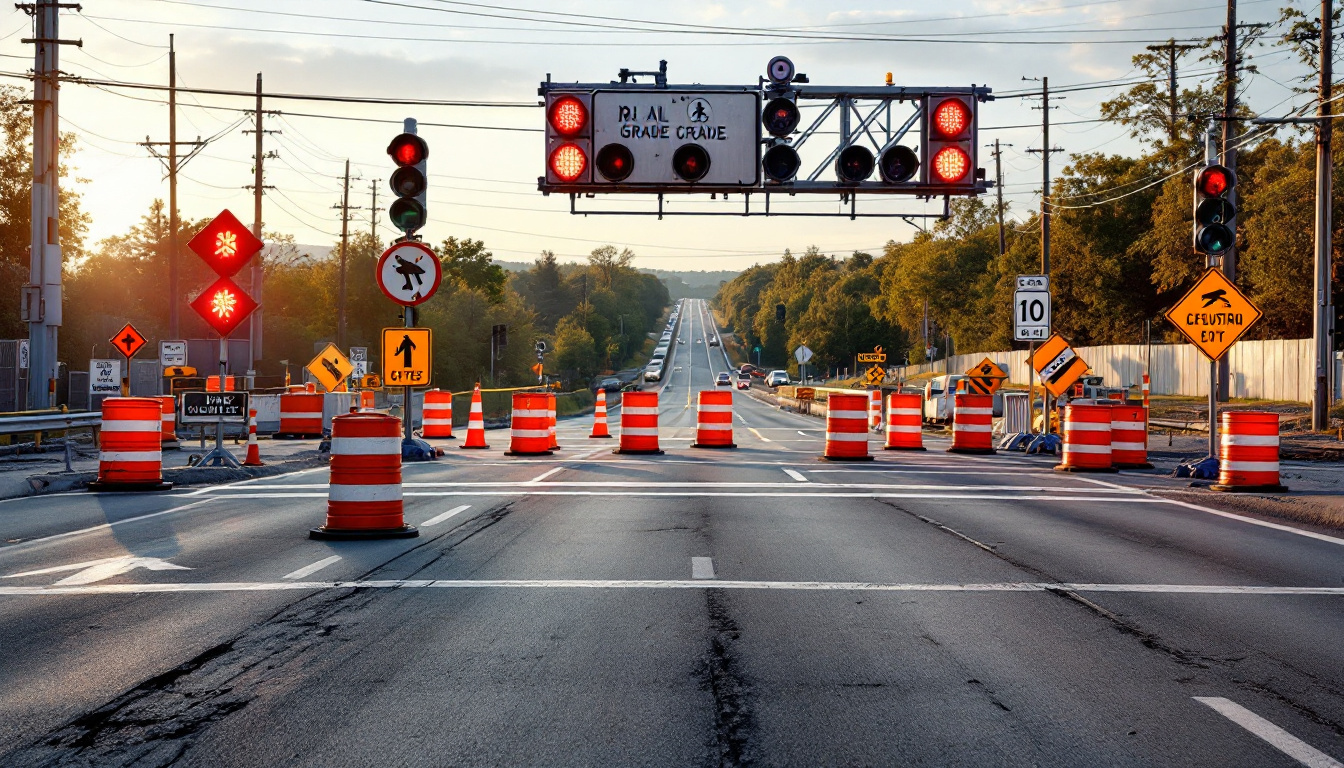
Most traffic control work has one authority: the agency owning the roadway. Put a lane closure near a highway-rail grade crossing and you acquire a second one, with its own rules, its own approval timeline, and no obligation to accommodate your schedule.
Contractors who work around rail regularly know this. Contractors who encounter it once every few years usually discover it late — typically when a permit condition or an inspector raises the crossing, and the project schedule has already been built.
The hazard that governs everything
At a grade crossing, the failure mode that matters is vehicles queued onto the tracks.
The mechanism is simple and does not require anyone to do anything unusual. Your closure narrows capacity downstream. Traffic backs up. The back of the queue reaches across the rails. A driver stops on the crossing because there is nowhere to go, and now the question of whether anyone is hurt is a question about train schedules.
Note what that means: the closure creates the hazard. The crossing was operating safely before you arrived. That is why the analysis owed here is not "does our setup comply with the crossing's device requirements" but "can our setup cause a queue over the rails, under the worst traffic conditions this closure will see."
That analysis has to consider the peak, not the average — a closure that is fine at 10 a.m. can be dangerous at 5 p.m., and the schedule you built around off-peak work has to actually hold.
The device and layout side
Highway-rail grade crossings have their own body of traffic control guidance. In the national manual, MUTCD Part 8 addresses traffic control for highway-rail grade crossings, while Part 6 covers temporary traffic control. Work near a crossing sits at the intersection of the two, and the practical consequence is that your temporary traffic control setup must not degrade the permanent crossing traffic control.
Concretely, that means confirming that your devices and signs do not obscure crossing signals, gates, crossbucks, advance warning signs, or pavement markings from any approach a driver will use; that a detour does not route traffic over a crossing that was not designed for the vehicle mix you are sending; and that a temporary alignment does not change the approach geometry to a crossing in a way nobody analyzed.
The underlying device obligation is unchanged and is enforceable by OSHA as a worker-protection matter: 29 CFR 1926.200(g)(2) states that "The design and use of all traffic control devices, including signs, signals, markings, barricades, and other devices, for protection of construction workers shall conform to Part 6 of the MUTCD (incorporated by reference, see § 1926.6)".
The coordination side, which is where schedules die
The railroad is not the roadway agency and does not work to its timeline. Depending on the railroad, the location, and the nature of the work, coordination can involve advance notification periods, a railroad representative or flagging service on site, insurance and indemnity requirements specific to the railroad, right-of-entry agreements for work within railroad property, and restrictions on equipment operating within a defined distance of the tracks.
Each of those is a schedule input and several are cost inputs. Railroad flagging in particular can be a meaningful line item, and who pays for it is a contract question that should be settled before a bid is submitted rather than after a change order is denied.
The practical guidance, stated plainly: if a project touches a crossing, identify the railroad and open the conversation during preconstruction. The lead time is the constraint. Discovering a multi-week notification requirement two days before a phase is the classic outcome, and it is entirely avoidable.
Federal and state programs govern the improvement and safety side of grade crossings, and the Federal Railroad Administration is the relevant federal agency for rail safety generally. For a contractor, however, the operative authorities are almost always the specific railroad owning the track and the roadway agency issuing your permit — which is one more instance of the general rule in how state DOT work zone requirements vary: the answer is local, and you have to ask.
What to do differently on the job
Do the queue analysis, and write it down. Estimate the worst-case queue from your closure and compare it with the distance to the crossing. If the numbers are close, the answer is not optimism — it is a different closure, different hours, or a dedicated person at the crossing.
Assign someone to the crossing when queueing is credible. Their job is singular: prevent vehicles stopping on the tracks. Not flagging the closure, not helping with setup. One task.
Brief the crew on the specific hazard. Not "there's a crossing" — the actual mechanism, including that a queue building behind them is the thing to watch for. Put it in the tailgate, per tailgate safety meetings for traffic control crews.
Confirm sight lines after setup, from a driver's seat. Devices placed correctly relative to your closure can still sit in front of a crossbuck from a particular approach. Drive every approach.
Document the coordination. Who you notified, when, what they required, and who was on site. Rail-adjacent incidents attract investigation from parties who were not at your preconstruction meeting, and contemporaneous records are the only useful answer — the same documentation discipline described in work zone inspections and agency audits.
Treat the permit conditions as binding detail. Crossing-related conditions tend to be specific and are frequently the conditions that get skimmed. Track them as records with the job, not as a PDF in an inbox — see multi-jurisdiction permit tracking.
The short version
A crossing adds a second authority, a coordination lead time, a possible cost you must price, and one hazard that dominates all the others. The single question that resolves most of it: can traffic queue from our closure back over the tracks, at the worst hour this closure will operate? Answer that honestly during planning, and everything else is logistics.
If you want permit conditions, coordination records, and field documentation living on the job record instead of in three inboxes, that is the shape of what Traffic OS does — and a demo can be run against one of your own rail-adjacent jobs.
Frequently asked questions
What is the core hazard at a work zone near a grade crossing?+
Queueing vehicles onto the tracks. A lane closure downstream of a crossing can back traffic across the rails, putting a stopped vehicle where a train will be. It is the one failure mode that turns a routine closure into a catastrophic event, and it is created by the closure rather than by the crossing.
Do we need to notify the railroad?+
Almost always, and usually earlier than contractors expect. The railroad is a separate authority from the roadway agency, and its coordination requirements, flagging services, and lead times are its own. Assume the notification is a scheduling constraint, not a formality, and confirm the requirement through the agency having jurisdiction and the railroad itself.
How far from a crossing do these considerations start?+
Further than the crossing's own device layout. The relevant distance is however far traffic can queue back from your closure, which on a congested arterial can be several hundred feet or more. Analyze the expected queue, not a fixed offset.
Can we close a lane at a crossing without a flagger?+
That depends entirely on the geometry, the queue analysis, the agency, and the railroad. What is not optional is deciding it deliberately in advance rather than discovering the queue at 7 a.m. Some agencies and railroads require a dedicated person watching the crossing whenever a closure could induce queueing over it.
Who pays for railroad flagging?+
It varies by contract and by railroad, and it can be a substantial cost. Establish it in writing before bidding — it is one of the most common sources of unpriced scope on projects near rail.