August 8, 2026 · The Key Bot
Yard Organization for Traffic Control Companies
The yard is where load-out speed, device condition, and inventory accuracy are decided. Here is how to lay one out so morning load-out stops being the bottleneck.
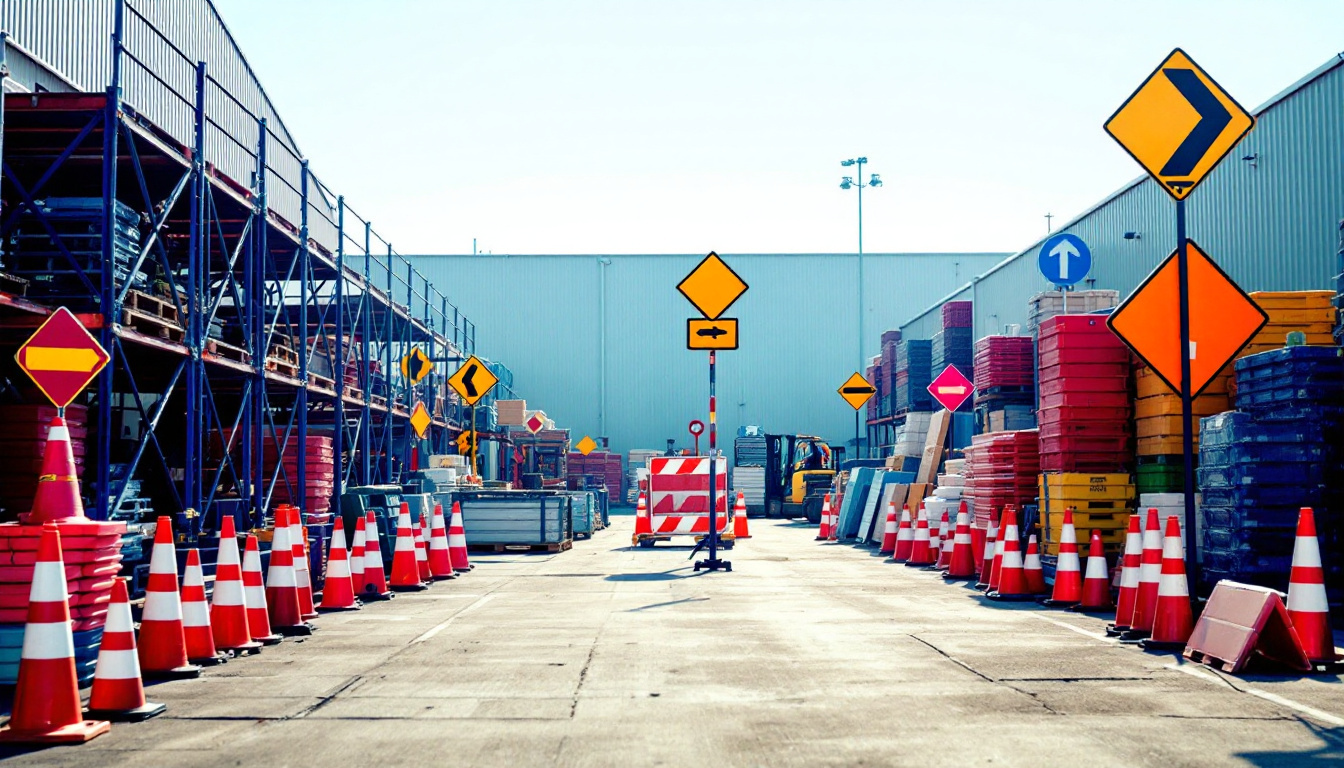
Ask where a traffic control company loses time and money, and most owners point at jobs. Watch a yard at 5 a.m. and you will usually find a different answer.
Load-out is the choke point of the whole operation. Every crew passes through it, at the same time, in the dark, under pressure to be on site before traffic builds. A yard that adds fifteen minutes per crew to that process is adding an hour a day across four crews — and doing it at the most expensive moment, when everyone is on the clock and the first job's window is closing.
Yard layout is also where device condition and inventory accuracy are actually decided, because both depend on things that either happen during load-out and return or do not happen at all.
Organize by turnover, not by category
The natural instinct is to group by type: cones here, barricades there, signs over there. It looks orderly and it is usually wrong, because it treats a device used every day and a device used twice a season as equals competing for the same real estate.
The better organizing principle is movement frequency. Whatever goes out most often gets the shortest, straightest path to the loading area. Specialty items — the equipment that appears on one job in twenty — can be further back, because the walk happens rarely.
Two supporting rules:
Group by kit where kits are real. If a standard lane closure always takes the same core set, staging that set together beats collecting it from four locations. Crews assemble the same combination hundreds of times a year; the yard should reflect that rather than making them rebuild the logic each morning.
Make counting possible from where things sit. Racks that hold a known quantity, marked positions, painted floor squares — anything that lets someone establish a count by looking rather than by physically tallying. This one change is what makes return counts fast enough to actually happen.
Stage the night before
This is the highest-return change available to most companies and it costs nothing.
At 5 a.m., in the dark, crews are searching, counting, and loading simultaneously while three other crews do the same in the same space. At 3 p.m. the previous day, the yard is empty, lit, and unhurried.
Staging means pulling each crew's load and setting it in a marked position — a bay, a painted square, a trailer — so the morning task is loading rather than gathering. Where the schedule is known the afternoon before, most of the load-out work can be done then. Where the schedule shifts overnight, staging the predictable portion still removes most of the delay.
The prerequisite is knowing what each crew needs before the morning, which means the schedule and the equipment requirement have to exist somewhere other than in the dispatcher's head. That connection between the day's dispatch and the yard is exactly the gap described in the daily dispatch routine.
Build the return process, not just the send process
Most yards are designed for equipment leaving and improvised for equipment coming back. That asymmetry causes the two most persistent inventory problems in the industry.
Return counting. If devices are counted while being unloaded, inventory stays approximately true. If they are unloaded now and counted later, later never arrives. Counting at return is fast because the devices are already in hand and someone is already touching every one of them.
Condition triage. Damaged devices must leave the normal flow immediately, into a physically distinct quarantine area. Not a corner, not a policy — a marked area a tired crew cannot mistake for the good rack. Sheeting degradation in particular passes casual inspection while failing its actual purpose at night, which is why the device condition standards need a physical enforcement mechanism rather than an intention.
Quarantine also feeds the replacement rate. Devices retired for wear, counted over a season, produce the annual replacement figure described in equipment fleet replacement planning — and that figure only exists if retirement is a recorded event rather than a barricade quietly disappearing behind a container.
Segregate what has to be segregated
If your fleet contains both older devices and current ones, the yard is where the distinction is maintained or lost. Under the AASHTO/FHWA joint implementation agreement, temporary work zone devices manufactured after December 31, 2019 must have been successfully tested to the 2016 edition of MASH, while devices manufactured on or before that date and tested to earlier criteria may run out their normal service lives. A mixed fleet therefore needs a deployment rule, and a deployment rule that depends on crews remembering which pile is which at 5 a.m. is not a rule.
Physical separation — different rows, different colour marking on the rack, different storage areas — is the only version of this that survives a rushed morning. The full picture is in MASH compliance for work zone devices.
The same principle applies to devices assigned to a specific long-running job, to devices awaiting repair, and to devices belonging to a customer rather than to you. Anything with a rule attached needs a place, or the rule is decorative.
Safety inside your own yard
Yards have forklifts, trucks reversing, and people on foot in the dark, which is the same hazard profile that makes work zones dangerous. Given that the majority of investigated work zone worker fatalities involve construction vehicles and equipment operating inside the work zone, it is worth noticing that a busy yard at 5 a.m. reproduces those conditions without the discipline of a traffic control plan.
The countermeasures are the same ones described in internal traffic control plans, applied to your own property: a one-way circulation pattern for trucks, a marked walking route, adequate lighting at the loading area, and a rule about backing. None of it is expensive. All of it is skipped in yards precisely because it is home ground.
Two yards and the point of no return
A second yard is a geography decision — it makes sense when drive time to a recurring cluster of work consistently exceeds what the second location would cost. What owners underestimate is the operational discontinuity that comes with it.
With one yard, everyone knows what you own because everyone can see it. With two, nobody does. Equipment migrates between locations on trucks, counts drift independently, and the question "do we have enough drums for Tuesday" becomes genuinely unanswerable. The informal system that worked for years stops working the week the second yard opens, and companies typically spend a season discovering this.
If a second yard is coming, put device tracking in place before it opens rather than after — the discipline in tracking devices by job site is what makes multi-location inventory survivable, and it is much easier to establish while you can still verify it by walking outside.
A short yard checklist
Marked staging positions per crew. High-turnover devices nearest the load-out path. Quarantine area for damaged stock, physically unmistakable. Return counting as part of unloading, not a separate task. Racks that make counts visible. Segregation for anything with a compliance or assignment rule. One-way truck circulation and a marked walking route. Lighting at the load-out area good enough to read a ticket by.
Every item on that list is cheap. Collectively they decide whether your crews leave at 5:15 or 5:45, and whether you know what you own.
If you want the yard, the schedule, and the device records to agree with each other, that is what Traffic OS is built around — and a demo can be run against your own yard rather than a sample dataset.
Frequently asked questions
What is the single biggest yard improvement?+
Staging load-outs the night before. Almost every morning delay in a traffic control yard comes from crews searching and counting at 5 a.m. Moving that work to the previous afternoon, when the yard is quiet and lit, removes the bottleneck without any capital spending.
How should devices be arranged?+
By how often they move, not by category. High-turnover items belong closest to the loading area with the shortest path; specialty and seasonal items can be further back. Most yards are organized by type because that seems tidy, which puts rarely used equipment in prime space.
Do we need a separate area for damaged devices?+
Yes, and it needs to be physically obvious. Without a quarantine area, damaged devices get reloaded, because at 5 a.m. a bent barricade in the normal rack looks like a barricade.
How do we keep inventory counts accurate?+
Count at return, not periodically. A return count while devices are being unloaded is fast and matches reality; a quarterly full count is slow, disruptive, and stale within a week.
When does a second yard make sense?+
When drive time from the single yard to a cluster of recurring work consistently costs more than the second yard would. It is a geography question, not a size question — and it is also the point where informal inventory tracking stops working entirely.