August 8, 2026 · The Key Bot
Short-Duration and Mobile Work Zones Explained
The federal framework treats a three-week closure and a twenty-minute operation as different problems. Here is how work duration categories are structured, why fewer devices can be the safer choice, and what that means for pricing and crew instruction.
One of the most useful ideas in temporary traffic control is also one of the most commonly missed by estimators: the requirements scale with how long the setup will exist. A closure that will stand for three weeks and a fifteen-minute operation on the same stretch of road are not the same problem, and the framework does not treat them as one.
Missing this costs money in both directions. Price a short-duration job as though it were a stationary closure and you lose the bid. Execute a stationary closure with short-duration methods and you have a safety problem and a compliance finding.
The categories
The Manual on Uniform Traffic Control Devices — the national standard for traffic control devices on roads open to public travel, currently the 11th Edition issued in December 2023 — organizes temporary traffic control work into duration categories running roughly as follows:
Long-term stationary. Work occupying a location for an extended period, typically measured in days or weeks. Attracts the most substantial treatment — durable devices, often physical separation, formal plans.
Intermediate-term stationary. Shorter than long-term but still occupying a location beyond a single work period, including overnight.
Short-term stationary. Daytime work occupying a location for a portion of a work period.
Short-duration. Work occupying a location very briefly, on the order of minutes rather than hours.
Mobile. Work that moves intermittently or continuously along the road.
The specific time thresholds separating these are stated in the manual, and states may modify them in their own adopted manual or supplement — see how state DOT work zone requirements vary. Work from the current governing document for your jurisdiction rather than from any summary, including this one.
Why fewer devices can be the safer answer
The counterintuitive part, and the part that crews sometimes read as the office cutting corners: on a very short operation, a lighter treatment can be the safer choice.
The reasoning is exposure. Placing and removing devices puts workers on foot in the traveled way, and that placement-and-removal exposure is a real hazard rather than a bookkeeping abstraction. If an operation will last fifteen minutes, an elaborate device array can require more worker-minutes in traffic to install and remove than the operation itself involves — meaning the devices increase total exposure rather than reducing it.
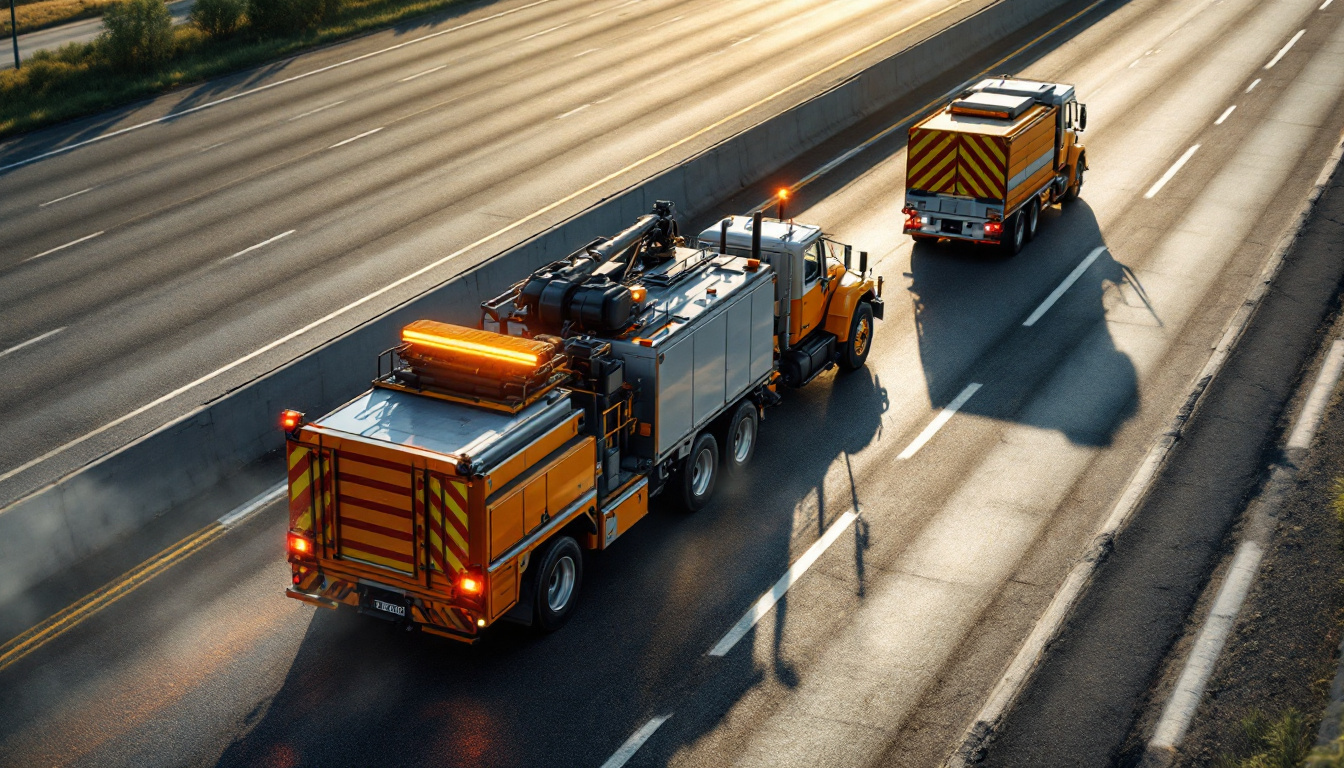
This is why short-duration and mobile work leans on vehicle-based treatment: high-visibility work vehicles, rotating or flashing warning lights, and where appropriate a shadow or trailing vehicle, sometimes equipped with an attenuator. The protection travels with the crew rather than being installed around them. See truck-mounted attenuators explained.
The trade is genuine, and it has limits. Higher speeds, poor sight distance, high volumes, and any situation where workers are outside the vehicle for meaningful periods push back toward a fuller treatment. The judgment is site-specific, which is exactly why the standards frame these as categories with engineering judgment rather than as a lookup table.
What this means for crews
The practical instruction set for short-duration work differs from stationary work in ways worth stating explicitly in a briefing, because the habits from stationary work do not all transfer.
Position the vehicle first. On short-duration work the vehicle is a primary protective element, not a place to park. Where it sits relative to the crew and to approaching traffic is the main decision.
Keep the operation short. The category's safety logic depends on the duration assumption. A "short-duration" operation that becomes an hour has quietly become a different category, and the treatment no longer matches. Crews need to know the threshold at which they stop and set up properly instead.
Do not leave devices behind. Whatever was placed comes back, every time. Devices left in place after an operation ends are a hazard and a liability, and they are also inventory you paid for.
Report intrusions. Short-duration operations produce a disproportionate share of near-misses precisely because the treatment is lighter, and almost none of them get recorded. See work zone intrusion prevention and response.
The exposure argument also cuts against a common instinct — that doing the work in several short visits is safer than one longer closure. Sometimes it is. But four short operations mean four setups and four takedowns, and the total exposure may exceed a single properly protected closure. That is a real planning question, not a rhetorical one.
Where the work must advance continuously along a corridor rather than stop at points, the category shifts again and so does the treatment. Our post on rolling lane closures and moving operations covers the shadow-vehicle and advance-warning logic that applies once the zone itself is in motion.
Pricing these correctly
Companies that price traffic control by device count systematically lose money on short-duration and mobile work, because the device count is small and the cost is not.
The actual cost drivers:
Mobilization and travel. Often the largest component. A fifteen-minute operation forty minutes away is a two-hour crew commitment minimum.
Vehicle. The shadow or work-protection vehicle is expensive equipment doing a job that no line item captures if you are billing cones.
Crew minimum. You are not sending one person, and you are not billing fifteen minutes.
Frequency and scheduling drag. Recurring short operations under a term contract consume scheduling capacity out of proportion to their revenue — they fragment a crew's day. See crew utilization metrics.
The right structure is usually a minimum charge plus a mobilization component, with device rental as a minor line rather than the basis. See bidding traffic control jobs for the general approach and device rental rates for the catalog side.
The documentation problem these create
Short-duration and mobile operations are the hardest work to document, for an obvious reason: nobody wants to spend ten minutes on paperwork for a fifteen-minute job, and a paper process guarantees the record is thinner than the work.
That matters more than it looks. These operations are frequently performed under recurring contracts where the annual volume is large even though each instance is small, and disputes about whether work was performed on a given day are correspondingly common. A crew that performs forty short operations a month and documents six has a billing problem waiting.
The only thing that fixes it is capture that is genuinely faster than not capturing — a signed record completed on a phone at the site, with the job, location, and time already populated, taking under a minute. That is the specific reason Traffic OS puts GPS-stamped signed tickets in the field app rather than in an office workflow, on flat-tier pricing rather than per user. If your short-duration work is under-documented and under-billed, book a walkthrough and bring a month of it.
Frequently asked questions
What are the work duration categories?+
The federal framework distinguishes long-term stationary work, intermediate-term stationary work, short-term stationary work, short-duration work, and mobile operations. The categories run from work occupying a location for weeks down to operations that move continuously or occupy a spot only briefly, and device, protection, and plan expectations scale accordingly. The exact definitions and time thresholds are set out in the governing manual, which is what you should work from rather than a summary.
Why do short-duration operations use fewer devices?+
Because the time spent placing and removing devices is itself exposure, and on a very short operation that exposure can exceed the risk the devices would mitigate. That is a deliberate engineering trade recognized in the standards, not a shortcut. It is also why substituting high-visibility vehicles and warning lights for an elaborate device array can be the correct choice on a fifteen-minute job.
Does a short-duration operation still need a traffic control plan?+
It depends entirely on the jurisdiction and the contract. Many agencies allow reference to a standard drawing rather than a custom plan for routine short operations, and some require nothing formal at all for certain maintenance activities. Confirm with the authority having jurisdiction rather than assuming, because the answer differs across the state line and sometimes across the county line.
What makes mobile operations different from short-duration work?+
Mobile operations move more or less continuously — sweeping, striping, pothole patching, utility locating, mowing. The work zone travels with the work, which means the protection has to be vehicle-based rather than device-based, and the geometry problem is about closing speed on a moving obstruction rather than about a fixed taper.
How should short-duration work be priced?+
By exposure and mobilization rather than by device count. A fifteen-minute operation with a two-person crew and a shadow vehicle has a small device bill and a real cost, and companies that price these by the cone lose money on every one. Travel, setup, takedown, and the vehicle are the cost drivers.