August 23, 2026 · The Key Bot
Traffic Control Plans for Bridge and Structure Work
Why bridge and structure jobs break the normal traffic control playbook — no shoulder to borrow, barrier instead of cones, staged decks, overhead work over live lanes — and what that changes in the plan and in the field.
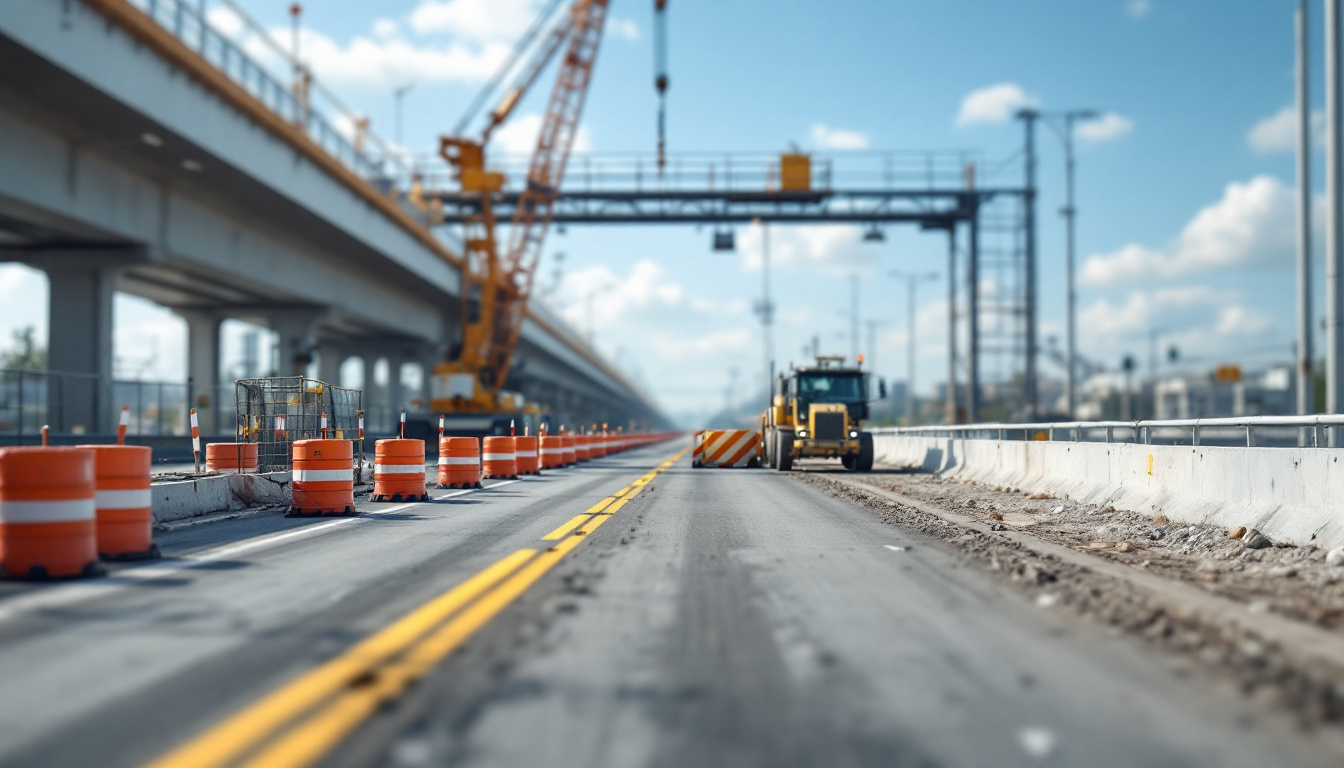
Bridge and structure work breaks most of the assumptions a traffic control plan normally rests on. There is no shoulder to borrow, no room to run a taper, and no recovery area for a vehicle that leaves the travel lane. Every one of those changes what the plan has to do, and most of the changes push cost and complexity onto the approach roadway rather than the structure itself.
The geometry problem drives everything
Start with the taper. MUTCD Part 6 sets merging taper length as a function of the offset width and the approaching speed — at 45 mph or above the length scales with speed directly, and below that it scales with the square of the speed divided by a constant, per the taper criteria in Part 6 of the MUTCD 11th Edition. At highway speeds with a full lane offset, the resulting length runs several hundred feet.
A typical overpass does not have several hundred feet of usable length, and it has no shoulder to develop the taper into. So the transition area migrates onto the approach roadway. Traffic gets shifted or merged before it reaches the structure and holds that alignment across the deck. That single decision cascades:
- The advance warning area moves further upstream, sometimes past an interchange or a cross street, which pulls other intersections into the plan.
- The buffer space now sits on the approach, not on the deck. MUTCD 6B.06 describes the activity area as the work space, the traffic space, and the buffer space, and is explicit that neither work activity nor storage of equipment, vehicles, or material should occur within a buffer space — which means the buffer is not somewhere you can stage steel.
- Driveways, ramps, and turning movements inside the shifted section have to be handled, because you have taken away the room they used.
MUTCD 6B.03 divides the temporary traffic control zone into advance warning, transition, activity, and termination areas. On a structure job the transition and the activity area frequently sit on different pieces of roadway with different owners, different speeds, and sometimes different jurisdictions. That is the core difficulty, and it is why these plans take longer to draw — see how traffic control plans get drawn.
Width, weight, and posting
Two constraints that rarely bind on open roadway work bind here.
Width. Deck width is fixed. Once you take a work space out of it, the remaining traffic space may be narrower than the standard lane, which affects allowable speed, whether oversize loads can pass, and whether trucks can maintain the shifted alignment through a curve on the structure.
Weight and load posting. Equipment on a deck is load on a structure, and staged materials are load that does not move. Whether a particular crane, boom truck, or concrete truck can be positioned where the contractor wants it is a structural question, not a traffic control question, and it can change the whole staging concept late. Load posting can also restrict which vehicles use the remaining lanes, which pushes trucks onto a detour and changes traffic patterns beyond the site.
The condition of the national bridge inventory is why this work keeps coming. FHWA's National Bridge Inventory reported 621,581 bridges nationwide in 2023, with 42,404 of them, or 6.8 percent, in poor condition, per the FHWA bridge condition data. That is a large, sustained rehabilitation pipeline, and the work is mostly staged rather than full-closure because these structures carry traffic that has nowhere else to go.
Barrier, not cones
On open roadway, a channelizing device does its job by telling drivers where the work space is. Errant vehicles have a shoulder, a clear zone, or at least a ditch.
On a structure there is none of that. An errant vehicle that leaves the traffic space enters the work space, or the parapet, or in the worst case goes over the edge. That is the condition where the plan needs a device that physically redirects.
Federal regulation is direct about the trigger. Under 23 CFR 630.1108, positive protection devices are indicated where workers have no means of escape from motorized traffic intruding into the work space unless an engineering study determines otherwise, and the section identifies tunnels and bridges, long-duration projects of two weeks or more, high-speed conditions of 45 mph and above, workers positioned close to travel lanes, and roadside hazards such as drop-offs among the conditions to consider. A bridge rehabilitation frequently checks four or five of those simultaneously.
That brings in a set of considerations that do not exist with drums:
- Deflection. Temporary concrete barrier moves on impact unless it is anchored, and the deflection distance has to fit between the traffic face and the work space. On a narrow deck it often does not, which drives anchoring — and anchoring into a deck you are rehabilitating is its own conversation with the structural engineer.
- Crashworthiness. Devices used on the National Highway System are evaluated under current crashworthiness criteria, and the barrier, its end treatment, and its anchoring detail all matter. See MASH compliance for work zone devices.
- End treatment. A blunt barrier end facing traffic is a hazard in itself. The terminal or attenuator at the upstream end is part of the plan, not an accessory — see truck-mounted attenuators explained for the mobile equivalent.
Positive protection in work zones explained covers the decision framework in more detail.
Staged decks and crossovers
Most structure rehabilitation is phased, because the structure has to keep carrying traffic. Half the deck at a time, or a third at a time, with traffic on the remainder.
Each phase is effectively a separate traffic control plan with its own transition, its own barrier line, and its own approach geometry. The transitions between phases are the highest-risk moments on the job: traffic is moved to a new alignment, often at night, often over a short window, and the setup that exists at 4 a.m. must be complete and correct because there is no partial state that is safe. Phased construction traffic control plans covers sequencing these.
Crossovers add another layer. Where a divided facility runs both directions on one structure during a phase, you now have opposing traffic separated by barrier, head-on exposure, and a median crossover at each end that has its own geometry, sight distance, and speed requirements. The crossover approach usually needs its own advance warning sequence and often its own reduced speed treatment.
Overhead work and falling objects
Structure work frequently means working above live traffic — deck overhangs, superstructure repair, painting, utility hangers, demolition of an adjacent span.
The exposure runs both directions. Traffic below is exposed to dropped tools and debris. Workers above are exposed to being struck by vehicles on the deck. OSHA's steel erection standard requires that materials, equipment, and tools not in use while aloft be secured against accidental displacement, and that the controlling contractor bar other construction processes below steel erection unless overhead protection is provided for employees below, per 29 CFR 1926.759. On a bridge over an open lane, "below" includes the traveling public, which is generally why containment, shielding, or a full closure of the lanes underneath ends up in the plan.
Practically, that means the traffic control plan for a structure often has two zones that must be coordinated: the setup on the structure and a separate setup on the facility beneath it. Those may be different roadways with different owners and different closure windows, and the plan has to reconcile them.
Utilities on the structure complicate it further. Water, gas, fiber, and electric commonly ride bridges because a bridge is the only crossing. Relocating or protecting them adds work zones, adds parties, and adds schedule risk in a place with no room to absorb any of it.
Pedestrians, where there is no alternate route
This is the constraint most likely to be handled badly. On an open roadway you can generally detour a pedestrian to the opposite side or a parallel street. On a bridge there is frequently no parallel anything. Detouring a pedestrian off a structure can mean a mile or more, and people will not walk it — they will walk in the closed lane, or on the barrier side, or across the deck through the work.
The plan has to address continuity directly: a protected temporary walkway maintained through each phase, with an accessible surface and a defined separation from both traffic and the work space, or a genuinely usable alternate. Assuming pedestrians will comply with an unreasonable detour is not a plan. Pedestrian accommodation in work zones covers the requirements and the common failures.
Bicycle traffic raises the same issue with more speed and less tolerance for a narrow shy distance.
Closure windows and capacity
Bridges are capacity pinch points. Removing a lane from a four-lane open section costs capacity; removing a lane from a four-lane bridge with no parallel route costs the corridor. That is why so much structure work runs at night and on weekends, and why closure windows get negotiated hard.
The corollary for a traffic control contractor is that structure work is disproportionately night work, with the visibility, fatigue, staffing, and lighting consequences that come with it — see night work traffic control: what changes. It also means short, hard windows: set up after the window opens, tear down before it closes, with liquidated exposure if you do not. Setup and teardown time becomes a scheduling input, not an afterthought.
Inspection access is the last piece. Structural inspection has to happen during and after the work, sometimes with under-bridge inspection units occupying a lane on the deck. Those are planned traffic control events even though they are not construction, and they get forgotten in early staging.
The federal layer
If the project receives federal-aid funding, 23 CFR 630 Subpart J applies. Under 23 CFR 630.1012, significant projects require a transportation management plan consisting of a temporary traffic control plan plus transportation operations and public information and outreach components; non-significant projects may have a TMP that is only a TTC plan. Plans and specifications must include appropriate pay item provisions for implementing the TMP.
And the classification is not always discretionary. Under 23 CFR 630.1010, all Interstate system projects within the boundaries of a designated Transportation Management Area that require intermittent or continuous lane closures for three or more consecutive days are considered significant projects. A bridge rehabilitation on an urban Interstate almost always meets that description, which means the TMP is fuller, the public information component is real, and the operations component may bring in detour routes, incident management, and corridor coordination.
Requirements vary by state and by owner agency. Confirm what applies with the authority having jurisdiction before you assume any of the above governs a specific job, and route the submittal through the process that agency actually uses — see submitting a traffic control plan for approval.
What this means for the crew and the office
Two practical consequences.
In the field, the margin for improvisation is smaller than anywhere else you work. If the plan does not fit — the barrier line will not close, the taper does not have room, the walkway pinches below usable width — that is an escalation, not a field adjustment. Field changes to an approved traffic control plan covers the process, and on a structure it is worth following exactly.
In the office, structure work is phase-heavy, night-heavy, and equipment-heavy, with barrier and attenuators tied up for weeks at a time. That is a scheduling and inventory problem as much as a traffic control problem: which barrier is on which phase, which attenuator is committed through which window, and what comes off the job when a phase closes. Traffic OS tracks equipment by job and by phase and carries the recurring rental side, which is mostly useful here because a barrier run committed for six weeks is capacity you cannot accidentally promise twice.
Frequently asked questions
Why can't a normal taper be used on a bridge?+
Because the taper length required by the posted speed usually will not fit on the deck, and there is no shoulder to develop it into. The MUTCD scales merging taper length off the offset width and the approaching speed, and at highway speeds that length runs well past a typical structure. The practical answer is to land the transition on the approach roadway so traffic is already in its final alignment before it reaches the deck.
Why barrier instead of drums on a structure?+
A drum tells a driver where not to go. On a bridge there is often nowhere for an errant vehicle to go except into the work space or over the side, so the plan needs a device that redirects rather than one that delineates. Federal regulation identifies tunnels and bridges among the conditions where positive protection devices should be considered, alongside high speeds and long duration.
Does a bridge job on the Interstate automatically get treated as a significant project?+
If it is on the Interstate system, inside the boundaries of a designated Transportation Management Area, and requires intermittent or continuous lane closures for three or more consecutive days, then yes — federal regulation classifies it as significant. That drives a fuller transportation management plan rather than a traffic control plan alone. States can request an exception from FHWA in limited circumstances.
How do pedestrians get across a bridge during construction?+
That is the hardest question on a lot of structure jobs, because a bridge frequently has no parallel alternate route. Detouring a pedestrian off a bridge can mean a detour of a mile or more, which people will not take. The plan has to address it explicitly rather than assume it away, and the answer is often a protected temporary walkway maintained through the staging rather than a closure.
Why is so much bridge work done at night or on weekends?+
Because a structure is usually a capacity pinch point with no parallel relief. Taking a lane during a peak period on a bridge produces queues that are worse than the same closure on an open roadway section. Shifting the closure window to nights and weekends is often the only way to keep the corridor functioning, which is why it drives the schedule so heavily.
What is the field crew's role when the plan does not fit the structure?+
Stop and escalate — do not improvise a fix on a bridge. Field modifications to an approved plan run through whoever has authority for that project, and the constraints that make structure work difficult are exactly the constraints that make an ad hoc adjustment dangerous. Document the conflict, call it in, and wait for direction.