October 2, 2026 · The Key Bot
Emergency Vehicle Access Through Work Zones: What the Plan and the Crew Need to Cover
A lane closure or road closure changes how fire, ambulance and police reach a call. What the MUTCD says about coordinating with emergency services, what a traffic control plan should address, and how crews and flaggers should respond when an emergency vehicle arrives.
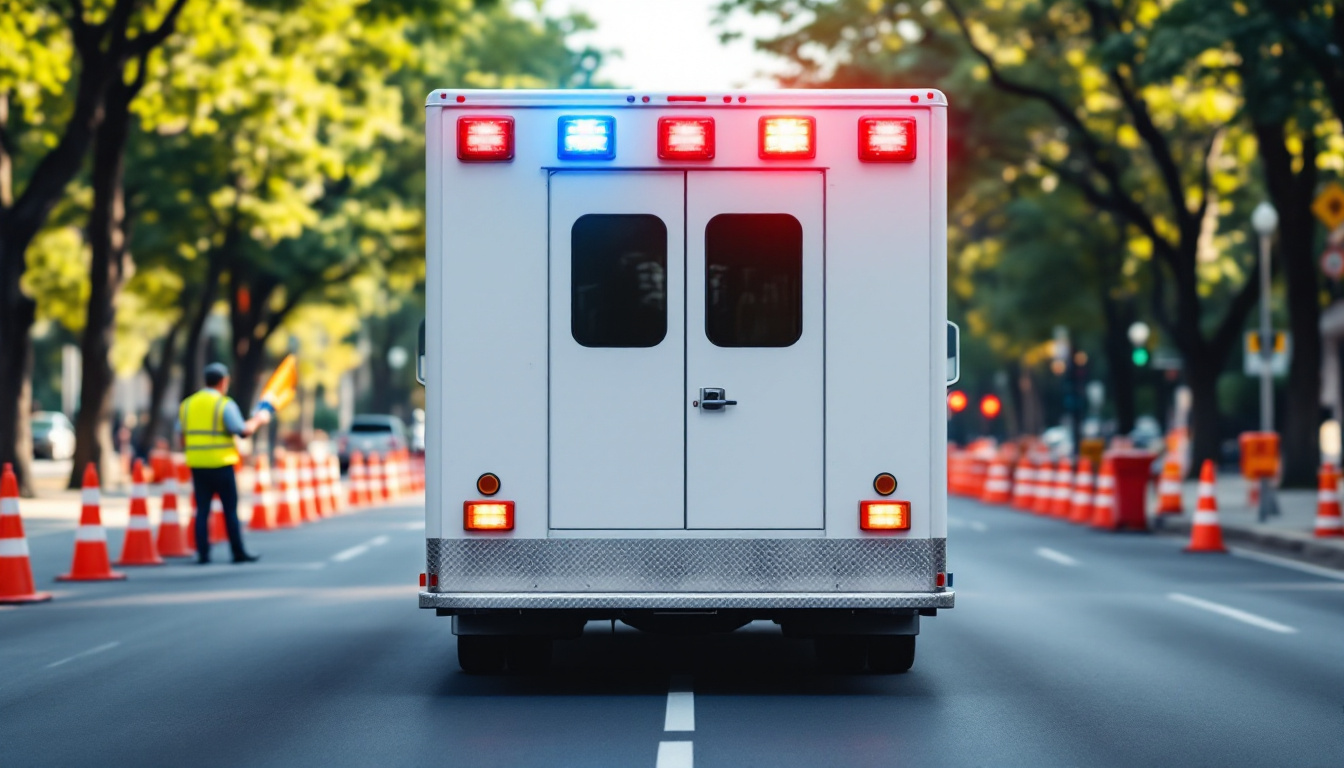
Every traffic control plan answers the question of how ordinary traffic gets past the work. A good one also answers a second question: what happens when an ambulance needs to get through.
It is easy to leave out. The plan reviewer is looking at tapers and sign spacing. The crew is thinking about the paving train. Then a fire engine arrives at a one-lane flagging operation with a queue in each direction, and three people have to invent a procedure in fifteen seconds.
This guide covers what the national manual says about emergency services, what a plan should address, and what crews and flaggers should be ready to do. Local practice varies a great deal. Fire departments, EMS providers and agencies each have their own expectations, and the permit and the agency having jurisdiction decide what is required on a given job.
What the manual says
The references are spread through Part 6 of the MUTCD 11th Edition. All are guidance or options, not mandates, in the national manual.
Assess their needs. Among the fundamental principles in Section 6A.02, under maintaining good public relations: the needs of emergency service providers (law enforcement, fire, and medical) should be assessed and appropriate coordination and accommodations made.
Coordinate early. The same section says early coordination with officials having jurisdiction over the affected cross streets and providing emergency services should occur if significant impacts to roadway operations are anticipated. Section 6N.16, on interchanges, repeats the point for ramp closures: early coordination should occur before ramp closings.
Consider staging space. Section 6B.06 gives an option for high-volume, highly congested facilities: a vehicle storage or staging space may be provided for incident response and emergency vehicles, such as tow trucks and fire apparatus, so they can respond quickly to road user incidents.
Devices that can be crossed. Section 6K.11 requires the base of a temporary lane separator to have sloping sides in order to facilitate crossover by emergency vehicles.
Have a plan for the unplanned. Section 6B.01 says a plan should be developed for unplanned and emergency situations where practicable, and Chapter 6O covers traffic control at incident scenes. See temporary traffic control for incident and emergency scenes.
For federally funded projects, agency-level planning for work zone impacts falls under the Work Zone Safety and Mobility Rule in 23 CFR Part 630, Subpart J. FHWA's traffic incident management program covers how responders and transportation agencies work together at incidents.
None of that tells you what your city's fire marshal expects. It does establish that emergency access is part of the design, not an afterthought.
Three different problems
"Emergency access" covers three situations, and each needs its own answer.
Getting past the work zone
A responder is traveling along the road to a call somewhere else. The work zone is in the way.
On a multi-lane closure with an open lane, the vehicle uses the open lane, and the concern is the queue. A congested single lane with barrier on one side and drums on the other gives drivers nowhere to pull over. On long closures, designers sometimes provide gaps or wider sections for that reason.
On a one-lane, two-way flagging operation, the emergency vehicle may arrive at the back of a stopped queue, or at the front on the wrong side of the cycle. This is the case crews must rehearse. See below.
Getting to an address inside the closure
A house, a business or a job site within the closed section needs a response. If the road is fully closed, the responder has to know which end to enter from and whether the route inside is passable. An open trench across the full width cuts the closure into two halves, each reachable from one end only. Dispatch centers need that information in advance; a crew member at the barricade cannot supply it in time.
This is the strongest reason for early notice on full closures. See road closure vs lane closure permits and maintaining driveway and business access in work zones.
An emergency in the work zone itself
A crash in the taper, a struck worker, a vehicle in an excavation. Now the work zone is the scene. Responders need to reach it, park and work, and your setup needs to keep protecting everyone while they do. See work zone intrusion prevention and response.
What the plan should address
For a plan preparer or a traffic control company reviewing a plan before building it, a short set of questions:
- Has anyone told the emergency services? Who is required to give notice, how far ahead, and to whom. This often lives in the plan's general notes or the permit conditions. See traffic control plan general notes explained.
- Is there a fire station, hospital or police station on or near the closed section? A closure in front of a station entrance needs specific treatment and a direct conversation with that station.
- Can fire apparatus use the detour? Width, turning radius, weight limits, low structures. A detour that works for cars may not work for a ladder truck. See detour route planning and signing.
- How does a responder reach addresses within the closure? From which end, and is the route kept clear.
- Are hydrants and building connections kept accessible? Stockpiles, parked equipment and barrier should not block them. Ask the local fire authority what clearance it expects.
- Is there a way through the closed lane if needed? If the intent is that responders may use the closed lane, it has to be kept free of obstructions for its whole length, and the contractor has to agree.
- What is the flagging procedure for an emergency vehicle? Written down, briefed, with radio wording.
- Who is the 24-hour contact? A name and number the agency and dispatch center can call.
Signals deserve a mention. Where a temporary signal or a portable signal controls a one-lane section, a responder may face a long red with no flagger to override it. Ask how that is handled before the system goes in. See portable traffic signals in work zones.
What the crew should be ready to do
In a one-lane, two-way flagging operation
The principle is simple and the execution needs practice. When an emergency vehicle approaches, the lane has to be cleared in its direction as quickly as it safely can be.
A common procedure, which you should adapt to your own operation and confirm against the plan:
- The flagger who sees or hears it calls it on the radio immediately, with direction: "emergency vehicle northbound."
- The flagger at the other end stops releasing traffic and holds.
- Vehicles already in the one-lane section are allowed to clear. They cannot reverse.
- The emergency vehicle is released as soon as the section is clear, ahead of the waiting queue where it can get past it.
- Both flaggers confirm on the radio when it is through before normal alternation resumes.
- The equipment operator in the work space is told, so nothing swings or backs into the lane.
Two things make this work. The radio wording is agreed before the shift, and there is one fixed phrase. And the flaggers know they are not to wave an emergency vehicle into a section that still has opposing traffic in it. A responder forced to stop for ten seconds is delayed. A head-on collision in the one-lane section closes the road.
Flaggers also need to know the normal signals well enough that an unusual situation does not scramble them. See how a flagger tells traffic to proceed and one-lane, two-way traffic control methods, which also explains a one-lane, two-way traffic taper. Mixed-language crews should rehearse the radio phrase specifically; see training Spanish-speaking traffic control crews.
Pilot car operations add a step: the pilot driver needs to hear the call too, and the procedure should say whether the emergency vehicle follows the pilot, passes it, or waits.
At a full closure
Someone at the barricade should know whether responders can get through, from which side, and how far. If the answer changes during the day because a trench is opened, the crew lead needs to know and the plan's contact should tell dispatch if that was a condition of the permit.
Type 3 barricades across a road are moved by hand. Decide who moves them and make sure that person is not a quarter mile away.
When the emergency is in your work zone
- Call 911 with a location a dispatcher can use. Mile marker, cross street, direction of travel. Every crew lead should have the site address written down before the shift starts.
- Keep the traffic control up. The setup is now protecting the scene.
- Meet the responders at the upstream end if you can do so safely and tell them what is inside the closure.
- Do what the incident commander asks. Once responders arrive, the scene is theirs.
- Write down what happened, with times, as soon as you are able.
Records that help later
After any event where an emergency vehicle was delayed, or where a crash occurred in the work zone, questions follow. Was notice given? What did the plan say? What did the crew do?
Keep:
- The notice to emergency services, with date and recipient
- The plan and permit, with the conditions
- The daily briefing record showing the emergency procedure was covered. See tailgate safety meetings.
- The daily ticket with crew names and roles
- Notes and photos from the day
Notification deadlines belong in the same tracker as permit dates, so they are not left to memory. Traffic OS keeps job files, crew assignments and signed, GPS-stamped daily tickets in one record, which is the place those documents should live. The features page lists what is included and pricing is by flat monthly tier. For event work, where emergency access planning is often a formal permit condition, see special event traffic control planning.
To see how job requirements and records are kept together, book a walkthrough.
The short version
The national manual asks that the needs of emergency services be assessed and that coordination happen early when a work zone will significantly affect a road. In practice that means three things: tell the responders before a closure, design the plan so they can get past it and into it, and brief the crew on exactly what to do when a siren approaches. Ask the permitting agency who gives the notice, ask the local fire authority what access it expects, and write the flagging procedure down before the first shift.
Frequently asked questions
Does the MUTCD require coordination with emergency services?+
It addresses it as guidance in several places. The fundamental principles in Section 6A.02 say the needs of emergency service providers, meaning law enforcement, fire and medical, should be assessed and appropriate coordination and accommodations made, and that early coordination with officials providing emergency services should occur if significant impacts to roadway operations are anticipated. Agencies and permits often turn that into a specific notice requirement.
Who notifies the fire department about a road closure?+
It depends on the jurisdiction and the permit. Some agencies notify emergency services themselves when they approve a closure; others require the contractor or the traffic control company to do it and to show proof. Ask the permitting agency, and get the answer in writing.
What should a flagger do when an emergency vehicle approaches?+
Follow the procedure your company and the plan set out. In a one-lane, two-way operation that generally means stopping opposing traffic, clearing the lane as quickly as it can be done safely, and telling the other flagger by radio. Crews should agree the procedure and the radio words before the shift, because there is no time to work it out when the siren is audible.
Can emergency vehicles drive through a closed work space?+
Only if the plan and the site allow it and the contractor has agreed how. A closed lane may contain open excavation, equipment or workers. If a route through the closure is intended for emergency use, it should be planned, kept clear and known to the crew and to the responders.
How does a full road closure affect emergency response?+
It can lengthen response routes and cut off addresses inside the closure. Detour planning should consider how responders reach properties within the closed section and whether the detour suits fire apparatus. This is why early coordination with emergency services is recommended before closures.