September 17, 2026 · The Key Bot
Flagger Hand-Signaling Procedures Explained: Paddle, Flag and the Single-Flagger Rule
How the MUTCD expects a flagger to stop, release and slow traffic, when a red flag is acceptable, when one flagger can run a one-lane two-way closure instead of two, and what a traffic control company should build around those rules.
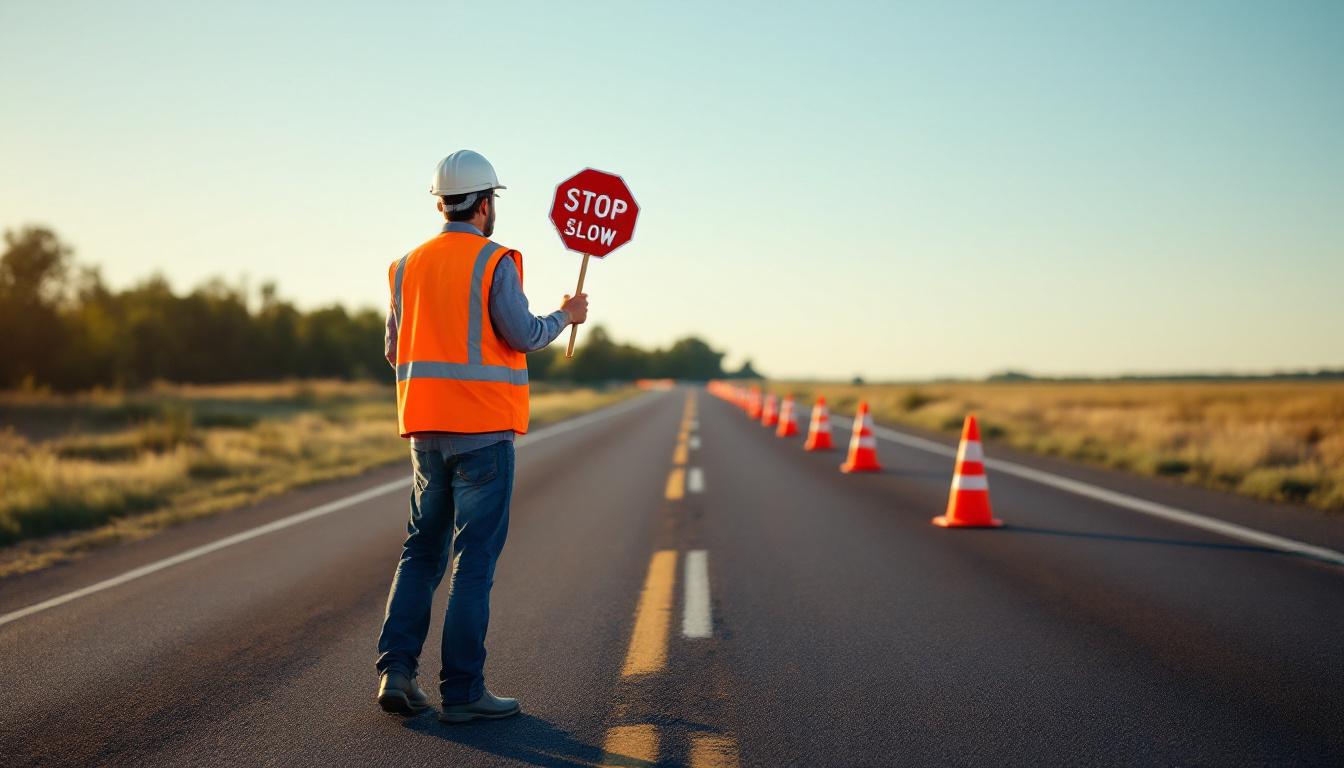
In-depth guide · sources linked inline
A flagger is the only traffic control device on a job that can change its message, apologise, and get hit. Everything else about a work zone is static until someone moves it; the flagger is making a decision every few seconds, in front of traffic, with a sign on a stick.
That is why flagging procedure is written down in more detail than almost anything else in the temporary traffic control part of the manual, and why it is one of the first things an agency inspector watches. This guide walks through what the national standard expects a flagger to do with a paddle and a flag, what it says about where a flagger stands, the question that comes up on nearly every short rural closure — when one flagger is enough — and what a traffic control company has to build around those rules so the person on the paddle is set up to do it right.
This is an explainer, not a substitute for the manual. The authoritative text is Part 6 of the MUTCD 11th Edition, currently carrying Revision 1, effective March 5, 2026, and many states publish their own manual or supplement that can be stricter. Section references below are to the 11th Edition.
Why this is worth getting exactly right
The case for precision is not abstract. FHWA's tabulation of FARS data records 891 work zone fatalities from 821 fatal crashes in 2022, including 145 people on foot or on bicycles and 94 highway worker occupational fatalities. The National Work Zone Safety Information Clearinghouse reports 850 work zone fatalities in 763 fatal crashes in 2024, including 37 "at work" pedestrian fatalities.
For the people standing in the road, the Clearinghouse's analysis of BLS Census of Fatal Occupational Injuries data shows that over 2022–2024, a worker on foot struck by a motor vehicle accounted for 52.7 percent of worker fatalities at road construction sites. A flagger is, by definition, a worker on foot at the edge of moving traffic.
Contractors feel it in the day-to-day too. In the 2026 AGC and HCSS highway work zone survey, 60 percent of contractors reported at least one crash involving a moving vehicle in their highway work zones during the past year, nearly one-third reported five or more, and among firms that had crashes, 27 percent reported crashes that injured construction workers.
"Summer construction season means more crews working just feet away from fast-moving traffic," said Jeffrey D. Shoaf, AGC's chief executive officer, in the survey release. "Too many drivers continue to speed, use their phones, or simply fail to pay attention in work zones, putting construction workers and motorists alike at serious risk."
Uniform signaling is one of the few things on that list a traffic control company fully controls. A driver who has seen a correctly presented STOP paddle a hundred times reacts to it faster than one who has to interpret an improvised gesture.
The legal hook: why the MUTCD governs your flaggers
Two layers make the manual binding for a flagging crew.
The first is the manual itself. The MUTCD is the national standard for traffic control devices on roads open to public travel, and Part 6 is where temporary traffic control lives. States adopt it directly, adopt it with a supplement, or publish their own manual in substantial conformance.
The second is OSHA. 29 CFR 1926.201(a) requires that signaling by flaggers and the use of flaggers, including the warning garments they wear, conform to Part 6 of the MUTCD. OSHA's highway work zones page points employers to the same manual. So a flagging deviation is not only a contract issue with the agency — it is a workplace safety issue for the employer.
On top of both sit state rules, agency permit provisions, and the specific contract. Those can require specific training cards, specific devices, or specific staffing. The national manual is the floor.
The devices: paddle first, flag for emergencies
Chapter 6D of the 11th Edition covers flagger qualifications, hand-signaling devices and procedures. The hierarchy is clear.
The STOP/SLOW paddle is the primary device. The manual's guidance names it the primary and preferred hand-signaling device because it gives drivers more positive guidance than a red flag. The paddle is octagonal, on a rigid handle, and must be retroreflectorized at night. Support text in Section 6D.02 describes the ideal presentation as a paddle on a staff tall enough that, with the staff resting on the ground, the message is high enough for approaching and stopped traffic to see — which is the practical argument against short hand-held paddles on a busy approach.
The paddle may carry flashing lights to improve conspicuity, in specified patterns and colours, with a flash rate inside a defined range. If your yard buys lighted paddles, the purchase specification should reference those requirements rather than trusting the product listing.
The flag is for emergencies. The manual states plainly that "Use of flags should be limited to emergency situations." When a flag is used it has minimum size, colour and staff-length requirements, and must be retroreflectorized at night. The practical message for a traffic control company is that a flag is not a planned device. If a job is scheduled with flags, the plan or the crew kit is wrong.
A flashlight supplements, it does not replace. In an emergency at night at a non-illuminated flagger station, the manual permits a flashlight with a red glow cone to supplement the paddle or flag, and specifies which hand holds it and how it moves for stop, proceed and slow. Again: emergency situations. A planned night flagging operation is supposed to have an illuminated station.
Automated Flagger Assistance Devices are a third option, with strings attached. An AFAD can be used by a trained flagger instead of hand-signaling, subject to its own sections (6L.02–6L.04) and the requirement that a flagger operates it. Automated flagger assistance devices explained covers when they fit.
Hand movements alone are prohibited for controlling a one-lane two-way operation. Section 6D.05 prohibits controlling that kind of operation with hand movements alone — without a paddle, flag or AFAD — with narrow exceptions for emergency responders at incident scenes and uniformed law enforcement. A flagger whose paddle blew over and who "just waves them through for a minute" is outside the standard for that minute.
The signals, in plain language
Section 6D.05 prescribes how a flagger signals with each device. The wording below is a paraphrase for training orientation; the manual's own text and figure are what a flagger should be trained and tested against.
With the paddle
Stop. Face the traffic. Hold the STOP face toward drivers, steady, with the arm extended horizontally away from the body. Raise the free hand above shoulder level with the palm toward approaching traffic.
Proceed. Face the traffic. Hold the SLOW face toward drivers, steady, arm extended horizontally. Motion with the free hand for traffic to proceed.
Slow or alert. Face the traffic. Hold the SLOW face toward drivers, steady, arm extended horizontally. The manual gives the option of adding an up-and-down motion of the free hand, palm down, to further slow traffic.
Note what is common to all three: the flagger faces the drivers, and the paddle is stationary. A paddle that twirls, flaps or gets used as a pointer is sending two messages at once. So is a flagger looking at the crew instead of at the traffic.
With a flag
Stop. Face the traffic and extend the staff horizontally across the traffic lane, stationary, so the whole flag hangs visibly below the staff. Free hand raised, palm toward traffic.
Proceed. Face the traffic with the flag and arm lowered out of drivers' view, and motion traffic through with the free hand. The manual is explicit that flags are not used to signal traffic to proceed.
Slow or alert. Face the traffic and slowly wave the flag in a sweeping motion of the extended arm from shoulder level down, without raising the arm above horizontal. Keep the free hand down.
STOP/STOP and SLOW/SLOW paddles
The manual allows a STOP/STOP or SLOW/SLOW paddle in certain conditions, so that drivers approaching from the opposite direction are not confused by the face meant for someone else. This matters most where a single flagger faces both directions. Stocking a few in the yard, and training crew leads on when to use them, is cheap.
Where the flagger stands
A perfectly executed signal from the wrong spot is still a problem. Section 6D.05's guidance and Section 6D.06 on flagger stations set the positioning expectations:
- Before stopping traffic, stand on the shoulder next to the traffic being controlled, or in the closed lane. Step into the moving lane only after traffic has stopped.
- Be visible to the first approaching driver at all times, and to other road users.
- Be far enough ahead of the work to warn workers of an out-of-control vehicle — the guidance mentions audible warning devices such as horns or whistles.
- Stand alone, away from other workers, work vehicles and equipment.
- Stopping distance. Flagger stations are to be located so approaching drivers have sufficient distance to stop at the intended stopping point. Where that is not achievable, the manual allows the location to be modified based on engineering judgment, and points to its stopping sight distance table, which may be increased for downgrades.
- Room to spare. Guidance calls for space for an errant vehicle to stop without entering the work space, and for the flagger to identify an escape route.
- Warning and light. Except in emergencies, flagger stations are preceded by advance warning signs and are illuminated when flagging at night.
Flagger station setup and escape routes goes deeper on picking the spot on a real road. The short version is that the station is part of the plan, not something the flagger chooses on arrival.
One flagger or two: the single-flagger rule
This is the question behind a lot of short, low-volume closures, and the answer in the 11th Edition is more specific than "use your judgment."
Chapter 6E covers one-lane, two-way traffic control. Its general rule is that when traffic in both directions must share a single lane for a limited distance, movements from each end are coordinated. The methods it lists include flagger control, flag transfer, a pilot car, temporary signals, and stop or yield control. One-lane, two-way traffic control methods compares them.
For the flagger method specifically (Section 6E.02):
The default is a flagger at each end. The guidance is that traffic should be controlled by a flagger at each end of the constricted section, with one designated as coordinator, and that the two should be able to communicate — orally, electronically or with manual signals that cannot be confused with flagging signals.
One flagger is an option when the zone is short enough to see through. When the one-lane section is short enough that a flagger can see from one end to the other, the manual permits either a single flagger or a flagger at each end.
Where the single flagger stands. When a single flagger is used, the guidance is to station them on the shoulder opposite the constriction or work space, or somewhere good visibility and control can be maintained at all times.
When one is not enough. If good visibility and traffic control cannot be maintained from one flagger station, the guidance is to go back to a flagger at each end.
Separately, the manual notes that on a low-volume street where the work space is short and drivers from both directions can see oncoming traffic through and beyond the site, one-lane two-way movement may be self-regulating — no flagger at all. That option has conditions attached, and most agencies will want to see it in an approved plan rather than decided on the day.
What trips companies up is treating the single-flagger option as a staffing default. It is a site condition, not a crew size. Two things change a single-flagger site into a two-flagger site during a shift, and a crew lead needs the authority to act on both:
- Sight lines change. Equipment parks in the line of sight, a queue grows past a curve, glare moves with the sun.
- Volume changes. A school lets out or a detour elsewhere dumps traffic onto a quiet road, and one flagger can no longer keep control of both approaches.
When either happens, the right call is to hold traffic and bring in a second flagger — which means the dispatcher has to be able to find one quickly. That is a scheduling problem as much as a safety one, and it is covered in flagger scheduling software: what to look for.
Other one-lane methods flaggers get pulled into
Flag transfer. The last driver into the section carries a flag or token to the flagger at the far end, who then releases the other direction. The manual's guidance limits this to relatively short sections, usually no more than a mile. It fails quietly when a driver ignores the instruction, so crews need a backup communication method.
Pilot car. A pilot car guides a queue through, must carry the PILOT CAR FOLLOW ME sign, and has to be coordinated with flagging or other control at each end. If an AFAD is used in a pilot car operation, the manual requires it to be operated by a flagger positioned near it and within line of sight, and never left unattended while in use.
What the manual expects a flagger to be able to do
Section 6D.01 frames qualifications as guidance rather than a certification mandate. It notes that flaggers make the greatest number of contacts with the public of all highway workers and recommends training in traffic control practice and public contact. It then lists abilities a flagger should be able to demonstrate. Paraphrased:
- Receive and pass on specific instructions clearly, firmly and courteously.
- Move quickly to get out of the way of an errant vehicle.
- Control paddles and flags so they give clear, positive guidance in changing situations.
- Understand and apply traffic control practice, including under stress or in emergencies.
- Recognise a dangerous traffic situation and warn workers in time.
Two of those five are about getting out of the way and warning others. The job is as much lookout as sign-holder.
Certification is a state and contract question
The national manual recommends training; the card a flagger must carry is set by the state, agency or contract. Requirements vary, and they change.
Virginia is a useful illustration of how quickly. VDOT's work zone page states that as of December 31, 2024, the two-year VDOT Flagger Training program is no longer accepted, and that new flaggers must use ATSSA's flagger certification, VDOT's Basic Work Zone certification, or VDOT's Intermediate Work Zone certification. ATSSA publishes its program details on its certification and recertification page.
A company working across several states needs to know, for each flagger, which cards they hold and when each expires, and needs dispatch to refuse an assignment the flagger is not carded for. Flagger certification requirements explained covers the landscape.
High-visibility apparel is part of the procedure
Because OSHA's rule covers the warning garments flaggers wear, apparel is not a separate topic from signaling. The manual's high-visibility safety apparel provisions apply, and night work typically raises the class required. High-visibility apparel classes explained covers what the classes mean. A flagger in a faded vest is a non-conforming device in the same way a faded sign is.
Building a company around correct flagging
Knowing the procedure is necessary and not sufficient. The failures that end up in incident reports are usually organisational: the wrong person sent, the right person sent without the kit, a single-flagger plan kept going after the site changed, a flagger left on a station for eight hours without relief.
Train to the text and test the signals. A short, practical sign-off where a crew lead watches each new flagger present stop, proceed and slow with both devices catches most bad habits before they reach a road. Repeat it periodically; habits drift. Tailgate safety meetings for traffic control crews is a natural place for the refresher.
Kit the truck, not the person. Every flagging assignment should load a paddle (lighted where the job is at night), a flag only as an emergency backup, radios for two-flagger operations, STOP/STOP or SLOW/SLOW paddles where a single flagger faces both directions, and apparel of the right class. A load-out checklist tied to the job type removes the "I thought someone else grabbed it" failure.
Schedule relief. Flagging is sustained attention in heat, cold and noise. Plan breaks and relief into the schedule, rather than relying on the flagger to ask. Heat illness prevention for traffic control crews covers the summer version of this.
Give the crew lead authority to upgrade the setup. If the plan says one flagger and the site now needs two, the lead should be able to call for a second person without a negotiation — and the dispatcher should be able to see who is closest and carded.
Record what was deployed. When an agency or an attorney asks what was on the road on a given day, the answer is the signed daily ticket with the flaggers, hours, devices and GPS stamp. Preventing daily ticket disputes covers what a defensible ticket looks like.
Traffic OS was built for exactly that operational layer: crew scheduling with certifications attached to the person, a GPS time clock so flagger hours are stamped on site, job kits so the paddle and radios are on the load-out, and GPS-stamped signed daily tickets that record who flagged, where, and for how long. Pricing is flat by tier — $499, $949 or $1,499 per month as of September 2026, with no per-user charge — on the pricing page, and the features page lists what each tier includes. A walkthrough is the fastest way to see whether it matches how your dispatch actually runs.
A short field checklist
Before a flagger takes a station:
- Right device for the job — STOP/SLOW paddle, retroreflective at night; flag only as emergency backup.
- Right card for this jurisdiction, current.
- Right apparel class for the time of day.
- Station located per the plan, with stopping distance and an escape route identified.
- Advance warning signs in place ahead of the station; lighting in place for night work.
- For one-lane two-way work: confirm whether the plan is one flagger or two, and whether the site still supports it.
- Radios checked for two-flagger operations; coordinator designated.
- Relief scheduled.
And during the shift: face traffic, keep the device stationary, stay out of the moving lane until traffic stops, stand apart from the crew, and escalate the moment sight lines or volumes change.
The standing caveat
Flagging procedures, device requirements, certification cards, apparel classes, and whether one flagger may be used all vary by state, county and city, and a contract or permit can require more than the national manual does. Everything above describes how the national standard generally works; verify the requirements for your specific job with the authority having jurisdiction before relying on them.
Frequently asked questions
When can a single flagger be used to control traffic in a one-lane, two-way work zone?+
The MUTCD 11th Edition permits a single flagger as an option when the one-lane, two-way section is short enough for the flagger to see from one end of the zone to the other. When one flagger is used, the manual's guidance is to station them on the shoulder opposite the constriction or work space, or somewhere good visibility and control can be kept at all times. If one station cannot keep good visibility and control, the guidance is a flagger at each end. Your state manual and contract can be stricter, so confirm with the agency.
Is the STOP/SLOW paddle required, or can a flagger use a flag?+
The manual treats the STOP/SLOW paddle as the primary and preferred hand-signaling device because it gives drivers more positive guidance than a flag, and its guidance limits flags to emergency situations. A flag, when used, has size, colour and night retroreflectivity requirements. Hand movements alone, without a paddle, flag or automated flagger assistance device, are prohibited for controlling a one-lane two-way operation except for emergency responders at incidents or uniformed law enforcement.
What are the three basic paddle signals?+
Stop, proceed, and slow. To stop traffic the flagger faces drivers with the STOP face held steady at arm's length and the free hand raised palm-out. To release stopped traffic the flagger shows the SLOW face held steady and motions drivers through with the free hand. To slow or alert traffic the flagger shows the SLOW face held steady, and may additionally move the free hand up and down, palm down. The authoritative wording is in Part 6 of the MUTCD.
Where should a flagger stand?+
On the shoulder next to the traffic being controlled, or in the closed lane, before stopping traffic — and only in the moving lane once traffic has stopped. The guidance also calls for the flagger to be visible to the first approaching driver at all times, far enough ahead of the work to warn workers of an errant vehicle, standing apart from other workers and equipment, and with an escape route identified.
Does OSHA require flaggers to follow the MUTCD?+
Yes. OSHA's construction standard at 29 CFR 1926.201(a) requires that signaling by flaggers and the use of flaggers, including their warning garments, conform to Part 6 of the MUTCD. State plans and state DOT manuals can add requirements on top, including specific training cards.
Do flaggers need to be certified?+
The national manual sets out abilities flaggers should demonstrate and recommends training, while certification requirements are set by states, agencies and contracts. Virginia, for example, stopped accepting its two-year VDOT flagger training at the end of 2024 and now accepts ATSSA flagger certification or VDOT's Basic or Intermediate Work Zone certification. Check the requirement for every jurisdiction you work in.