August 29, 2026 · The Key Bot
Pennsylvania Work Zone Requirements: What Contractors Need to Know
PennDOT Publication 213, the flagger certification requirement, 67 Pa. Code Chapter 212, and the automated speed enforcement program that made Pennsylvania work zones different from its neighbours.
In-depth guide · sources linked inline
Pennsylvania is a state where the general advice to "check the state manual" is unusually load-bearing. It has its own guidance publication, its own regulatory chapter, its own flagger certification requirement tied to a construction specification, and a permanent automated speed enforcement program in active work zones that most neighbouring states do not run.
This is an orientation to those pieces for a contractor working in the Commonwealth — where they sit, how they relate, and what to verify before you rely on any of it.
Standing caveat, and it matters more here than usual: requirements vary by state, county, and municipality, and change over time. This describes how the framework generally works as of August 2026. It does not tell you what your specific job requires. The agency having jurisdiction over your roadway — which is frequently a borough or township rather than PennDOT — sets that, and their conditions can be more restrictive than anything described here. Verify with them.
The document stack
Four layers, and confusing them is the usual source of error.
The national MUTCD is the floor. The 11th Edition was published by FHWA in December 2023 and carries Revision 1 dated December 2025. Part 6 covers temporary traffic control. Note that the typical applications moved to Chapter 6P in this edition — they were Chapter 6H in 2009, and Pennsylvania-specific documents that predate the renumbering may cite the old chapter.
67 Pa. Code Chapter 212, Subchapter E is the regulation. It runs from Section 212.401 through Section 212.419 and covers temporary traffic control for highway construction, maintenance operations, utility work, and incident management, either on a highway or so close to a highway that workers, equipment, or materials encroach on it. The section list is worth reading as a checklist in its own right: general, exempt work, temporary traffic-control plans, sign supports, regulatory speed limits, channelizing devices, markings, impact attenuators, travel lane rumble strips, delineators, flaggers, flagger signaling devices, portable traffic-control signals, emergency work, Type D arrow panels, shadow vehicles, flashing warning lights, good management principles, and special controls in work zones.
Two of those deserve a contractor's attention immediately. Section 212.402, exempt work, is where you find out whether your activity is inside or outside the chapter — an answer people assume rather than check. And Section 212.414, emergency work, sets the framework for the situation where you cannot plan in advance, which is the one most likely to be improvised badly.
PennDOT Publication 213, Temporary Traffic Control Guidelines, is the guidance. It is intended as a guide for developing temporary traffic control measures in Pennsylvania and includes applications for road maintenance work, utility work, special events, emergency situations, and incidents. It is the document Pennsylvania flagger training is built on, together with Publication 234, the Flagging Handbook.
Publication 408 is PennDOT's construction specifications, and it is the layer contractors most often forget is part of the traffic control picture. Section 901.3 is the flagger training requirement referenced below.
The relationship between these is the important part. The regulation binds. The publications guide. Neither replaces the site-specific plan, and none of them overrides a municipality's permit conditions on a local road.
Flagger certification is a requirement, not a best practice
This is the single most consequential difference for a company crossing into Pennsylvania from a state without a certification mandate.
Publication 213 requires that all individuals with flagging responsibilities on any road open to the public be certified in compliance with the most current version of Publication 408, Section 901.3, Flagger Training. Training courses draw on Publication 213, the MUTCD, and Publication 234, and providers commonly issue a wallet card on passing a short written exam, typically valid for three years.
Three practical consequences.
Certification is a scheduling constraint, not just a compliance item. If you dispatch on availability alone, a crew can be short a certified flagger on the morning of a job. That is a dispatch problem before it is a compliance problem, and it is solved the same way as any other credential constraint — by making certification and expiry a field the dispatch board can see, rather than a folder in the office.
Expiry dates need tracking. A three-year card issued to a seasonal worker will lapse quietly in an off-season. Our piece on flagger certification requirements generally covers how the reciprocity picture varies between states, which is the second half of this problem for multi-state operators.
Certification is not competence and does not transfer supervision. A card says someone passed a test. Flagger station setup and escape routes is still the crew lead's responsibility, and it is where the actual risk sits.
The speed cameras: what they are, and why contractors should care
Pennsylvania's Automated Work Zone Speed Enforcement program is the feature that most distinguishes its work zones operationally.
The program began as a pilot under Act 86 of 2018, which added Section 3369, Automated Speed Enforcement Systems in Active Work Zones, to Title 75 of the Pennsylvania Consolidated Statutes, and ran with the support of PennDOT, the Pennsylvania Turnpike Commission, and the Pennsylvania State Police. Act 38 of 2023, signed December 14, 2023, established permanent implementation.
Mechanically, systems in active work zones detect vehicles exceeding the posted speed limit by 11 mph or more. Enforcement escalates from a warning letter on a first offence to civil penalties on subsequent ones; PennDOT publishes the current penalty schedule, the 15-day warning interval, and the contest procedure on the program's policies and regulations page. Two features are worth knowing because they get misreported: the penalties are civil only, and they carry no points on a licence and no insurance merit-rating impact. Violations are contestable within a defined window from the mailing of the notice.
None of that lands on your company or your crew — the notice goes to the registered owner of the speeding vehicle. So why does it matter to a contractor?
Because it changes the traffic you are working in. The program exists on the theory that speed in work zones is the controllable factor, and Pennsylvania's own published figures give the context: PennDOT reports 1,804 work zone crashes in Pennsylvania in 2018 resulting in 23 fatalities, against under 1,300 crashes and 14 fatalities in 2022. For national context, the Work Zone Safety Information Clearinghouse records 850 work zone fatalities across 763 fatal crashes in 2024, following 905 fatalities across 824 fatal crashes in 2023.
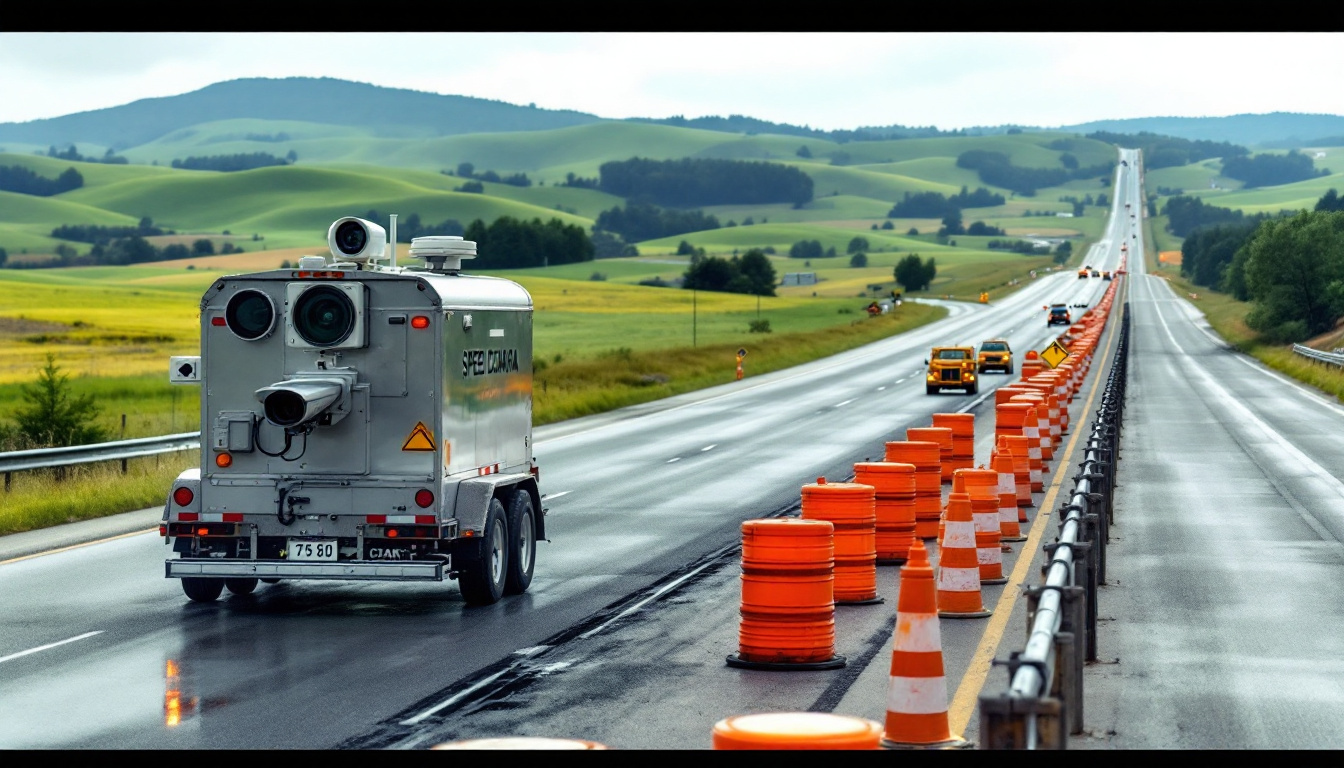
Because enforcement presence interacts with your setup. An enforcement unit occupies space, usually on a shoulder, and it operates in an active work zone — which means its presence is a condition of the zone rather than something separate from it. Coordination is the agency's business, but a crew that does not know it is coming will treat it as an obstruction.
Because "active work zone" is a defined condition, not a description. The program applies to active work zones, which puts weight on when your zone is active and how that is evidenced. That is the same question your own records answer, and it is worth being able to answer it precisely. Our piece on work zone speed management and enforcement covers the broader picture of what does and does not slow traffic down.
The permit layer, which is where jobs actually stall
Everything above concerns how the work is controlled. Whether you may occupy the road at all is a separate question with a separate answer, and in Pennsylvania as elsewhere it depends on who owns the road.
Work on a state highway is PennDOT's; work on a borough or township street belongs to that municipality; and a great deal of utility work touches both within a few hundred feet. The framework distinctions are the ordinary ones — right-of-way permits for occupying the corridor, and the difference between a road closure and a lane closure permit, which are different applications with different lead times and different conditions attached.
The failure mode for out-of-state contractors is assuming that a state-level answer covers a municipal road. It does not, and the municipality's conditions frequently include restrictions the state manual says nothing about — permitted hours, notification requirements, business-access provisions. For companies working across several municipalities on one utility contract, multi-jurisdiction permit tracking stops being an administrative nicety and becomes the thing that determines whether crews roll.
Where restrictions bite hardest is on permitted working hours, which is the subject of lane closure restriction windows and curfews and is worth understanding before you bid, not after.
The regulation sections contractors underestimate
Reading a section list is dull, so most people skim it. Four of the nineteen sections in Subchapter E are worth stopping on, because each maps to a decision a crew makes in the field.
Section 212.416, shadow vehicles. Shadow vehicles are the most commonly improvised element of a setup — a truck positioned by judgment rather than by requirement, often the nearest one available. Where a regulation addresses them specifically, the positioning, the vehicle, and the attenuator are not free choices. This is the same subject as truck-mounted attenuators, and the intersection of "what does the regulation require" and "what does our fleet actually have" is worth resolving in the yard rather than on the shoulder.
Section 212.417, flashing warning lights. Warning lights are cheap, small, and treated casually, which is exactly why the rules on them get broken. Whether a light flashes or burns steady is not decorative — it distinguishes "warn of a condition" from "follow this path," and the two are not interchangeable. Barricade and warning light types covers the underlying national requirements that the state layer builds on.
Section 212.409, travel lane rumble strips. Temporary rumble strips are an intervention with real evidence behind them and real installation and removal costs. Where they are addressed in regulation, whether you deploy them may not be entirely your call on a given class of road — see temporary rumble strips in work zones.
Section 212.405, regulatory speed limits. A reduced work zone speed limit is a regulatory act, not a sign you can post because it seems prudent. Posting an unauthorised regulatory limit is worse than posting nothing, because it is unenforceable and it teaches drivers that your signs can be ignored. In a state running automated enforcement against the posted work zone limit, the provenance of that posted number matters more than it does elsewhere.
What changes if you are a utility contractor
A large share of the traffic control work in Pennsylvania is incidental to utility work rather than to highway construction, and that changes the shape of the problem in three ways.
The jobs are short and numerous. A utility contractor may touch a dozen locations in a week, several of them in different municipalities. The compliance burden is not depth on any one setup, it is repetition across many — which makes standardisation and record-keeping the binding constraint rather than engineering judgment. Traffic management software for utility contractors is written to that problem specifically.
Emergency work is a routine category, not an exception. A main break does not wait for a permit. Section 212.414 addresses emergency work for exactly this reason, and the operationally important thing is knowing in advance what the emergency provisions permit and what notification they require — because the moment you need that knowledge is the moment nobody has time to look it up. The broader treatment is in utility work traffic control and in the national framework for incident and emergency scenes.
Restoration and repeat mobilisation get missed at bid time. A trench that is opened, worked, plated, and returned to is several setups, not one, and each is a separate traffic control cost. Estimators pricing from the permit rather than the sequence tend to price one.
Prequalification and getting on the work
Bidding PennDOT work is its own process, distinct from the traffic control requirements, and it runs on a longer clock than most newcomers expect.
Contractor prequalification and the bidding system are administered by PennDOT and require submission and approval well ahead of any particular letting. The general shape of that process — financial statements, experience, equipment, and a safety record that will be examined — is covered in DOT prequalification for traffic control contractors, and the safety component in safety records and EMR in prequalification.
Two Pennsylvania-flavoured notes. Municipal and authority work follows entirely separate procurement, so a company that is not prequalified with the state is not thereby excluded from a great deal of work — bidding municipal traffic control contracts is often the faster route in. And prime contractors on state work will flow their own traffic control requirements down through subcontracts, which means your obligations may be set by a subcontract exhibit rather than by anything you read on a PennDOT page.
Federal requirements still apply on top
Two federal layers sit above all of this regardless of state.
OSHA's construction standards apply to the employer with respect to their employees, and the signs, signals, and barricades requirements at 29 CFR 1926 Subpart G tie work zone traffic control back to the MUTCD. That obligation runs independently of whichever agency owns the road, which is why "the municipality did not require it" is not a complete answer to a safety question.
And on federal-aid highway projects the Work Zone Safety and Mobility Rule drives agency-side requirements for transportation management planning that flow down to contractors through project specifications.
Winter, and why the calendar is a compliance question here
Pennsylvania has a real winter, and it shapes the traffic control year in ways southern operators underestimate.
Paving and marking work has temperature windows, which compresses the season and concentrates demand into the months when everybody wants crews. Winter maintenance changes what is on the road and how quickly a shoulder-parked device is buried by a plow. And agencies restrict work during winter operations periods, which is a restriction on top of the ordinary permitted-hours question.
For a contractor, the operational consequence is that the same headcount has to cover a peak that is shorter than the calendar year, and that devices left out over a winter come back in worse condition than the depreciation schedule assumes. Both of those are planning problems rather than compliance ones, but they are the reason a Pennsylvania operation and a Texas operation with identical revenue look quite different on the balance sheet. Managing seasonality in a traffic control business and equipment fleet replacement planning both bite harder in a four-season state.
A short checklist before you work in Pennsylvania
Confirm who owns the road. State, county, municipal, or authority. Everything else follows from that answer.
Confirm your flaggers' certification status and expiry dates before the schedule is built, not on the morning of the job.
Read 67 Pa. Code Chapter 212 Subchapter E once, properly — particularly the exempt-work and emergency-work sections, which decide whether your activity is even inside the chapter.
Get the current edition of Publication 213 and Publication 408 Section 901.3, and check them rather than relying on a training memory or a summary like this one.
Ask specifically about work zone speed enforcement on the corridor you are working, since it affects staging and shoulder use.
Read the permit conditions as the operative document. They are more restrictive than the manuals and they are what you will be inspected against.
The genuinely portable lesson from Pennsylvania is one that applies everywhere: the national manual tells you how a work zone is built, and the state and local layers tell you whether, when, and by whom. Companies get into trouble by knowing the first layer well and the second two by reputation. Keeping the certifications, permits, and conditions attached to the job record rather than in someone's memory is the boring fix, and it is the one that works — see the features page for how we handle it.
Frequently asked questions
What is PennDOT Publication 213?+
Publication 213, Temporary Traffic Control Guidelines, is PennDOT's guide for developing temporary traffic control in Pennsylvania. It covers road maintenance work, utility work, special events, emergency situations, and incidents, and sits on top of the MUTCD rather than replacing it. It is the document Pennsylvania flagger training is built from, alongside Publication 234, the Flagging Handbook.
Do flaggers need to be certified in Pennsylvania?+
Yes. Publication 213 requires that individuals with flagging responsibilities on any road open to the public be certified in compliance with the current version of Publication 408, Section 901.3, Flagger Training. Training providers commonly issue a wallet card valid for three years. Confirm the current requirement and card validity with PennDOT or your training provider before relying on it.
What regulation governs temporary traffic control in Pennsylvania?+
67 Pa. Code Chapter 212, Subchapter E covers temporary traffic control for highway construction, maintenance operations, utility work, and incident management. It runs from Section 212.401 through 212.419 and includes specific sections on flaggers, channelizing devices, shadow vehicles, flashing warning lights, and emergency work.
Does Pennsylvania use speed cameras in work zones?+
Yes. Automated Work Zone Speed Enforcement began as a pilot under Act 86 of 2018, which added Section 3369 to Title 75 of the Pennsylvania Consolidated Statutes, and was made permanent by Act 38 of 2023, signed December 14, 2023. Systems detect vehicles exceeding the posted work zone speed limit by 11 mph or more.
Do the speed camera penalties affect my crew or my company?+
No. The violations are civil penalties issued to the registered owner of the speeding vehicle, with no points on a licence and no insurance merit-rating impact. Its relevance to contractors is indirect but real: it changes driver behaviour approaching your setup, and the program's operation interacts with how your work zone is signed and staffed.
Is Publication 213 the same as a traffic control plan?+
No. Publication 213 is a guideline document containing standard applications. Your traffic control plan is a site-specific design for your roadway and your conditions, subject to the requirements of the agency having jurisdiction — which for local roads is frequently a municipality rather than PennDOT.