September 17, 2026 · The Key Bot
Traffic Control for Work at Intersections: Near Side, Far Side and In the Box
Intersections break the simple midblock lane closure. Here is how the MUTCD classifies intersection work spaces, why far-side closures need near-side treatment, what happens to the signals, how pedestrians are kept moving, and what that means for planning, staffing and pricing the job.
In-depth guide · sources linked inline
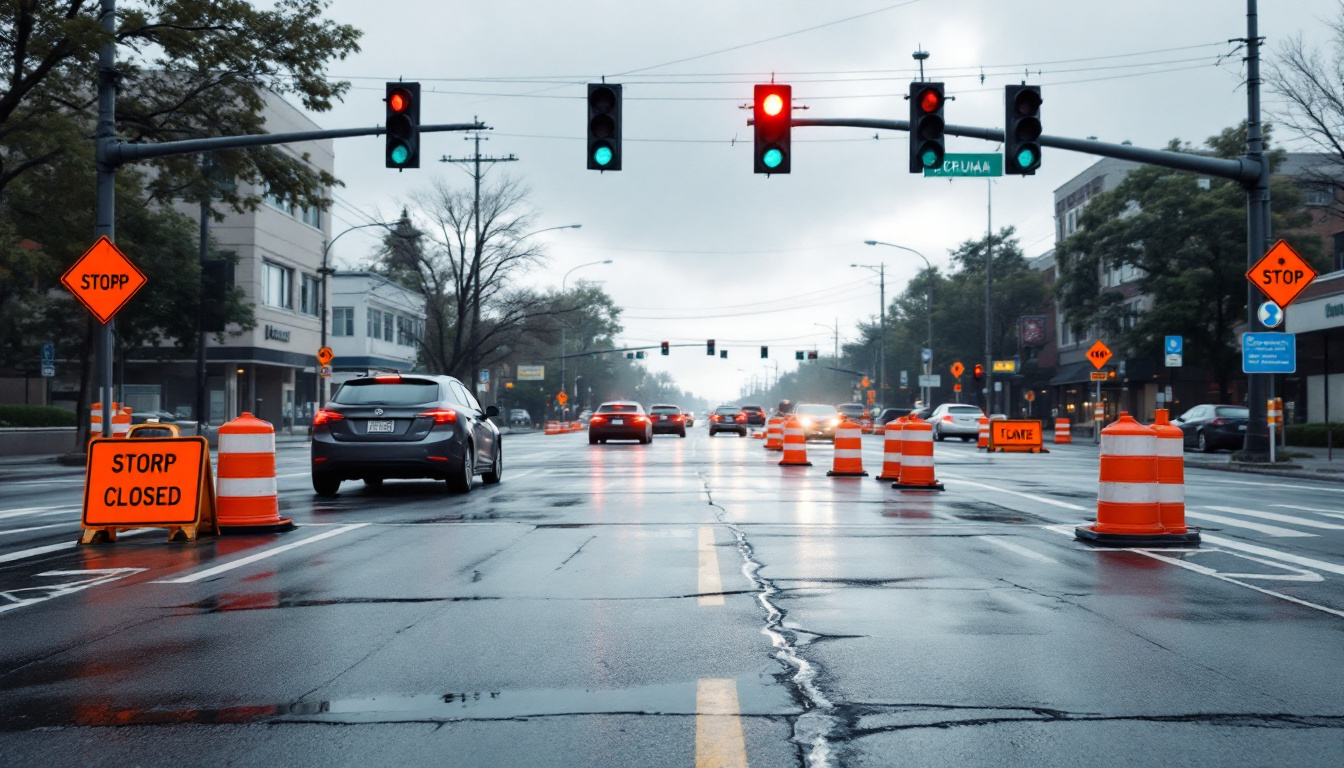
A midblock lane closure has one direction of approach per lane and one thing the driver needs to do: merge. An intersection has approaches from every leg, turning movements that cut across your taper, signals that were timed for a road that no longer exists, detector loops under your cones, and pedestrians who still need to cross.
That is why intersection work is one of the places a plan copied from a straight-road template most often goes wrong, and one of the places agencies look hardest during review. This guide explains how the national standard thinks about intersection work spaces, what it expects you to do about signals and pedestrians, and what that means for how a traffic control company plans, crews and prices the job.
The provisions discussed here are in Section 6N.12 of the MUTCD 11th Edition Part 6, which carries Revision 1, effective March 5, 2026. The typical application figures are referenced by number rather than reproduced; use the official figures and your state's manual when drawing a plan.
Why intersections deserve their own plan
The numbers point at arterials. FHWA's tabulation of FARS data for 2022 records 821 fatal work zone crashes, of which 405 were on arterials and 321 on interstates — arterials, where most signalized intersections are, accounted for roughly half. The same tabulation records 145 people on foot or bicycles killed in work zones that year, the road users intersection work most directly affects.
The Work Zone Safety Information Clearinghouse's national table shows 850 work zone fatalities in 763 fatal crashes in 2024, with 119 non-work pedestrian-involved fatalities in addition to 37 "at work" pedestrian fatalities.
Contractors report the same pressure from the other side. In the 2026 AGC and HCSS highway work zone survey, 60 percent of respondents experienced at least one crash involving a moving vehicle in a highway work zone in the past year, and more than half said crashes had delayed projects. Only 29 percent believed current enforcement was deterring unsafe driving.
"Better training, stronger enforcement, and improved public policies can help reduce crashes, but motorists ultimately bear the responsibility for slowing down and staying alert in work zones," said Jeffrey D. Shoaf, AGC's chief executive officer, in the survey release.
A traffic control company cannot control motorist attention. It can control whether the setup at a complex intersection gives drivers one clear, early, unambiguous instruction — or several conflicting ones.
The three classifications
The manual classifies intersection typical applications by where the work space sits relative to the intersection area, which it defines by the extension of the curb or edge lines. There are three classes.
Near side. The work space is on the approach, before the driver enters the intersection. From the driver's point of view this is a lane closure they reach before the intersection.
Far side. The work space is on the departure side, after the driver has crossed the intersection. Drivers reach it by going straight through, or by turning left or right into the closed leg.
In the intersection. The work space is inside the area bounded by the extended curb or edge lines.
The manual's important observation is that work spaces often extend into more than one portion of the intersection. Work in one quadrant, for example, commonly creates a near-side work space on one street and a far-side work space on the cross street. Its answer is not a special figure for every combination but an approach: build the plan by combining features from two or more of the intersection and pedestrian typical applications.
That is a judgment exercise, which is exactly why it is where plans get rejected. Engineering judgment in traffic control plan design covers how to document a combination so a reviewer can follow it, and MUTCD typical applications: how to use them covers the limits of using a figure as a drawing.
The intersection-related typical applications in the 11th Edition include lane closure on the near side (Figure 6P-21, TA-21), right-hand and left-hand lane closures on the far side (TA-22 and TA-23), a half road closure on the far side (TA-24), multiple lane closures at an intersection (TA-25), closure in the center of an intersection (TA-26), closure at the side of an intersection (TA-27), and the sidewalk and crosswalk pedestrian applications (TA-28 and TA-29). Circular intersections have their own figures (TA-52 through TA-54).
Near-side work spaces
The manual's support text says near-side work spaces are handled simply as a midblock lane closure. The geometry is familiar: advance warning, a transition, a buffer, the work space.
The problem it names is capacity. A near-side closure takes away an approach lane at exactly the point where the signal is metering traffic, and during busy hours that can produce congestion and back-ups well beyond the advance warning signs.
Two options in the manual deal with the practical consequences:
- Mandatory turn lane. When near-side work spaces are used, a mandatory turn lane may be used for through traffic — which in practice reassigns lane use so the remaining capacity is used efficiently.
- Short blocks. Where space in advance of a near-side work space is restricted — the manual gives short block spacing as the example — two warning signs may be used in the advance warning area, and a third action-type warning sign or a regulatory sign such as Keep Left may be placed in the transition area.
The queue is the part to plan for. The manual's fundamental principles in Section 6A.02 call for an assessment of expected queue length as part of plan design, which may lead to changing sign spacing and number or using more conspicuous devices, because a stopped queue that extends past your first warning sign turns a routine closure into a rear-end crash site. At a signalized intersection the queue length at peak is often knowable in advance from the signal timing and counts, which is another reason to talk to the agency early. Lane closure restriction windows and curfews covers how agencies control when you are allowed to take the lane in the first place.
Far-side work spaces
Far-side work is where intersection plans most often fail, because drivers reach the closed lane by more than one path.
The manual's support text notes that far-side work spaces need additional treatment because road users typically enter the activity area by straight-through, left-turn or right-turn movements. A driver turning right from the cross street may have seen none of the advance warning placed on the main approach.
Two provisions shape the plan:
Close the near side too. The guidance is that when a lane through an intersection must be closed on the far side, it should also be closed on the near-side approach, to prevent merging movements within the intersection. Merging inside the box, across turning traffic, is the conflict the whole design is trying to avoid.
Or make it a turn lane. If a significant number of vehicles turn from that near-side lane, the manual allows converting it to a mandatory turn lane rather than closing it outright.
Warn every leg. For work at an intersection generally, the guidance calls for advance warning signs, devices and markings on all cross streets, as appropriate. The cross-street approaches are where the right- and left-turning drivers come from.
In practice that means a far-side plan usually has at least three advance warning sequences — the main approach and both cross-street approaches — which is worth remembering when you count signs, stands and labour.
Work in the middle of the intersection
When the work space is in the intersection itself, the manual offers four strategies, which can be combined:
- A small work space that road users can move around (Figure 6P-26, closure in the center of an intersection).
- Flaggers or uniformed law enforcement officers directing road users (Figure 6P-27).
- Staging the work so the work space stays as small as possible at any time.
- Road closures or upstream diversions that reduce the volume reaching the intersection.
The guidance adds that, depending on road user conditions, flaggers and/or uniformed law enforcement officers should be used to control road users.
Flagging an intersection is harder than flagging a two-lane road: there are more approaches, more turning conflicts, and drivers who are used to taking instructions from signal heads. Crews need to know whether the signal will be placed in flash, turned dark, or left running, because a flagger giving one instruction while a signal gives another is a conflict you built. Law enforcement is often the better tool at busy signalized intersections; law enforcement in work zones: when to use it covers how that is arranged and paid for. Flagger hand-signaling procedures explained covers the signals themselves.
The signals
Intersection work almost always touches signal operation, even when nobody touches the signal.
The guidance in Section 6N.12 is to consider the effect of the work on signal operation and to take temporary corrective actions if necessary. Its examples:
- Revising signal phasing and/or timing to provide adequate capacity with lanes closed.
- Maintaining or adjusting signal detectors — a closed lane over an inductive loop, or a work vehicle parked on one, can call a phase that has no traffic or fail to call one that does.
- Relocating signal heads so they remain visible, as described in Part 4 of the manual, which covers highway traffic signals (Part 4 PDF).
The manual also observes that conflicts are most frequent at more complex signalized intersections — ones with signal heads over particular lanes, lanes assigned to specific movements, multiple phases, actuated detection, and accessible pedestrian signals.
Operationally, signal changes are the agency's call. The agency that operates the signal controls its timing and equipment; your plan identifies what needs to change and when, and the agency or its signal contractor makes it happen. That coordination has lead time, and it is the most common reason an intersection job slips.
The Standard: contact the agency
Most of Section 6N.12 is guidance, but one statement is a Standard. When work will occur near an intersection where operational, capacity, or pedestrian accessibility problems are anticipated, the highway agency having jurisdiction shall be contacted.
The fundamental principles in Section 6A.02 reinforce this with guidance for early coordination with officials having jurisdiction over affected cross streets and those providing emergency services, where significant impacts on roadway operations are expected. At an intersection, the cross street is frequently a different jurisdiction from the main road — a city street crossing a state route — which means two agencies, two permits, and two sets of restrictions. Multi-jurisdiction permit tracking covers how to keep that straight.
At the federal level, agencies receiving federal-aid highway funds operate under the Work Zone Safety and Mobility rule at 23 CFR 630 Subpart J, which is part of why many agencies ask for an assessment of work zone impacts on significant projects. Work zone impacts and road user cost explained covers that side.
Speed changes the advance warning
The intersection typical applications depict urban intersections on arterial streets. The guidance recognises that not every intersection is urban: where the posted speed limit, the off-peak 85th-percentile speed before work starts, or the anticipated speed exceeds 40 mph, additional warning signs should be used in the advance warning area.
A rural highway intersection with 55 mph approaches is therefore not a TA-21 with the same number of signs. Plan it, sign it, and stock it for the speed. Work zone sign types and sizes explained covers why speed drives size and spacing.
Pedestrians are part of the intersection
Intersections are where pedestrians cross, and intersection work is where crossings get closed, moved, or turned into obstacle courses.
Section 6N.12 carries guidance that pedestrian crossings near temporary traffic control sites be separated from the work site by appropriate barriers that maintain accessibility and detectability for pedestrians with disabilities. The sidewalk and crosswalk applications — sidewalk detour or diversion (TA-28) and crosswalk closures and pedestrian detours (TA-29) — are typically combined with the vehicle applications.
Accessibility standards sit behind that: the U.S. Access Board's public right-of-way accessibility guidelines are the reference point many agencies use. Practical failures to design out:
- Closing a crosswalk without providing an accessible alternate crossing.
- Devices that a person using a cane cannot detect.
- Barricade feet and ballast projecting into the pedestrian route.
- A pedestrian push button that is now behind the work space.
ADA and temporary pedestrian access routes in work zones and pedestrian accommodation in work zones cover both in more detail.
Roundabouts and circular intersections
Circular intersections behave differently: traffic is continuous, entries yield, and a closure on the circulatory roadway affects every entry. The 11th Edition has separate typical applications for short-term or short-duration work in a circular intersection (TA-52), flagging on a single-lane circular intersection (TA-53) and an inside lane closure on a multi-lane circular intersection (TA-54). Do not adapt a signalized-intersection plan to a roundabout.
What this means for running the job
Intersection jobs cost more, take more coordination, and fail in more ways than their footprint suggests. Treat them that way from the quote onward.
Count every approach when you quote. A far-side closure with advance warning on three legs uses roughly three times the signs and stands of the same closure midblock, plus the labour to set and maintain them. Bidding traffic control jobs: estimating basics covers building that into the number.
Price the coordination. Signal timing changes, a second agency, law enforcement scheduling, and a pedestrian detour are all time. If the quote assumes a simple lane closure and the plan requires three agencies to sign off, the margin disappears before the first cone goes out.
Plan staffing for flagging or officers. An in-the-intersection job with flaggers usually needs more than one, with communication and relief. Confirm whether law enforcement is required by the permit and who books it.
Stage the setup. The order devices go out matters more at an intersection than anywhere, because a half-built setup can channel turning traffic into the work area. Setting up and removing a work zone safely covers installation sequence.
Check it at the busy hour. A setup that works at 10 a.m. may produce a queue past the first sign at 5 p.m. Crew leads should check it during the peak the plan was designed for, and have authority to escalate.
Record what was built. For each approach: which devices, where, when set, when inspected, when removed. That record is what answers an agency inspector — or a claim after a crash. Preventing daily ticket disputes covers what the ticket needs to show.
Traffic OS is built for this operational layer: job records that hold the plan and the permit, device kits per job so each approach's signs and stands are on the load-out, crew and flagger scheduling with certifications, and GPS-stamped signed daily tickets showing what was deployed and when. Pricing is flat by tier — $499, $949 or $1,499 per month as of September 2026, with no per-user charge; details are on the pricing page and the features page, and a walkthrough shows it against your own jobs.
A planning checklist for intersection work
- Classify the work space — near side, far side, in the intersection, or a combination.
- Identify the typical applications to combine, including pedestrian applications.
- Confirm the jurisdiction for every leg and contact each agency early.
- Identify signal effects: phasing, timing, detectors, head visibility — and who changes them.
- For far-side closures, close the near side or plan a mandatory turn lane.
- Put advance warning on every approach that feeds the work.
- Add warning signs where speeds exceed 40 mph.
- Assess queue length at the peak you will actually work through.
- Provide an accessible pedestrian route and crossing, detectable and unobstructed.
- Decide on flaggers or law enforcement for in-intersection work, and staff and schedule them.
The standing caveat
Intersection requirements, signal coordination procedures, pedestrian accessibility obligations, law enforcement requirements and permit conditions vary by state, county and city, and the agency that operates the signal has the final word on it. Everything above describes how the national standard generally works; verify the requirements for your specific intersection with every authority having jurisdiction before relying on them.
Frequently asked questions
How does the MUTCD classify intersection work spaces?+
By where the work space sits relative to the intersection, defined by the extension of the curb or edge lines: near side, far side, and in the intersection. Real work often spans more than one — work in a quadrant can create a near-side work space on one street and a far-side work space on the cross street — and the manual's approach is to combine features from two or more typical applications.
Why close the near side when the work is on the far side?+
The 11th Edition's guidance is that when a lane through an intersection must be closed on the far side, it should also be closed on the near-side approach so drivers are not merging inside the intersection. If many vehicles turn from that near-side lane, the manual allows converting it to a mandatory turn lane instead.
Do I have to contact the agency before working at an intersection?+
Where operational, capacity, or pedestrian accessibility problems are anticipated at work near an intersection, the manual's Standard is that the highway agency having jurisdiction shall be contacted. In practice most urban intersection work is permitted work, and the agency controls the signal, so early contact is almost always needed anyway.
What happens to traffic signals during intersection work?+
The guidance is to consider the effect of the work on signal operation and take temporary corrective action where needed — for example revising phasing or timing to keep adequate capacity, maintaining or adjusting detectors, and relocating signal heads to keep them visible. Signal changes are normally made by or with approval of the agency that operates the signal, not by the traffic control contractor on its own.
What options exist when the work is in the middle of the intersection?+
The manual lists a small work space that traffic can move around, flaggers or uniformed law enforcement directing traffic, working in stages to keep the space small, and road closures or upstream diversions to cut volumes. Depending on conditions, the guidance is to use flaggers and/or uniformed law enforcement to control traffic.
Are there extra requirements on faster roads?+
The intersection typical applications depict urban intersections on arterial streets. Where the posted speed, the off-peak 85th-percentile speed before work, or the anticipated speed exceeds 40 mph, the guidance calls for additional warning signs in the advance warning area. State manuals and the specific permit can require more.