September 23, 2026 · The Key Bot
Traffic Control for Pavement Marking and Striping Operations
Striping is the classic mobile operation: the work zone moves with the truck, the paint needs time to dry, and the protection is mostly vehicles rather than devices. Here is what the MUTCD 11th Edition says about mobile operations on two-lane and multi-lane roads, and how to plan striping traffic control that protects both the crew and the fresh line.
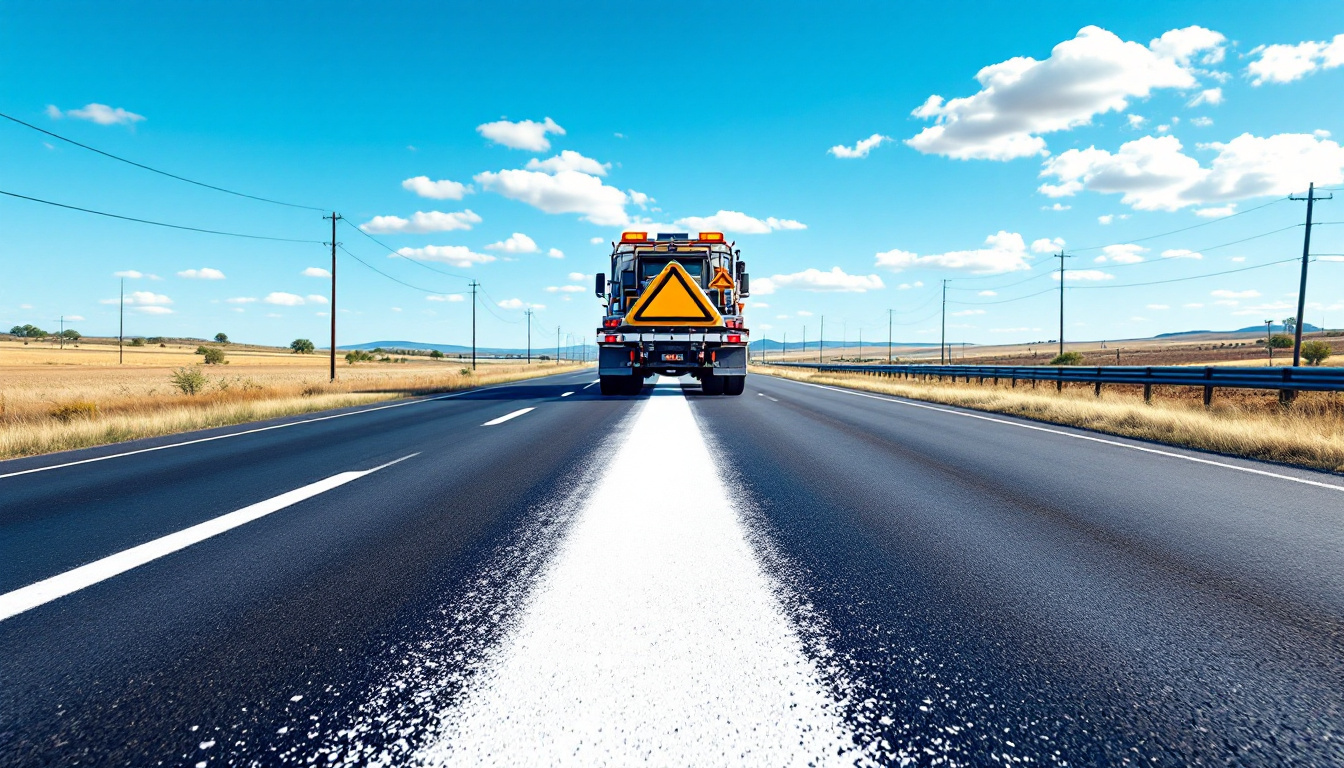
Striping is traffic control in its most compressed form. The work zone is a truck and a few vehicles behind it. It moves continuously, it is gone before most drivers understand what it is, and the thing the crew is producing — a wet line — is itself something traffic must not touch for a few minutes.
That makes striping a poor fit for the stationary lane closure thinking that dominates most traffic control plans. The protection comes mostly from vehicles, lights and arrow boards rather than cones and drums, and the hazards come from speed differentials and drivers trying to pass. This post covers what the national manual says about mobile operations as they apply to striping, and how to plan traffic control that protects the crew and the line.
Everything here is the national baseline from the MUTCD 11th Edition. States publish their own striping and mobile operation standards, and the approved plan governs your job.
Is it mobile, short-duration or stationary?
The first decision is classification, because it changes what the plan needs.
Section 6N.01 of the MUTCD 11th Edition, Part 6 describes mobile operations as including work activities in which workers and equipment move along the road without stopping, usually at slow speeds, with the advance warning area moving with the work area. Long-line striping fits that description. The same section notes that mobile operations that make frequent short stops are similar to short-duration operations.
Some marking work is not really mobile. Stop bars, crosswalks, arrows and symbols can keep a crew in one spot long enough that a short-duration or short-term stationary setup is the honest classification. Our guide to short-duration and mobile work zones covers how the categories differ.
What the national manual asks of a mobile operation
Paraphrasing the mobile operation provisions of Section 6N.01:
- Safety should not be traded for mobility. Safety in short-duration or mobile operations should not be compromised by using fewer devices simply because the operation moves frequently.
- A shadow vehicle should follow. When mobile operations are being performed, a shadow vehicle with an arrow board or a sign should follow the work vehicle, especially when traffic speeds or volumes are high. Where feasible, warning signs should be placed along the road and moved as the work progresses.
- Schedule for low volume. Consideration should be given to scheduling mobile work during off-peak hours.
- Arrow boards on high-speed multi-lane roads. For mobile operations in a high-speed travel lane of a multi-lane divided highway, arrow boards should be used.
- Lights are required. Mobile operations shall have appropriate devices on the equipment — high-intensity rotating, flashing, oscillating or strobe lights, signs, or special lighting — or use a separate vehicle with them. Hazard warning lights may supplement those lights but shall not replace them.
- Very slow operations. For operations moving slower than 3 mph, mobile signs or stationary signs that are periodically retrieved and repositioned may be used.
Striping on two-lane roads
The manual's Typical Application 17 covers mobile operations on a two-lane road. Its notes, paraphrased:
- Vehicle-mounted signs must not be obscured by equipment or supplies, and their legends must be covered or turned away when work is not in progress.
- Shadow and work vehicles must display high-intensity rotating, flashing, oscillating or strobe lights.
- If an arrow board is used on a two-lane road, it must be in caution mode — not an arrow pointing traffic into the opposing lane.
- Where practical and when needed, the work and shadow vehicles should pull over periodically to let traffic pass.
- When there is adequate stopping sight distance to the rear, the shadow vehicle should maintain the minimum distance from the work vehicle and travel at the same speed, slowing ahead of curves and crests that restrict sight distance.
- The distance between the work and shadow vehicles may vary with terrain, paint drying time and other factors.
- Additional shadow vehicles, including law enforcement vehicles, may be used to warn and slow oncoming traffic, and a truck-mounted attenuator may be used on the shadow or work vehicle.
- If the vehicles cannot pull over often enough, a DO NOT PASS sign may be placed on the rear of the vehicle blocking the lane.
Two-lane striping has a particular hazard: centerline work puts the striper in both directions' paths, and impatient drivers pass on the wrong side. That is why the pull-over guidance and the oncoming-traffic shadow vehicle option matter. For work that stops long enough to require alternating traffic, our guide to one-lane two-way traffic control methods covers flagging and other approaches.
Striping on multi-lane roads
Typical Application 35 covers a mobile operation on a multi-lane road. Its notes, paraphrased:
- Arrow boards must be at least Type B, 60 by 30 inches.
- Vehicle-mounted signs must not be obscured and must be covered or turned when work is not in progress.
- Shadow and work vehicles must display the required high-intensity lights.
- An arrow board must be used when a freeway lane is closed, and a separate arrow board for each closed lane when more than one is closed.
- Shadow Vehicle 1 should carry an arrow board and a truck-mounted attenuator; Shadow Vehicle 2 should carry an arrow board and a lane closure sign placed so it does not obscure the arrow board.
- Shadow Vehicle 2 should travel at a varying distance to give approaching traffic adequate sight distance.
- Spacing between the work vehicle and shadow vehicles should be minimized to deter drivers from cutting in between.
- Work should normally be done off-peak.
- When the work is in an interior lane and there is a right shoulder of 10 feet or more, Shadow Vehicle 2 should drive on the shoulder with a sign indicating work in the interior lane.
- On high-speed roads, a third shadow vehicle may be used, with the vehicles in the closed lane, straddling the edge line and on the shoulder.
Our explainer on truck-mounted attenuators covers the protection vehicle itself, and moving operations and rolling lane closures covers how rolling closures differ from a moving striping train. Our guide to using MUTCD typical applications explains how to adapt these layouts rather than copying them.
Protecting the wet line
Striping adds a problem most traffic control does not have: the product is vulnerable for a while after it is placed. The manual acknowledges it directly, allowing the work-to-shadow distance to vary with paint drying time.
Practical measures that planners use, subject to the agency's specifications:
- Match the shadow distance to drying time at the day's temperature and humidity, within the plan's limits.
- Use cones or markers on fresh line where the specifications call for them, placed and retrieved by the train.
- Avoid pull-overs onto the wet line by planning where the train can safely let traffic by.
- Record conditions. When a customer or agency disputes tracked paint, weather and drying conditions at the time matter.
Markings in stationary work zones
Striping crews also work inside stationary zones, placing temporary markings or removing old ones for traffic shifts. Section 6J.01 of the manual requires existing markings to be maintained in long-term stationary zones, requires temporary markings to match the alignment at both ends of the zone, and requires markings along the full length of any paved detour or temporary roadway before it opens. It also states that painting over existing markings with black paint or spraying them with asphalt is not accepted as a substitute for removal. Our post on temporary pavement markings in work zones covers that side in detail.
The risk behind the rules
Mobile operations put a small number of vehicles directly in the path of traffic moving much faster than they are. FHWA's work zone facts and statistics report 174 rear-end fatal crashes in work zones in 2022 — 21 percent of the total — which is the crash type a slow striping train invites. The attenuator on Shadow Vehicle 1 exists for exactly that crash.
Records for a moving work zone
Striping jobs generate disputes about quantities, locations and timing, and the work zone leaves no trace but paint. The daily record should capture the route, direction and limits worked, the configuration used, the crew and vehicles, and the times. In Traffic OS, the daily ticket records lanes closed, route, direction, start and end mile markers and the type of work, plus crew by role including TMA units, and it is signed on site with time and GPS position recorded. See the features page or book a demo.
A striping train is a work zone that fits on a single stretch of road. Plan it with the same seriousness as a stationary closure, and let the approved plan and your agency's standards set the configuration.
Frequently asked questions
Is striping a mobile operation under the MUTCD?+
Usually. The MUTCD describes mobile operations as including work where workers and equipment move along the road without stopping, usually at slow speeds, with the advance warning area moving with the work area. Most long-line striping fits that description. Operations that stop for extended periods, such as some symbol and crosswalk work, may be short-duration or stationary instead.
What lights do striping and shadow vehicles need?+
The mobile operation typical applications require shadow and work vehicles to display high-intensity rotating, flashing, oscillating or strobe lights, and state that vehicle hazard warning signals shall not be used instead of those lights.
How many shadow vehicles does a multi-lane striping operation need?+
The multi-lane mobile operation typical application shows two shadow vehicles, with guidance that Shadow Vehicle 1 carry an arrow board and truck-mounted attenuator and Shadow Vehicle 2 carry an arrow board, and it allows a third on high-speed roadways. Your agency's standards and the approved plan decide the actual configuration.
How far behind the striper should the shadow vehicle follow?+
The two-lane typical application says the distance between the work and shadow vehicles may vary according to terrain, paint drying time and other factors, and gives guidance for maintaining the minimum distance when sight distance allows. Agencies often specify distances or ranges; follow the plan.
Can we cover old markings with black paint during a traffic shift?+
No. The MUTCD states that painting over existing pavement markings with black paint or spraying with asphalt shall not be accepted as a substitute for removal or obliteration.