August 29, 2026 · The Key Bot
Traffic Control Glossary: The Terms That Actually Matter on a Job
A working glossary of temporary traffic control — the zone areas, taper types, device classes, plan documents, and business terms — with the MUTCD sections and rules behind each one.
In-depth guide · sources linked inline
Every trade has vocabulary that separates people who do the work from people who talk about it. Traffic control has more than most, partly because it draws on a federal manual, state specifications, agency permits, and construction contracting all at once — four vocabularies that overlap imperfectly.
This is a working glossary organised the way a job unfolds rather than alphabetically, with the underlying rule or section named where one exists. It is aimed at estimators, coordinators, new crew leads, and office staff who need to read a plan and a permit without guessing.
One caveat throughout. The national MUTCD is a floor. State manuals, state specifications, and local permit conditions sit on top of it and can differ in both substance and vocabulary. Where a term matters to a decision, confirm which document is being used before you rely on the definition. The current national manual is the MUTCD 11th Edition, published December 2023 and carrying Revision 1 dated December 2025.
The manual and how to read it
MUTCD. The Manual on Uniform Traffic Control Devices, the national standard for traffic control devices on all public roads, published by FHWA. Part 6 covers temporary traffic control and runs from Chapter 6A through Chapter 6P.
Standard / Guidance / Option / Support. The four headings that classify every statement in the manual. Standard is a requirement, expressed with "shall." Guidance is recommended practice, expressed with "should," deviable with engineering justification. Option is permissive, expressed with "may." Support is informational only. Misreading a Guidance statement as a Standard makes you rigid and expensive; misreading a Standard as Guidance is how you end up explaining yourself.
Typical Application (TA). One of the illustrated layouts in the manual showing a representative device arrangement for a common situation. Table 6P-1 indexes the 54 typical applications in the 11th Edition. They moved from Chapter 6H in the 2009 edition to Chapter 6P — a renumbering that quietly breaks older specifications. A TA is not a plan; see how to use typical applications.
Engineering judgment. The evaluation of available facts by a qualified person applying the principles in the manual. It is the mechanism by which Guidance is deviated from, and it is only a defence if it is documented.
AHJ — agency having jurisdiction. Whoever owns and controls the road you are working on. Their conditions govern, and they may be more restrictive than any manual.
The zone and its parts
TTC — temporary traffic control. The whole discipline: the signs, signals, markings, channelizing devices, and flagging used to move road users safely through or around a work zone. See what is temporary traffic control.
TTC zone. The area from the first advance warning device to the point where traffic returns to its normal path. It has four areas, below.
Advance warning area. Where drivers are told what is ahead. Distances scale with speed and road type: on urban streets the nearest sign sits at 4 to 8 times the speed limit in feet, on rural highways 8 to 12 times, and on freeways placement extends as far as half a mile or more with the area running 1,500 feet or more.
Transition area. Where traffic is moved out of its normal path, using a taper.
Activity area. Contains three distinct spaces: the work space where the work happens and workers are, the traffic space where road users pass, and the buffer space separating them.
Buffer space. Lateral or longitudinal separation between the traffic space and the work space. Its defining property is that it contains nothing — no workers, no equipment, no stored material. A buffer with a truck parked in it is not a buffer. See taper length and buffer space.
Termination area. Where traffic returns to its normal path, typically with a downstream taper.
Tapers and the arithmetic
Taper. A series of channelizing devices, sometimes with pavement markings, that moves traffic out of or into its normal path.
L — taper length. Calculated, not fixed. MUTCD Table 6B-4 gives L as W times S squared divided by 60 at 40 mph or less, and W times S at 45 mph or more, where W is the offset width in feet and S is the posted speed limit, the off-peak 85th-percentile speed before work starts, or the anticipated operating speed.
Merging taper. Moves traffic from a closed lane into an adjacent one. At least L — the longest taper type, because drivers must merge into shared road space.
Shifting taper. Moves traffic laterally without a merge. At least 0.5 L.
Shoulder taper. Used where a shoulder is closed. At least 0.33 L.
Downstream taper. Returns traffic to its normal path in the termination area. A flat 50-foot minimum to 100-foot maximum.
One-lane two-way taper. Also 50 to 100 feet. Used where a single lane serves both directions under one-lane two-way traffic control, which is the classic two-flagger operation.
Device spacing. Spacing between cones, tubular markers, vertical panels, drums, and barricades should not exceed a distance in feet equal to 1 times the speed limit in mph for taper channelization, and 2 times the speed limit for tangent channelization. These two rules plus the taper length are what turn a plan into a device count — the substance of a quantity takeoff.
Devices
Channelizing device. The collective term for cones, tubular markers, vertical panels, drums, barricades, and longitudinal channelizing devices. Covered in channelizing devices explained.
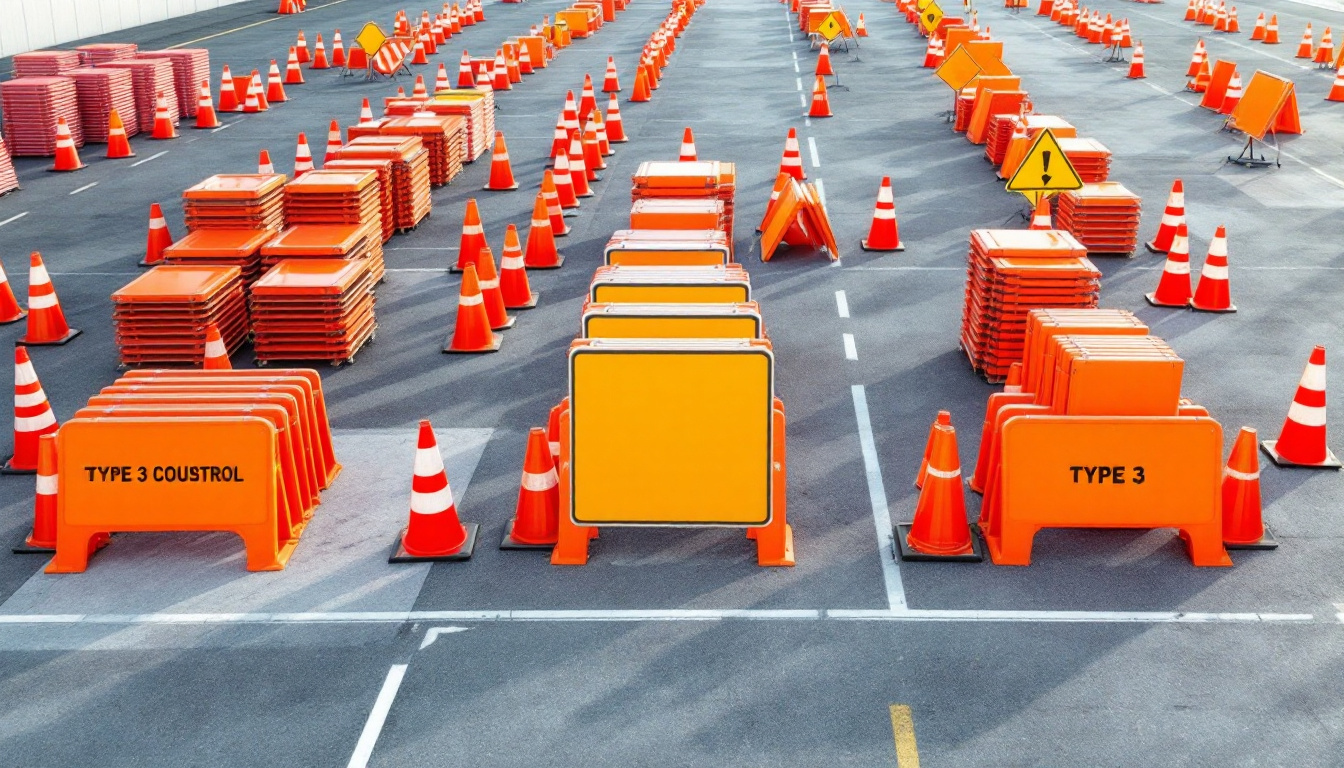
Barricade, Type 1 / Type 2 / Type 3. Classified by the number and arrangement of reflective rails. Type 3 is the large multi-rail unit used at road closures. See barricade types explained.
Drum. A large channelizing device with high visibility and good target value, generally preferred where devices must be seen from a distance or must stay put in wind.
Warning light. Portable, powered, yellow, lens-directed enclosed lights in Types A, B, C, and D, covered by MUTCD Section 6L.07. Type A is low-intensity flashing for night; Type B is high-intensity flashing for day and night; Types C and D are steady-burn for delineation. The critical rule is that flashing lights warn of a condition while steady-burn lights delineate a path, and flashing lights are not to be used for delineation. See barricade and warning light types.
Arrow board. A powered sign displaying an arrow or caution pattern, in Types A through D by size and application, addressed with changeable message signs in arrow boards and message signs.
PCMS / CMS. Portable changeable message sign, or changeable message sign — the programmable text board.
TMA. Truck-mounted attenuator, a crash cushion mounted on a shadow vehicle to absorb an impact. Covered in truck-mounted attenuators explained.
Shadow vehicle. A vehicle positioned upstream of a work space or crew to take an intrusion, usually carrying a TMA.
Positive protection. Barriers and devices that physically prevent an errant vehicle from entering the work space, as distinct from devices that only guide. See positive protection in work zones.
MASH. The Manual for Assessing Safety Hardware, the crash-testing framework devices are evaluated against. MASH compliance for work zone devices covers what the designations mean when purchasing.
Retroreflectivity. The property that returns light to its source, making a sign or device visible in headlights. It degrades with age and damage, which makes it a maintenance obligation rather than a purchase decision — see sign retroreflectivity and device condition standards.
High-level warning device (flag tree). A tall device with flags, designed to be seen over the roofs of passenger cars.
Operations
Flagger. A person controlling road users through a TTC zone, subject to MUTCD Chapter 6D and, in many states, a certification requirement. See flagger certification requirements.
Flagger station. The location a flagger occupies, chosen for visibility, escape route, and distance from the work space. See flagger station setup and escape routes.
Rolling closure. A moving operation in which traffic is paced or briefly held rather than diverted around a fixed setup, used for short-duration work over a length of road. The trade-offs are genuinely different from a stationary closure, and the term is frequently misused for anything short — see moving operations and rolling lane closures.
Mobile operation. Work that moves continuously or in short stops, such as striping or sweeping, with the TTC moving with it.
Short-duration work. Work occupying a location for a short period, where the manual recognises that the exposure from installing and removing a full setup can exceed the benefit.
TIMA — traffic incident management area. A TTC zone established in response to an unplanned incident. The MUTCD classifies incidents by expected duration: major is more than 2 hours, intermediate is 30 minutes to 2 hours, and minor is under 30 minutes, and the National Incident Management System requires the use of the Incident Command System at incident scenes. See temporary traffic control for incident and emergency scenes.
ITCP — internal traffic control plan. A plan governing the movement of workers, equipment, and vehicles inside the work space, as opposed to public traffic outside it. Covered in internal traffic control plans.
Signs
Regulatory, warning, and guide signs. The three functional classes, each with its own chapter in Part 6 of the manual. Regulatory signs impose a legal requirement, such as a speed limit or a prohibited movement. Warning signs alert drivers to a condition ahead. Guide signs provide direction and route information. The distinction matters because a regulatory sign has legal force only if it was authorised — posting a reduced speed limit because it seems sensible does not make it enforceable, and an unenforceable regulatory sign teaches drivers that your signs are advisory.
Sign support. The stand, post, or base holding the sign face. Supports are a separate item from faces for procurement, inventory, and takeoff purposes, because they are damaged, blown over, and stolen at quite different rates.
Sign sheeting. The retroreflective material on the face, graded by type. Sheeting grade determines night-time visibility and is one of the things an inspector can assess without instruments.
Roll-up sign. A flexible sign on a portable spring stand, used for short-duration and mobile work where rigid signs are impractical.
Pedestrians, bicycles, and access
Pedestrian accommodation. The obligation to provide a safe, accessible route past or around a work zone for people on foot when an existing pedestrian route is disrupted. Closing a sidewalk and posting nothing is not an accommodation. Covered in pedestrian accommodation in work zones.
Sidewalk detour / diversion. The two distinct approaches: a diversion keeps pedestrians on the same side of the street via a temporary walkway, while a detour routes them across or around. The manual has dedicated typical applications for both, and selecting a vehicle-only TA leaves the pedestrian condition unaddressed.
Bicycle accommodation. The equivalent obligation for cyclists, including bike lane closures with and without on-road detours. See bicycle accommodation in work zones.
Business and residential access. Maintaining driveway and entrance access during a closure. It is frequently a permit condition rather than a manual requirement, and it is one of the most common sources of complaints escalating to the agency.
Equipment and yard terms
Kit. A pre-assembled grouping of devices treated as one unit for dispatch and billing — a lane closure kit, a flagging kit. Kits make loading faster and inventory counts harder, which is a trade-off worth making deliberately.
Yard. The storage location devices are pulled from and returned to. Companies running more than one yard face an allocation problem that single-yard companies do not, addressed in software for multi-yard operations.
Recurring rental. Devices left on site and billed by the day, week, or month rather than by the job, which is the standard commercial model for barricade work. See automating equipment rental billing.
Shrinkage. Devices that leave and do not return, whether through damage, burial, or theft. It is a cost of doing business until it is measured, at which point it is usually larger than expected — see equipment theft and vandalism.
Plans and paperwork
TCP — traffic control plan. The site-specific design for a particular work zone. See what is a traffic control plan and who can prepare one.
TMP — transportation management plan. A broader agency document covering how a project's impacts will be managed, which may contain a TCP alongside public information and transportation operations components.
MOT — maintenance of traffic. Used in several states as a synonym for temporary traffic control or for the plan document. The distinctions are unpacked in TCP vs TMP vs MOT.
Detour plan. The signed alternate route when a road is closed, with its own sign schedule and frequently its own approval — see detour route planning and signing.
Lane closure permit / road closure permit. Different applications with different conditions and lead times; road closure permits are generally the harder of the two to obtain.
Restriction window / curfew. The hours during which a closure is prohibited, set by the agency and frequently the binding constraint on how a job is staged. See lane closure restriction windows and curfews.
ATSSA supervisor certification. The traffic control supervisor credential many agencies and primes require on site, described in traffic control supervisor certification explained.
Daily ticket. The signed field record of what was furnished on a given day — crew, hours, devices, and the customer's acknowledgement. It is the document a payment dispute turns on, which is why preventing daily ticket disputes is a commercial subject rather than an administrative one.
Business terms that show up on this work
MSA / rate sheet. A master service agreement with agreed unit rates, under which individual jobs are released — see master service agreements and rate sheets.
Standby / show-up time. Paid time when the crew is present and unable to work. Pricing it is covered in pricing standby and show-up time.
Certified payroll. The wage reporting required on covered public projects, covered in certified payroll for traffic control contractors.
Prequalification. The agency approval required before bidding certain public work — see DOT prequalification.
EMR. Experience modification rate, the workers' compensation factor used as a safety proxy in prequalification and by primes. See safety records and EMR.
Why the vocabulary is worth getting right
This is not pedantry. The terms carry obligations, and using the wrong one moves the obligation.
Calling a buffer space a work space puts people in it. Calling a rolling closure a lane closure gets the wrong plan submitted. Calling a typical application a plan gets a submittal rejected. And the regulatory stakes are real: OSHA's construction standards at 29 CFR 1926 Subpart G tie work zone traffic control back to the MUTCD, so the manual's vocabulary is the vocabulary of an enforceable obligation.
And the underlying risk is not abstract. The Work Zone Safety Information Clearinghouse records 850 work zone fatalities across 763 fatal crashes in 2024, following 905 fatalities across 824 fatal crashes in 2023, while FHWA reports 891 work zone fatalities in 2022 and 963 in 2021. A shared vocabulary is how a crew lead, a designer, and an inspector end up describing the same setup the same way — which is a prerequisite for the setup being right.
If you are onboarding office staff or new crew leads, this page is a reasonable first read, followed by reading a traffic control plan in the field. The terms above are the ones that appear on plans, permits, and invoices, and knowing them is most of what separates someone who can run a job from someone who can only be told how.
Frequently asked questions
What is the difference between TTC, TCP, TMP, and MOT?+
TTC is temporary traffic control, the whole discipline. A TCP is a traffic control plan — the site-specific design document. A TMP is a transportation management plan, a broader agency-level document that may contain a TCP along with public information and operations strategies. MOT stands for maintenance of traffic and is used in some states as a synonym for temporary traffic control or for the plan itself.
What are the four areas of a temporary traffic control zone?+
The advance warning area, where approaching road users are told what is ahead; the transition area, where traffic is moved out of its normal path using a taper; the activity area, containing the work space, the traffic space, and the buffer space between them; and the termination area, where traffic returns to its normal path.
What does L mean on a traffic control plan?+
L is the taper length, calculated rather than fixed. The MUTCD gives L as W times S squared divided by 60 at 40 mph or less, and W times S at 45 mph or more, where W is the offset width in feet and S is the speed basis in mph. Other taper types are expressed as fractions of L.
What is the difference between a Standard, Guidance, Option, and Support statement?+
They signal how binding a statement is. Standard statements are requirements. Guidance statements are recommended practice that should be followed unless there is documented engineering justification to do otherwise. Option statements describe permissible practice. Support statements are informational and carry no requirement.
What is a channelizing device?+
The family of devices used to guide traffic along a path and away from the work space — cones, tubular markers, vertical panels, drums, barricades, and longitudinal channelizing devices. The MUTCD groups them together because they share spacing rules, though they are not interchangeable in every application.
Why do the same terms mean different things in different states?+
Because states adopt their own manuals in substantial conformance with the national MUTCD rather than adopting it verbatim, and separate state specifications and permit conditions add vocabulary on top. MOT versus TTC is the clearest example. Always confirm which document a term is being used under.